The mesothelioma latency period refers to how long it takes from when you were first exposed to asbestos to when you're diagnosed. This period typically ranges from 20 to 60 years. Your age, overall health, how much asbestos you breathed in and how long you were exposed can all affect your timeline.
Learn more about mesothelioma, asbestos and the steps you can take to fight this disease.
Sean Marchese, MS, RN: Mesothelioma Latency Period
The latency period of a disease is the amount of time it takes before a patient begins to show or develop symptoms. Asbestos-related diseases have a long latency period. Sometimes it takes 10 or even 40 years for symptoms to show after getting exposure to asbestos, and that's because asbestos fibers are microscopic barb-shaped particles that, when they're lodged in the lungs or the pleural lining of the lungs, inflame and irritate that sensitive tissue and break down that healthy tissue over and over again.
And over many years, that's how diseases develop. It can damage the DNA within cells and cause issues like mesothelioma and asbestosis to occur.
Sean Marchese, MS, RN: Mesothelioma Latency Period
The latency period of a disease is the amount of time it takes before a patient begins to show or develop symptoms. Asbestos-related diseases have a long latency period. Sometimes it takes 10 or even 40 years for symptoms to show after getting exposure to asbestos, and that's because asbestos fibers are microscopic barb-shaped particles that, when they're lodged in the lungs or the pleural lining of the lungs, inflame and irritate that sensitive tissue and break down that healthy tissue over and over again.
And over many years, that's how diseases develop. It can damage the DNA within cells and cause issues like mesothelioma and asbestosis to occur.
How Long Does Mesothelioma Take to Develop?
Mesothelioma usually takes 20 to 60 years to develop after you first breathe in asbestos. This time gap is called the latency period. It means the cancer can grow quietly for decades before you notice any symptoms.
Susan Dickman tells us she was diagnosed with mesothelioma when she was 72 years old. This was nearly 60 years after her initial asbestos exposure. Susan says, “We were 17-years-old kicking what we thought were feathers at the time. But it was asbestos.”
“The latency period of a disease is the amount of time it takes before a patient begins to show or develop symptoms. Asbestos-related diseases have a long latency period. It takes 20 to 60 years for symptoms to show after exposure to asbestos. Asbestos fibers are microscopic barb-shaped particles that when lodged in the pleural lining of the lungs inflame and irritate that sensitive tissue, breaking down that healthy tissue over and over again.”
Sean Marchese, registered nurse and oncology medical writer
“The occupations where there is asbestos exposure are the ones where people are at risk. And the latency — the time from exposure to presenting with disease — [is a long one]. So many of these people are retired. Those occupations are things like people who've worked with insulation, mechanics who've worked with brakes, people who worked in the shipyards, on ships where the insulation contained asbestos.”
Dr. Andrea Wolf, director of the Women’s Lung Cancer Program at Mount Sinai
“It’s all a part of that continued fight of making it and achieving all of the things that at 15 I was told I never would. Those little day-to-day simple joys are what mean so much, because those were never promised to me. My doctors told me it takes at least 15 years to present symptoms, but I actually started showing symptoms around age 12.”
Alyssa H., peritoneal mesothelioma survivor
Malignant mesothelioma has a median latency period of 34 years, meaning 50% of people are diagnosed before then and 50% after.
In rare cases, mesothelioma develops in fewer than 10 years or more than 70 years.
Asbestos exposure at work is linked to shorter mesothelioma latency periods than environmental exposure.
Mesothelioma takes so long to develop because this cancer involves many cellular changes over time. Asbestos fibers stay embedded in tissue for decades and can gradually break down the body’s natural defenses.
“The latency period of a disease is the amount of time it takes before a patient begins to show or develop symptoms. Asbestos-related diseases have a long latency period. It takes 20 to 60 years for symptoms to show after exposure to asbestos. Asbestos fibers are microscopic barb-shaped particles that when lodged in the pleural lining of the lungs inflame and irritate that sensitive tissue, breaking down that healthy tissue over and over again.”
Sean Marchese, registered nurse and oncology medical writer
“The occupations where there is asbestos exposure are the ones where people are at risk. And the latency — the time from exposure to presenting with disease — [is a long one]. So many of these people are retired. Those occupations are things like people who've worked with insulation, mechanics who've worked with brakes, people who worked in the shipyards, on ships where the insulation contained asbestos.”
Dr. Andrea Wolf, director of the Women’s Lung Cancer Program at Mount Sinai
“It’s all a part of that continued fight of making it and achieving all of the things that at 15 I was told I never would. Those little day-to-day simple joys are what mean so much, because those were never promised to me. My doctors told me it takes at least 15 years to present symptoms, but I actually started showing symptoms around age 12.”
Alyssa H., peritoneal mesothelioma survivor
Malignant mesothelioma has a median latency period of 34 years, meaning 50% of people are diagnosed before then and 50% after.
In rare cases, mesothelioma develops in fewer than 10 years or more than 70 years.
Asbestos exposure at work is linked to shorter mesothelioma latency periods than environmental exposure.
Mesothelioma takes so long to develop because this cancer involves many cellular changes over time. Asbestos fibers stay embedded in tissue for decades and can gradually break down the body’s natural defenses.
External Factors That Impact Mesothelioma Latency Period
How much asbestos you were exposed to and for how long are the main factors that determine your mesothelioma latency period. The specific type of asbestos you encountered is also a factor.
For example, insulation and asbestos manufacturers had heavy exposure for a long time. They may have shorter latency periods. First responders often have high-level exposure for a brief period. Some first responders who experienced 9/11 or Hurricane Katrina developed malignant mesothelioma in a short period.
A 2025 study published in the Italian journal Epidemiology and Prevention suggests the risk of mesothelioma levels off about 40 years after asbestos exposure instead of continuing to rise.
Duration and Intensity of Asbestos Exposure
Total asbestos exposure, duration and intensity may be the biggest factor in mesothelioma latency. Long-term asbestos exposure, or high levels for a short time, can shorten latency periods. A 2023 study of 60 years of data in the Australian Mesothelioma registry found a link between longer latency and low-level exposure.
Mesothelioma survivor Chuck Gast tells us all it took was 6 weeks of asbestos exposure for him to develop mesothelioma. Despite this very brief timeframe, both Chuck and his former wife, Melva, developed mesothelioma 40 years later. Melva’s diagnosis was the result of secondary exposure to asbestos fibers Chuck brought home on his work clothes.
Chuck shares that in 1973, while working as a teacher, he took a summer job to make extra money. He tells us, “For approximately 6 weeks, I worked in an industrial furnace factory. The furnace insulation was asbestos. So, I was directly involved with it, getting it all over me.”
Occupation
Some occupations involved very heavy daily asbestos exposure. Jobs with long-term or high exposure tend to shorten the mesothelioma latency period. But there are varying latency periods among these jobs. For example, one study compared the exposure of factory workers and miners. Asbestos product workers have a shorter latency period than asbestos mine workers or those who lived near the mines.
About 1.3 million U.S. construction and general industry workers are exposed to asbestos. Renovations, maintenance and demolition can release fibers. Workers face the risk of asbestos exposure in more than 75 jobs.
Chuck shares that while working at the summer job responsible for his mesothelioma, he often handled asbestos insulation and bricks. He also hand-packed asbestos into a furnace. He tells us, “I was 27 years old and never thought something like this would come back to haunt me. That’s one job I should have never taken.”
Occupation
Average Mesothelioma Latency Period
Mining
35
Production
31
Shipyards
37
Construction
33
Maintenance
33
Source:
International Journal of Environmental Research and Public Health
Secondhand Exposure
Secondhand asbestos exposure happens when asbestos fibers are transferred from one person to another. Asbestos workers may bring fibers home on their clothes and gear. This poses a threat to family members, especially if they handle contaminated items. This type of asbestos exposure can be as dangerous as direct exposure. However, it’s linked to longer latency periods.
Chuck explains that Melva’s pleural mesothelioma was a result of asbestos from his job. “I brought the [asbestos] fibers home on my clothing,” Chuck said. “She would launder my clothes.”
Melva developed symptoms a few years before Chuck noticed his own symptoms, and she was diagnosed 3 years before him. One of Chuck’s doctors in Toledo said it’s very rare for people in the same home to both have mesothelioma.
Asbestos Type
Certain types of asbestos fibers may have shorter mesothelioma latency periods. Each of the 6 types of asbestos has distinct fibers and different uses.
Crocidolite, or blue asbestos, has very thin fibers. It’s considered deadlier than other asbestos types. It also has a shorter mesothelioma latency period. A 2022 study published in Case Reports of Gastroenterology shows crocidolite is closely associated with peritoneal mesothelioma.
Navigate Mesothelioma Treatment Costs
$32 Billion Available for Mesothelioma Patients
Discover financial assistance programs, insurance guidance, and veteran benefits to help cover your mesothelioma treatment expenses.
Biological Characteristics That Influence Mesothelioma Latency
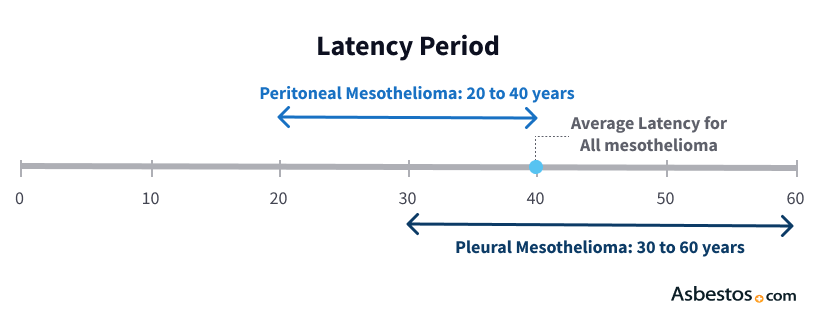
Your overall health, gender, age, genetics and cancer type affect how long it takes for mesothelioma to develop. Peritoneal mesothelioma usually takes 20 to 40 years to develop. Pleural mesothelioma usually takes 30 to 60 years.
People who are exposed in similar ways can have different latency periods. For example, Cheryl Pilkington and Tamron Little were both exposed to asbestos when they were kids. But their latency periods were very different.
Cheryl tells us she was repeatedly exposed to asbestos at her father’s workshop. She was diagnosed with pleural mesothelioma 60 years later. Tamron was exposed to asbestos as a toddler. But she developed peritoneal mesothelioma at a young age.
Tamron shares, “I was just 21 years old when I was told I had peritoneal mesothelioma. Being diagnosed so young is a rarity. I didn’t fit the description of the typical mesothelioma patient.”
Peritoneal mesothelioma usually takes 20 to 40 years to develop, while pleural mesothelioma usually takes 30 to 60 years.
Mesothelioma Type
The site of your tumors can affect your mesothelioma latency period. The latency period for all mesothelioma types is 20 to 60 years. Some of the rarer forms of the disease develop more quickly.
Latency Periods by Mesothelioma Type
Pericardial and testicular mesothelioma: These rare types of mesothelioma have shorter latency of 20 to 30 years. The testicular type can develop in fewer than 20 years in some cases.
Peritoneal mesothelioma: Peritoneal mesothelioma has a latency period of 20 to 40 years.
Pleural mesothelioma: This is the most common type and tends to develop over the course of 30 to 60 years.
One study found a much shorter latency for peritoneal mesothelioma than for pleural. This study found the average latency for pleural mesothelioma was 44 years. For peritoneal mesothelioma, it was under 30 years for women and 39 years for men.
Gender
Some studies suggest women tend to have a longer mesothelioma latency than men. This may be attributable to higher rates of environmental exposure among women. The mean mesothelioma latency period for men is 48 years. The mean mesothelioma latency period for women is 53 years.
Recent data shows mesothelioma rates have risen among women. This is despite traditionally lower exposure to asbestos at work. Asbestos-contaminated talc in some cosmetics may play a role. Women may have used these products more often than men.
Some research suggests that your age at the time of your asbestos exposure may affect mesothelioma latency. Being younger when you’re first exposed is associated with longer latency periods. But very young children and older adults may be at higher risk of getting sick from asbestos exposure.
Children’s immune systems are still developing. And immune systems can decline with age. This may mean very young children and older adults’ bodies are less able to clear asbestos. However, children have a longer average mesothelioma life expectancy than adults.
Alyssa Hankus was diagnosed with peritoneal mesothelioma when she was only 15. Alyssa has been in remission for more than 15 years after aggressive treatment. She tells us she doesn’t take life for granted.
Expert Insight
It’s all a part of that continued fight of making it and achieving all of the things that at 15 I was told I never would. Those little day-to-day simple joys are what mean so much, because those were never promised to me. My doctors told me it takes at least 15 years to present symptoms, but I actually started showing symptoms around age 12.
Alyssa Hankus, peritoneal mesothelioma survivor
Genetics and Gene Mutations
Some people have a genetic makeup that makes them more likely to develop cancer. This genetic predisposition may also influence how long it takes for asbestos-related diseases to appear. Certain gene mutations can lead to shorter latency periods.
A 2022 case report published in Frontiers in Oncology identifies 12 genes associated with mesothelioma. Mutations in the BRCA-1 gene, which normally stops tumor growth, may increase the risk of mesothelioma. A mutation in the related BAP1 gene may cause mesothelioma to develop faster.
The BAP1 mutation is specifically linked to shorter latency periods. This mutation may explain cases of mesothelioma in younger people who have been exposed to asbestos. However, more research is needed to confirm how genes impact the timing of mesothelioma development.
How Latency Period Affects Mesothelioma Diagnosis
Because mesothelioma has such a long latency period, symptoms often don’t appear until the disease is in an advanced stage. When symptoms become noticeable, many people don’t connect them to past asbestos exposure.
Mesothelioma symptoms can also look like other common illnesses, which sometimes leads to initial misdiagnosis. Common symptoms of pleural mesothelioma include a persistent cough and difficulty breathing. Pleural effusion, a buildup of fluid in the chest, is often mistaken for pneumonia or heart failure.
Common Symptoms After a Long Latency Period
Chest pain or tightness
Difficulty breathing or shortness of breath
Persistent cough that doesn’t go away
Pleural effusion, a buildup of fluid around the lungs
Since mesothelioma is very rare, doctors usually don’t suspect it unless they know about possible asbestos exposure. If you served in the military, worked in construction or had other higher-risk jobs, you may have had direct asbestos exposure. People who lived with someone with primary asbestos exposure could have experienced secondary exposure. It’s important to share your history with your doctor.
Common Questions About Mesothelioma Latency Period
Does smoking affect mesothelioma latency?
Smoking, in any amount, seems to shorten the latency period for mesothelioma.
How does asbestosis affect the latency period for mesothelioma?
People with asbestosis can experience a shorter latency period with mesothelioma. The presence of asbestosis is a sign that a person had heavy exposure to asbestos. Shorter latency periods for mesothelioma are associated with heavy asbestos exposure.
What symptoms might indicate mesothelioma?
The most common symptoms of mesothelioma are a lingering dry cough and trouble breathing.
What should I do if I have a known history of asbestos exposure?
If you have a known history of asbestos exposure, talk to your doctor. Ask about screenings for asbestos-related diseases.
Why does mesothelioma take so long to develop?
Asbestos fibers that are inhaled or ingested can become embedded in mesothelial tissue in the body. Over the course of decades these fibers cause irritation and eventually this process can cause cellular changes that transform healthy cells into cancer cells. It’s a slow and continual process of breaking down the body’s layered cellular protections over the course of 20 to 60 years.
Can mesothelioma develop in fewer than 20 years?
Yes, mesothelioma can develop in fewer than 20 years, but it’s rare. Doctors have documented cases with latency periods of fewer than 10 years, most often in people with very high or prolonged direct exposure. First responders at disasters such as 9/11 developed mesothelioma after a relatively short but very intense exposure period.
Recommended Reading
Your web browser is no longer supported by Microsoft. Update your browser for more security, speed and compatibility.
If you are looking for mesothelioma support, please contact our Patient Advocates at (855) 404-4592
Fact Checked
Our fact-checking process begins with a thorough review of all sources to ensure they are high quality. Then we cross-check the facts with original medical or scientific reports published by those sources, or we validate the facts with reputable news organizations, medical and scientific experts and other health experts. Each page includes all sources for full transparency.
Reviewed
Asbestos.com is the nation’s most trusted mesothelioma resource
The Mesothelioma Center at Asbestos.com has provided patients and their loved ones the most updated and reliable information on mesothelioma and asbestos exposure since 2006.
Our team of Patient Advocates includes a medical doctor, a registered nurse, health services administrators, veterans, VA-accredited Claims Agents, an oncology patient navigator and hospice care expert. Their combined expertise means we help any mesothelioma patient or loved one through every step of their cancer journey.
More than 30 contributors, including mesothelioma doctors, survivors, health care professionals and other experts, have peer-reviewed our website and written unique research-driven articles to ensure you get the highest-quality medical and health information.
About The Mesothelioma Center at Asbestos.com
Assisting mesothelioma patients and their loved ones since 2006.
Helps more than 50% of mesothelioma patients diagnosed annually in the U.S.
A+ rating from the Better Business Bureau.
5-star reviewed mesothelioma and support organization.
My family has only the highest compliment for the assistance and support that we received from The Mesothelioma Center. This is a staff of compassionate and knowledgeable individuals who respect what your family is experiencing and who go the extra mile to make an unfortunate diagnosis less stressful. Information and assistance were provided by The Mesothelioma Center at no cost to our family.
Asbestos.com. (2026, September 29). Mesothelioma Latency Period. Retrieved October 22, 2026, from https://www.asbestos.com/mesothelioma/latency-period/
Asbestos.com. "Mesothelioma Latency Period." Last modified September 29, 2026. https://www.asbestos.com/mesothelioma/latency-period/.
The Patient Advocates are absolutely amazing and helpful! I am so very pleased with the information and the emotional support that I have received from everyone! When I felt all hope was lost, Amy gave me great information and was so compassionate. I do not feel alone, and I know there is strong support for anyone dealing with this tragic disease. I received a FREE information package, including a recipe book, information on the disease, a toll-free number to contact for assistance, and a book with the answers to 100 questions that are commonly asked. This information alone was worth my time! I read for hours and hours, and just that alone—knowledge—can be a great comfort. To fully understand this disease, to just have the knowledge!!! Thank you all!! Thank you so, so much.
I found out about The Mesothelioma Center while researching peritoneal mesothelioma days after being diagnosed with the malignant cancer. While a lot of the 'Mesothelioma' websites are actually law firms just trying to get your business, theirs is a user-friendly, comprehensive website set up to aid patients, their loved ones, and/or caregivers with all things related to a cancer diagnosis from asbestos exposure. I was soon put in touch with one of their doctors, Snehal Smart, M.D., who immediately sent me a packet of general information, a book on surviving mesothelioma, and offered me assistance in finding doctors, reputable law firms, financial help, support groups, and so much more! The Mesothelioma Center's website is, in my opinion, the best resource for anyone suffering from cancer due to asbestos. Dr. Smart is amazing! She is very knowledgeable and helpful, but she is also a very kind, caring doctor who goes the distance whether she is researching a pertinent topic, making suggestions, providing contacts, or just being a good listener on the other end of the phone. In addition, Dr. Smart referred me to a law firm who is now fighting to get me compensation for the negligence of those defendants whose products exposed me to asbestos and caused my subsequent cancer. Thank you, TMC and Dr. Smart, for helping me determine the best treatment plan for my cancer and being part of my miracle. I am currently cancer-free and back to being a mom to my precious daughter. The Mesothelioma Center, their website, and their staff rock!!
I reached out and talked to Aaron a couple of weeks before my diagnosis of malignant mesothelioma. He was very helpful and gave me a lot of information at that time. I have talked to him several times since and always gotten my questions answered. Aaron is very knowledgeable and has been very helpful and supportive. He also sent me a comprehensive packet of information, including info on nutrition, legal help, and medical resources.
My brother was recently diagnosed with mesothelioma. I began researching it online. The information I received from The Mesothelioma Center is all-inclusive. No need to look anywhere else! The first phone call was with Karen, and she answered all my questions with ease. She also had a calming effect by presenting all the options available for my brother and his family. Thank you!
My Dad was diagnosed with mesothelioma, and thankfully The Mesothelioma Center was the first place I called. Snehal Smart answered the phone immediately and was very helpful. She immediately sent us an information packet and answered questions. She followed up each week to see how things were going and if we had any questions. She also connected us with a lawyer. I highly recommend this Center.
Registered Nurse and Board Certified Patient Advocate
Karen Selby is a registered nurse and Board Certified Patient Advocate at The Mesothelioma Center with more than 30 years of experience in oncology and thoracic surgery. She worked as an operating room nurse in thoracic surgery at the University of Maryland for 6 years, assisting with surgeries such as lung transplants, pneumonectomies and pleurectomies. She later served as regional director of the tissue procurement program at the University of Florida. Karen joined The Mesothelioma Center in 2009, providing patients with personalized support and resources.
Fact-checked and verified content:
Our fact-checking process begins with a thorough review of all sources to ensure they are high quality. Then we cross-check the facts with original medical or scientific reports published by those sources, or we validate the facts with reputable news organizations, medical and scientific experts and other health experts. Each page includes all sources for full transparency.
Please read our editorial guidelines to learn more about our content creation and review process.