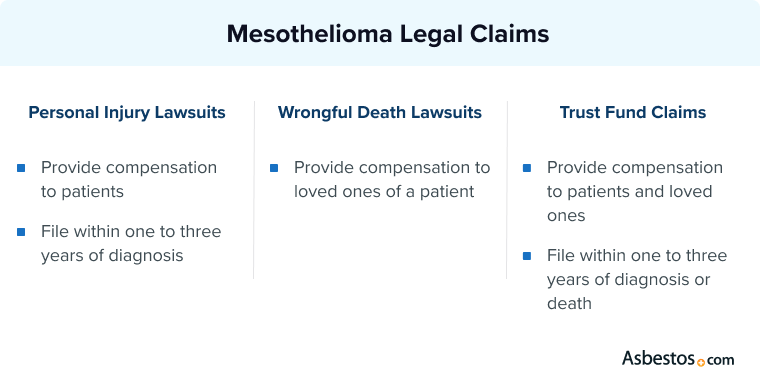
Filing a mesothelioma claim means pursuing every source of compensation available to you, including lawsuits, asbestos trust funds, VA benefits and insurance claims. Patients and families can combine multiple claim types, with some payouts exceeding $1 million.
What Are Mesothelioma Claims and Why Should You File One?
Mesothelioma claims are legal or administrative claims people diagnosed with mesothelioma file to hold companies accountable for exposing workers and the public to asbestos. Most mesothelioma claims result in settlements, though some cases go to trial.
Compensation from a claim can be in the form of a settlement, trial verdict or asbestos trust fund payout. This financial assistance can cover expenses such as mesothelioma treatment, travel expenses to cancer centers, home care, lost wages and other expenses related to your diagnosis.
More than $30 billion is currently available in asbestos trust funds to compensate claimants.
Each state has its own statute of limitations, which typically range from 1 to 3 years from the date of your mesothelioma diagnosis for personal injury claims.
According to the latest data from consulting firm KCIC, Americans diagnosed with asbestos-related diseases filed 4,244 lawsuits in 2025, including 2,035 mesothelioma claims.
Carla F., who was exposed to asbestos at her father’s place of work, successfully filed a claim after her diagnosis of mesothelioma. She was initially hesitant about seeking financial help through the legal process. But given the expenses she was facing, she felt it was the best option for her family. Carla says taking legal action is a way for survivors and their loved ones to make asbestos companies accountable for asbestos exposure.
[These companies] knew what asbestos could do. And to keep asbestos in their products, that’s not right. It’s not fair to the people that are using those things. It’s just not right.
Carla F., pleural mesothelioma survivor
How to File a Mesothelioma Claim
Filing a mesothelioma claim is easier if you hire a lawyer who specializes in asbestos litigation. A knowledgeable attorney will help you gather the documentation you need to prove your asbestos exposure. They’ll walk you through the process and answer any questions you may have.
Documentation You May Need
Financial records showing the monetary hardships the illness has caused your family.
Medical records proving your asbestos-related diagnosis.
Testimony required to prove the cause of your exposure to asbestos and the resulting cancer diagnosis.
Work history records demonstrating where or how you or your loved one was exposed to asbestos.
Your experienced attorney can determine the best strategy to help you receive compensation for your losses. They’ll also ensure your claim is filed properly and on time.
$30B+ IN TRUST FUNDS AVAILABLE
File Your Mesothelioma Claim
When filing a mesothelioma claim, the right legal representation is everything. We’ll connect you to a top lawyer who will help you secure financial compensation.
The mesothelioma claims process includes consulting an asbestos lawyer, gathering evidence, filing your claim, discovery and settlement or trial. One of the most important things you can do when filing a mesothelioma claim is to speak with an experienced lawyer who can advise you of your rights. They will walk you through the process and answer your questions.
The mesothelioma claims process is complex. An experienced attorney can determine the best strategy to help you receive compensation for your losses. These can include medical bills, travel for treatments, funeral costs and other expenses.
Claims Process Steps
Consult an experienced asbestos lawyer: An experienced mesothelioma lawyer will assess your situation and help you and your family plan the best strategy.
Gather evidence: Your legal team will investigate your asbestos exposure history and collect supporting records linking your illness to asbestos.
File your claim: Your lawyer will file your claim in the proper court or with an asbestos trust fund, carefully following all processes and timelines.
Begin discovery: After filing, your lawyer and the defendant’s lawyer gather evidence, conduct interviews, take depositions and share evidence.
Settlement or trial: Attorneys usually resolve most mesothelioma claims through a negotiated settlement. If the attorneys cannot reach an agreement, your case may go to trial.
This process can take weeks or months, depending on the complexity of the claim. Your lawyer works to speed things along while ensuring you receive fair compensation.
Expert Insight
I think a lot of people might be tempted to do this kind of thing on their own. Certainly, it’s possible to do it on your own. It’s just very, very complex and time consuming. And people would be leaving a lot of money on the table if they try to do it by themselves.
Joe Lahav, Lawyer and on-site legal advisor
Deadlines for Filing a Claim
State laws, called mesothelioma statutes of limitation, limit how long you can wait to file a mesothelioma claim. Deadlines usually vary by state. You may have the option of filing mesothelioma claims in multiple states, depending on the locations of the companies identified as defendants and where your exposure occurred. Work with a qualified mesothelioma attorney to decide where to file, make sure your claim paperwork is filled out properly in each jurisdiction and ensure your claim is filed on time.
Mesothelioma Claim Payout Amounts
Mesothelioma claim payout amounts depend on the type of claim you file, the strength of your evidence and the defendants named in your case. Settlements and trust fund payouts account for the majority of the compensation people receive. A trial verdict can award significantly more, though it usually takes longer to resolve. An experienced mesothelioma attorney can review your claim and give you a realistic estimate of what you may recover.
Most people diagnosed with mesothelioma qualify to file more than one type of claim. For example, you can file a personal injury lawsuit against companies still in business and separately file trust fund claims against bankrupt companies. Filing multiple claims can significantly increase your total compensation.
Claim Type
Average Payout
Typical Timeline
Personal injury lawsuit (settlement)
$1 million – $2 million
6–18 months
Personal injury lawsuit (trial verdict)
Up to $20.7 million
1–3 years
Asbestos trust fund claims
$300,000 – $400,000 (total)
90 days to 12 months
Wrongful death claim
$1 million – $2 million
Varies by case
VA disability compensation
$4,158.17/month*
Varies
*VA rate for a veteran with a spouse and 100% disability rating, per 2026 rates.
Recent Payout Examples
Recent verdicts show how significant mesothelioma compensation can be. These examples aren’t typical outcomes, but they reflect the serious financial accountability courts place on companies that knowingly exposed people to dangerous asbestos.
Notable Verdict Examples
February 2026: The California 2nd District Court of Appeals upheld a $51 million verdict against Avon after Rita-Ann Chapman developed mesothelioma from decades of using Avon talc-based cosmetics, with evidence showing Avon may have known its talc contained asbestos as early as the 1970s.
December 2025: A Baltimore jury awarded more than $1.5 billion to Cherie Craft, who developed peritoneal mesothelioma after decades of using Johnson & Johnson talc-based baby powder. This is the largest individual talc-related mesothelioma verdict on record.
October 2025: A Los Angeles jury ordered J&J to pay $966 million to the family of Mae Moore, who died from mesothelioma allegedly caused by asbestos in J&J’s talc baby powder, including $950 million in punitive damages.
Most cases settle before trial, meaning many people receive compensation faster, without stepping into a courtroom. Talk to a mesothelioma lawyer about filing your mesothelioma case.
What Affects Your Payout Amount
Several factors influence the final amount of a mesothelioma claim including age, jurisdiction and exposure history. Your attorney will consider all of them when building your case.
Factors That Could Affect Your Payout Amount
Age and health: Younger people and those with more advanced diagnoses often receive higher awards to account for long-term medical costs and lost wages.
Exposure history: Workers with long-term, direct asbestos exposure, such as construction workers, shipyard workers or industrial laborers, tend to receive higher payouts.
Jurisdiction: The state where you file a claim can affect the laws that apply to your case, as well as the claims process and potential compensation.
Number of liable companies: Many people were exposed to asbestos products from multiple companies. Identifying each company that might bear responsibility may give you more potential sources of compensation.
Your mesothelioma attorney will review your exposure history, medical records and other details of your case to identify the companies and compensation sources that may apply. They can then help you determine which claims to pursue and build your case around the losses and costs associated with your mesothelioma diagnosis.
How Long Does a Mesothelioma Claim Take?
How long a mesothelioma claim takes depends on the type of claim you file. Asbestos trust fund claims resolve the fastest. Personal injury settlements generally take longer, and a case that goes to trial is even lengthier.
Trust fund claims move more quickly because they skip the court system. Instead, your attorney submits the claim directly to each trust for administrative review. A lawsuit against a company still in business must move through the courts, which adds time but can yield a larger recovery. Many people file both, and the trust fund payment often arrives before the lawsuit resolves.
Exclusive Content
Carl Money: How Long Does It Take for a Mesothelioma Lawsuit
Well, depends on if you’re doing a bankruptcy case or if you’re filing against viable defendants. So if you’re in the tort system or in the trial system going against viable defendants, then generally what you do is you’ve got to file it and then you get a court date. Hopefully you can get a court date within a year. Once you have that court date, you’ve got all kinds of timelines and that’s going to bring these defendants to the table to try to settle the case. With regard to the bankrupt asbestos companies going after the asbestos trust funds, you can get money within thirty, sixty days of me meeting you. I mean, we decide, well, look, we’re gonna file all these bankruptcy claims right away, then, yeah, we get them thirty, sixty, ninety days because you’re getting affidavits, you’re filing them, you worked at the right place, the right trade, right time, or you worked in a place that’s already a pre approved site. So hopefully we can get you bankruptcy funds quickly.
Asbestos lawsuits climbed to 4,244 in 2025, the highest total since before pandemic-era court closures slowed filings nationwide. Mesothelioma cases crossed 2,000 for the…
What Happens If Your Loved One Can’t Participate in the Claims Process?
If your loved one isn’t feeling well enough to initiate a claim, a family member may be able to start the process on their behalf. After their death, the estate may be able to file a wrongful death claim.
Your lawyer will conduct research and interviews, locate witnesses and record testimony. Witnesses become even more important to the case if your loved one can’t record testimony on their own behalf. Filing a claim as soon as possible affords time for the investigatory period.
Expert Take
Jim Kramer: What can family members do if their loved one cannot participate in the claims process?
In cases where a family member may be a mesothelioma victim and unable to testify or start the process themselves, family members can step into their shoes to start the process. And what that means is talking to a mesothelioma lawyer to begin the process of filing the case, finding other people who could be witnesses in that case, that could speak about the type of work that the mesothelioma patient may have done, the types of products that person may have used, and the types of asbestos exposures that person may have had.
After that’s completed, a case can still move forward, depositions of those people can be taken, and settlements or even going to trial can still occur.
Types of Mesothelioma Claims
The most common types of mesothelioma claims are personal injury claims, wrongful death claims and asbestos trust fund claims. Patients and their families can file mesothelioma cancer claims to obtain compensation for their injuries.
Payouts from settlements, asbestos trust funds or trial verdicts vary depending on the nature of the claim filed, but many claims result in payouts exceeding $1 million. Experienced mesothelioma lawyers have extensive records building successful cases against the appropriate asbestos product manufacturers and companies responsible for your exposure. Their expertise is invaluable in successfully filing and collecting on your mesothelioma-related claims.
Patients and families have multiple options to seek mesothelioma compensation.
Personal Injury Claims
A personal injury lawsuit is a legal claim someone diagnosed with mesothelioma files. With a mesothelioma claim, you must prove the cause was asbestos exposure.
In addition to covering medical expenses and lost income, compensation from a personal injury lawsuit may include damages for loss of consortium and pain and suffering. In some cases, juries can also award plaintiffs punitive damages. This is monetary damages awarded to discourage future wrongdoing. Most mesothelioma lawsuits are settled out of court before a trial takes place.
The estate representative, usually the spouse or child of the deceased, represents the estate on behalf of the deceased party. They act in the interest of the estate in seeking compensation through a wrongful death claim.
Asbestos Trust Fund Claims: A Complete Guide
Asbestos trust fund claims are an extremely common way people diagnosed with mesothelioma receive compensation. Dozens of active trust funds hold over $30 billion for people with asbestos-related diseases. Trust fund claims and lawsuits aren’t the same thing, and understanding the difference helps you make the most of your legal options.
A lawsuit targets companies that are still in business and proceeds through the court system. A trust fund claim targets companies that have already declared bankruptcy and have gone through the trust’s administrative process. Trust fund claims don’t go to court. Instead, your attorney submits your claim directly to each relevant asbestos trust for review.
Trust fund claims resolve faster than lawsuits, and expedited claims may pay out even sooner. In many cases, you can also file trust fund claims at the same time as a personal injury lawsuit. Your attorney will advise you on this process.
Notable Asbestos Trust Funds
Hundreds of companies have created asbestos trust funds, but a handful hold the most assets and process the most claims. Your attorney will determine which of these funds apply to your case based on your work and exposure history. Some of the largest and most active trust funds include the following. Payment percentages change over time as trusts pay out claims and manage their assets. Your attorney will confirm the current payment rate for each trust before filing.
Trust Fund
Initial Funding
Notes
Bondex International Trust
$797.5 million
Created 2016; mesothelioma scheduled value $80,000
DII Industries Trust (Halliburton)
$2.5 billion
Pays at 60%; mesothelioma scheduled value $136,500
Johns Manville Asbestos Trust
$2.5 billion
First trust created (1988); pays claims at 5.1%
Quigley Company Asbestos Trust
$965 million
Funded by Pfizer; created 2013
WRG Asbestos PI Trust (W.R. Grace)
$3 billion
Created 2014; mesothelioma scheduled value $180,000
Mesothelioma Claims by Exposure Type
The type of asbestos exposure you experienced shapes how your attorney builds your claim and what documentation you’ll need. Occupational exposure is the most common cause of mesothelioma, but secondary, environmental and military exposure also give people the right to seek compensation. Understanding your exposure type helps your legal team identify the right defendants and file the strongest possible claim.
Occupational Exposure Claims
Workers in construction, shipyards and industrial settings account for most mesothelioma diagnoses in the U.S. These workers handled asbestos-containing materials directly, often for years or decades and usually didn’t receive adequate warnings about the risks. If you worked in one of these industries, your attorney will build your claim around your specific job sites, employers and the asbestos products you worked with.
Key documentation: Employment records, pay stubs, job site records and witness statements from former co-workers.
Secondary or Take-Home Exposure Claims
Secondary exposure happens when a family member carries asbestos fibers home on their clothing, skin or hair, exposing others in the household. Homemakers account for the highest percentage of mesothelioma deaths among women at 22.8%, largely from washing contaminated work clothes. Secondary exposure claims require your attorney to document both your own diagnosis and the primary exposure history of the person who brought asbestos into the home.
Key documentation: The primary worker’s employment records, witness statements and evidence linking your household to asbestos-containing products.
Environmental exposure often affects people who live near asbestos mines, industrial facilities or natural asbestos deposits. This type of exposure can be harder to document, but it can still be grounds for a legal claim. Your attorney will research the location and history of nearby asbestos sites to build your case.
Key documentation: Residential history, evidence of nearby asbestos sources and medical records confirming your diagnosis.
Military and Veteran Exposure Claims
A large share of mesothelioma cases are linked to military asbestos exposure. Every branch of the U.S. military used asbestos from the 1930s through the 1980s, with Navy veterans facing the highest risk. Veterans can typically file a VA disability claim and a separate legal claim against asbestos manufacturers. These are independent processes, and filing one usually doesn’t prevent you from filing the other.
Key documentation: Military service records, Form DD214, a detailed asbestos exposure statement and a doctor’s statement linking your diagnosis to your service.
Who Is Eligible to File a Mesothelioma Claim?
Mesothelioma patients, eligible family members and estate representatives can file a mesothelioma claim. Eligibility depends on proving asbestos exposure and filing within the legal time limits.
Mesothelioma Claim Requirements
Able to provide evidence asbestos exposure caused an illness
Diagnosed with mesothelioma or another asbestos-related cancer
Filing within the deadline (statute of limitations) for claims
Must be the diagnosed individual, an eligible family member or an estate representative
A mesothelioma attorney can advise you on the types of compensation you may be entitled to receive. Financial compensation can come from several sources, including liable companies, asbestos trust funds, insurance companies and the Department of Veterans Affairs.
Filing a Claim When You’re Not Sure How You Were Exposed
Daniel was just 32 when he was diagnosed with pleural mesothelioma. He wasn’t sure how he’d been exposed to asbestos or whether pursuing legal help was an option for him. As he began struggling with bills, he became more open to exploring his options.
Patient Advocate Vanessa Blanco helped Daniel understand that not knowing where he was exposed didn’t mean he couldn’t pursue a legal claim. She connected him with an experienced attorney who could investigate his asbestos exposure and help him understand his legal options. Within 15 minutes, the attorney reached out, helping Daniel take the next step toward getting the support he needed.
“I explained what proving exposure could mean for him, and he agreed to talk to an attorney I trust.”
Vanessa Blanco, MHA, OPN-CG,
Patient Advocate and Oncology Patient Navigator
Insurance Claims and Other Financial Support Options
Other types of claims may provide compensation in addition to filing a lawsuit. Claims filed for health insurance, VA benefits and workers’ compensation may offer financial relief.
Insurance claims: Health insurance, disability insurance and life insurance can provide funds to help you afford the cost of your cancer. Private insurance, Medicare and Medicaid serve as the most immediate financial resource. Social Security Disability Insurance provides monthly compensation to those who qualify.
Veterans benefits: The VA offers disability compensation and survivor benefits. Examples include disability compensation, VA health care and special monthly compensation.
Workers’ compensation: Often, this type of claim is not designed to compensate for occupational cancer adequately. Filing a workers’ compensation claim can sometimes mean giving up your right to file a lawsuit. Discuss options that best serve your needs with your lawyer.
Working with an experienced claims agent or lawyer can help ensure you receive all the health insurance benefits available. An experienced VA-accredited claims agent can help you file for VA benefits.
VA Claims or VA Disability Claims
Some veterans were exposed to asbestos during service. The Department of Veterans Affairs recognizes mesothelioma and other asbestos-related illnesses as potentially service-connected conditions. This means patients and family members may be eligible for disability compensation and survivor benefits.
Our VA-accredited claims agent can help veterans with mesothelioma understand their options and file a claim. VA-accredited team members at The Mesothelioma Center are available to help veterans 7 days a week.
Survivor Experience
Thank you for helping me file my brother’s VA claim. If you hadn’t guided me each step of the way, I would have felt helpless. The Mesothelioma Center made it easier than I could have imagined.
Carrie D., sister of a veteran diagnosed with peritoneal mesothelioma
Verified Asbestos.com Survivor
Common Challenges in Filing Mesothelioma Claims
People diagnosed with mesothelioma face real obstacles when pursuing legal compensation, from gathering decades-old evidence to navigating complex court procedures, all while managing an aggressive cancer. These challenges can feel overwhelming, but an experienced mesothelioma attorney knows how to handle each one. Understanding what to expect helps you take action quickly and protects your right to compensation.
Challenges When Filing Mesothelioma Claims
Complex evidence requirements: Cases demand extensive investigation to collect medical records, employment history and witness statements, with the added challenge of proving historical asbestos exposure when decades-old records may no longer exist. Your attorney will interview former co-workers, review Social Security records and trace your full work history to build a strong case.
Emotional and physical barriers: Serious illness and emotional distress often delay filing a claim, which can reduce compensation. Filing as early as possible gives your legal team the most time to build your case and preserves critical evidence.
Jurisdiction selection: Where your attorney files your claim significantly affects your payout and your timeline. Your lawyer will review your exposure history, residential history and the location of defendant companies and manufacturers to identify the most favorable jurisdiction.
Legal complexities: Corporate defense teams work hard to challenge mesothelioma claims. An experienced mesothelioma attorney knows their strategies and has the expertise to counter them effectively.
Statute oflimitations: Generally, deadlines to file a personal injury claim vary by state. Missing this deadline can affect your right to compensation, which is why you should speak with an attorney as soon as possible after a diagnosis.
Not knowing exactly where your asbestos exposure happened doesn’t necessarily prevent you from filing a claim. Experienced mesothelioma attorneys specialize in tracing exposure through your full work and life history. Your lawyer will review your employment records, military records and Social Security history and may interview former co-workers and other witnesses to pinpoint when and where you encountered asbestos.
A company’s bankruptcy doesn’t always preclude your ability to seek compensation. Bankruptcy courts often require asbestos companies to establish trust funds before they can reorganize. Your attorney will identify which trusts apply to your case and file claims on your behalf. If you think you’ve missed the deadline to file, you may not have lost your compensation options.
Exclusive Content
Danielle DiPietro, Sam Meirowitz, & Daniel Wasserberg: Legal Panel Discussion: Investigating Mesothelioma Cases
Hi. My name is Danielle. I am a board certified patient advocate and VA accredited claims agent here at the Mesothelioma Center from asbestos.com. Today we’re here to discuss mesothelioma and the investigative approach.
So mesothelioma is a cancer that’s caused from exposure to asbestos and it typically develops decades after someone’s been exposed which leads to exposure being difficult to prove at times. Some patients have worked for numerous employers, they’ve had different occupations, and lived in different states. Today I’m joined by Sam Meirowitz and Daniel Wasserberg of Meirowitz and Wasserberg. These are two attorneys that have been in the industry for a few decades working with mesothelioma cancer patients and their families.
We’re going to discuss how they investigate exposure and help patients move forward with the claims process. Dan, can you please introduce yourself today?
Yes, I’m Daniel Wasserberg. I’ve been practicing attorney for twenty two years.
Been doing asbestos for the last two decades, as you mentioned. I started my practice in Texas and then moved to New York and expanded to a nationwide practice. I’m personally licensed in five jurisdictions, but our firm, and our asbestos docket in particular, has attorneys who are licensed all over the country.
And Sam?
I’m Sam Meirowitz. I actually started out as a prosecutor, representing people that were victims of crimes. And then I moved into working with people that were exposed to asbestos. And I feel in the same way that they’re also victims of corporate crime. So it really makes me feel passionate about the work that I do. And like Daniel, I’ve been practicing for over twenty years and licensed in multiple jurisdictions.
Thank you. So we’ll get started talking about how we investigate these cases. And my first question is what makes a mesothelioma case unique?
What makes a mesothelioma case unique is the fact that the person is always diagnosed a decade or more after they’ve been exposed to asbestos. So we say that the injury occurred when they were diagnosed, but the cause of the injury was many, many years ago, and so that requires a unique investigative approach.
Yeah, and we have to go back in time and try to recreate what the work history was in order to figure out all the different ways that the person was exposed to asbestos. And that takes time. It takes investigation. It takes talking to people, sometimes sitting down and hearing stories about what kind of work different people did and who they did it with.
Essentially you’re getting their life story to understand everything that they’ve done throughout their life. I mean, some patients I talk to, they worked 50 ago, so…
We absolutely are getting their life story even more than they realize what they would be telling us.
Yeah, lot of times they’re just like, I have no idea how I was exposed to asbestos, how are you gonna know? And that’s why we’re experts in this because we know all the different asbestos containing products and so when we sit down and we do a work history with them, we can ask them, hey, what are different types of specific tasks that you would do on the job? And then we ask them, hey, did you ever do this? Did you ever do that? Yes, no, yes, no. And then we build from there.
And what about your patients that had no occupational exposure? That say they’ve never worked with asbestos, what kind of conversation is that?
We all hear about mesothelioma and asbestos so often that it sounds like an open and obvious danger, but it’s not. It’s really more of a hidden defect or a hidden danger.
So what we have to do is, we have to talk to the people, find out what products they used. For example, maybe it was talcum powder, shouldn’t have had any asbestos in it, wasn’t supposed to have any asbestos in it, but unfortunately often did. That’s just an example of a hidden asbestos danger.
Yeah, I mean, what I think a lot of people don’t realize, and I get asked this all the time, you know, what is asbestos? What is it? Is it some kind of chemical that’s made in a lab? You know, no.
It’s a naturally occurring mineral fiber. So it didn’t bother anyone until we mined it and took it out of the ground. The weird thing about it is it doesn’t doesn’t smell funny. It doesn’t really irritate your skin.
So it’s not something that your body would ordinarily know to stay away from. Like for example, you know not to drink bleach, right? Because it smells really strong, it feels like it’s toxic. So that’s something that your body says, no, I’m not gonna mess with that.
Or if something’s super hot, you don’t want to touch it. But with asbestos you just don’t realize how dangerous it is.
Yeah, which is, I mean we talk to patients that don’t know how they were exposed or have secondary exposure, so their spouse coming home with asbestos on their clothes and they don’t know. So that leads to needing to ask a lot of questions to figure out exposure.
Oh yeah, one of the big cases we had, the woman who we ended up representing thought she was exposed to asbestos from Christmas tree flocking, but it turned out that she wasn’t even alive during the time period when Christmas tree flocking did contain asbestos. Unfortunately, it did contain asbestos for a period of time. What turned out was she had a secondary exposure from her father, but she wasn’t even thinking about that when we started the case.
Yeah, which I find very, very common. A lot of patients think it’s one avenue and it turns out to be 10 avenues or something completely different than they thought. So using an experienced firm helps identify that exposure.
Or some bizarre thing that you would never think about. Like, for example, there were actually cigarette filters that contained one of the most potent forms of asbestos. And people thought that they were actually doing a good thing by getting an asbestos filtered cigarette because they were told that this was healthier and didn’t realize that they were actually sucking in really, really potent asbestos fibers even worse than the tobacco that they were smoking.
Yeah.
Marketed as the safer cigarette because of the asbestos filter in And the people had no idea.
You know, people had no idea. So you have to sit down and have a conversation with people. That’s why sometimes when we meet, we sit on the couch for hours with these people and go through their whole history and like, really, why do you care about that? And we’re like, well, we’ll see.
Yeah, lot of people don’t know what contained asbestos.
Yep. And people, back to your original question, people will be surprised that we could stay for a long time and the time just flies by.
You know, they think, wow, you were here for like two, three hours and I learned so much about myself.
Yeah. How do you piece together a person’s history when they’ve worked for multiple employers, had different occupations, worked in different states? How do you go about figuring out who to pursue and really piecing together the puzzle for them?
Yeah, the way that I like to do it is when I come to your home and meet with you, I break the meeting into three parts. And what I’ll do is I’ll probably start with medical and then we’ll go to what’s going to be the longest part of the meeting if you have an extensive work history. And then after work history, I’ll do probably explain the legal side, how I represent you. But that work history piece is the longest part.
And during that, we can either work backwards from the present day all the way to your first job or we can start with your job and work up to the present day. But either way, we’re going to try to go through your whole work history and identify how you were exposed to asbestos because asbestos caused the mesothelioma, and by doing that, we typically are able figure out pretty quickly how a person was exposed. Now sometimes it was non occupational and that’s a different story. We also have to go outside of the work history to figure that out.
Yeah, and if it is occupational, a lot of times what we’ll do is ask, do you have any coworkers that you worked with that we can talk to that are willing to give us information? Because sometimes they may remember something that your actual client doesn’t remember. And so they can sometimes fill in the pieces to the puzzle that would be so much easier than trying to potentially have to order documents that were records that don’t exist anymore. Oftentimes, like you said, it’s years and years and years after the actual work history, like the work exposures. So there’s no like video of what people are doing. It’s really just learning from investigation.
And are family members just as valuable as coworkers to the investigation at times?
Oh yeah, it depends what kind of case, but absolutely. Particularly in cases where it’s a non occupational exposure or say a talcum powder case, the family member is going to be critically important. Sometimes a family member is also critically important in an occupational case, but I’m just emphasizing that’d be even more so when it’s outside of the work history.
Yeah, and the family members also, I notice will… The spouse will remember like, hey. Do you remember Jimmy? Like, you forgot about Jimmy. Like, I remember his his wife. We used to play whatever together. And then finds a way to actually get in touch with that coworker.
So having the family around a lot of times can be super helpful.
Sometimes you just need a person’s son or daughter to just keep them focused and keep the meeting moving forward.
And sometimes family members work together. You’ll a son or a daughter that worked with a parent and can fill in blanks as well.
Those are some really good points to understand why it’s important to have family present in these meetings. And coworkers, if they can make the meetings, great. But you can probably get in touch with them at a later time to verify some exposure and get more details to pursue a case.
100%. And, you know, with the children, we do sometimes have to ask them to kindly leave the room because attorney client privilege only applies to the attorney and the mesothelioma victim and their spouse. So there are times when we have to ask them not to be present. They don’t always understand that, so I just like to mention that.
Yeah. I mean, there’s informational sessions where you’re trying to gather information, and that’s helpful to have them around. But then when you’re talking about case strategy, you don’t want them around. And it’s really just like Daniel said, to preserve the attorney client privilege.
And then like you said, when we’re having an initial meeting, we’re not asking them to bring in coworkers and stuff like that. It’s really just getting who might they remember. Although I think Daniel one time went from a… Literally went from a sign up to meet with a potential coworker. Do you remember that? I think that was in the South. I can’t remember what case that was.
Yeah. It turned out that we went to meet this man and I said, you look really familiar to me.
And he said, no, I don’t think we’ve ever met before. And I said, do you have a brother? He’s like, I got a couple brothers. And turned out I had deposed his brother.
Interesting.
It’s been all over.
Yeah. The stories are Yeah. Always And what about so we talk about records and coworkers and family members. Now, I talk to patients that’ll you know, you’re talking about exposure and they’re like, oh, well, my company’s not in business anymore, or the building I worked in or the factory I worked in are destroyed.
So how do you get these records if the companies aren’t around, or the names have changed, ownerships changed, those types of things?
More often than not, it has changed or been demolished or been recreated in some way. I mean, we’re talking about fifty years plus for the kind of industrial job sites that you mentioned. I mean, it could be less than that.
But in most cases, we’re not going to be able to have current era site inspection where the place looks like it did when the person worked there.
However, really good at investigating, I guess you could call it forensic investigating, and we go back and recreate a picture, and we do that with documents, we do that with historical information, and we do that with the person’s memory. I mean, we do rely on our client’s memory a great deal, I think more than they realize that it’s going to be before they’ve actually hired us. Wouldn’t you say so?
Totally. Everything Daniel said is true. But then on top of that, if they did work at some large factory that some massive corporation, some large international corporation in manufacturing, production, something like that. A lot of times what we do on the back end is we go and we get discovery. We pursue in court discovery against those companies and those… And we force those companies to produce documents that show what they had at certain locations. So that’s in unique circumstances we can do that. But like Daniel said, a lot of the small mom and pop shops, you’re just not going be able to do that.
Yeah, just to develop a contrast.
We represent a lot of U. S. Navy veterans.
If you have a Navy case, most of the time we will be able to get records. We’ll be able to get personal records, ship records, and other records.
Contrast that with a factory, say, in Syracuse or Rochester, New York that was torn down decades ago. It can be a deeper dive and a big dig, but we are typically able to get information through work history records, through documentation. So it comes union Union records, asbestos abatement records, information at the local library, other coworkers who work there, and our clients’ memories.
Yeah. And the larger non military facilities like big paper mills or big power plants, those are the types of facilities that we are able to usually get documents from the companies themselves, even if a plant closes down.
And in situations where if a plant closes down because of some type of toxic pollution, then there’s all kinds of environmental protection documents that you can get as well.
And are there cases you’ve done, let’s say, twenty years ago that will help you make a case for a new patient today?
Absolutely. That’s kind of the nature of asbestos litigation. If I understand your question correctly, you know, somebody worked at a job site, I don’t want to name any particular company, and then a decade or two later I’m representing somebody from the same building, absolutely, yes. That information can be useful both in terms of just from a common sense approach of refreshing some person’s recollection And also, it could be evidence in the next case if those companies were there and they were at the deposition and cross examined the person who was testifying or the documents were, you know, made formal exhibits somehow. It could be actual evidence.
Yeah, mean we have a head start in that situation. We’ve already worked up the job site. So we have leads on coworkers. Like Daniel said, have leads on documents. It puts us in a much better position. But it doesn’t mean that we need to have had prior cases at a site. We’re always working up new job sites almost every day.
Okay.
Yeah, mean, sounds like And old.
And old.
New, right?
Yeah, it just sounds like there’s numerous ways to get these documents and help move a case forward.
So there’s not much burden on the patient other than them sharing verbally what they know, and then you do the rest on the Yeah, back clients are not going out and investigating.
We’re doing all that work. They’re focused on their health. The most important thing. Course. And that’s what they hire us to do.
What would you say to someone who’s worried that they don’t have a case because they’re just so unsure of their exposure history or remembering details from twenty to fifty years ago?
What I would say to the person is please don’t try to be your own lawyer or attorney.
You have to let a professional asbestos lawyer interview you and talk to you in order for you to have any idea whether or not you have a case. And you might have to speak to more than one, to be honest, if the first one doesn’t figure it out. But again and again we see people who have decided on their own that they don’t have a case because they’re not sure how they were exposed. And I’ll just tell you, we’ve gotten 3,000,000, 4,000,000, $5,000,000, maybe even more for people who thought they didn’t have a case.
Yeah, to piggyback on that, a lot of times, you know, they’ll rely upon their doctors and they’ll think, Well, my doctor doesn’t know how I was exposed to asbestos or how I, you know, why I got this. And the thing is, is that the doctor’s focus is in treating the disease. It’s not going backwards in time and figuring out how it happened. Their job is to help deal with the future. What can we do to make your life better going forward? And so we look backward and try to figure out how it happened, the causation, the exposure, and all of those things. And that’s not really the doctor’s role, right?
When your car breaks down, do you try to figure out what’s wrong with it?
Oh, me?
Absolutely not.
Don’t No, call go to person auto mechanic and you ask the auto mechanic, what’s wrong with my car? Please come and talk to us. We’re here to help. We want to investigate. This is what we love to do. This is what we’ve trained our entire team to do. We’re here to help you figure out how you were exposed to asbestos and ultimately to get you compensation to help you with your medical and personal life.
Yeah, mean the other thing is that one thing that I hear over and over again is, Oh, am I going to have to go into court? Oh, I don’t want to do that. Right? And they worry about all of the involvement. That’s the word they use oftentimes. I don’t want to be involved in a whole bunch of court stuff, right?
Most cases do not go to trial. So the only involvement that they ever really have is us preparing them for a statement that just talks about their work history. And that’s about it. We handle all the other stuff.
So they’re actually surprised a lot of times about how little involvement they actually have to have. And the statement that they have to give, they get nervous about it in the beginning and then realize very quickly that it’s actually an opportunity for them to talk about their life’s work. And nine out of 10 times they really enjoy it. In fact, don’t think I’ve had too many clients say to me, Wow, I really hated that process.
Most of the time they really enjoy being able to talk about what they did because a lot of our clients love what they did.
I have represented attorneys who thought they didn’t have a case. So they needed an asbestos lawyer to help them figure out what their case was really about. And I’m talking to one lawyer right now who says, you know, the company that I worked for, they never used asbestos. And I’m trying to figure out a soft landing to explain to him that actually they did because it’s kind of a source of pride for him that they didn’t use asbestos, but we actually can prove that they did use asbestos. So just because you don’t think you have a case, just because you’re even an attorney who doesn’t think you have a case, let a person who spent the last two decades investigating asbestos cases and who’s on the modern cutting edge of the asbestos litigation figure out whether or not you have a case.
Yeah, and I always tell patients, I mean, there’s the medical and legal side, it’s rare cancer, it’s rare litigation, so it’s few and far to find an expert when it comes to getting treated properly as well as when it comes to litigating a case or finding your exposure. And to touch on what you said, Sam, yes, a lot of patients’ concern is time is of the essence. They want to spend their time with their family. They want to focus on their health and the thought of lawyers in court and all these things. But it’s usually just a misunderstanding. So taking the time to speak with their patient advocate or with a lawyer that’s experienced helps ease their mind into moving forward with talking with someone to figure out exposure.
Yeah, we’re super conscious of that part of it and we assure the family that we’re not going to do anything to get in the way of their medical treatment. And oftentimes the sooner that we’re able to get involved, the easier it is to plan around that. So timing is of the essence in that sense, because it allows us to be able to get with the court, let the court know what’s going on, and schedule things. If you wait to the last minute, it makes it a lot harder.
Yeah. We have to be careful here because we don’t want to sound like we won’t try a case. We will try a case if a client wants to.
Right.
But the number of clients who end up having to go into a courtroom is few and far between. And it’s typically because they want to. If the client doesn’t want to go to court, that’s fine because the great majority of cases resolve.
And I can say I’ve only ever been thanked by patients for informing them that this is an option and helping them get to the right lawyer. Know, your patients that don’t want to do this at first because of all these worries we discussed. Usually within months, they’re so grateful that they took that step to talk to someone and figure this out, make sure their family’s taken care of and those types of things.
There’s literally no downside to sitting down and having the conversation.
Our fee process is you only pay if you get a recovery, so there’s no out of pocket costs. So just having the conversation is there’s no downside to it.
If we don’t win, you don’t pay.
Right. So it’s always worth someone’s time to have that conversation.
So what sets Meirowitz and Wasserberg apart from other firms in the way you investigate a case?
Well, look, Daniel and I are still really involved in the process. So even though we don’t handle every aspect of every single case because we couldn’t possibly do it, we have a great team of people that have taken our core values and applied them in the cases. And we take if somebody is exposed to if somebody has mesothelioma, it means they were exposed to asbestos in some way. And we feel like it’s our job to figure it out.
Right? And so some firms, they may not if it’s if it’s not clear, if it’s not easy, if it’s not obvious, it may not be something that they want to put their time and effort into. For us, we feel like every patientclient deserves the best investigation and the most thoughtful creative process to figure out how to help them. And I think that’s where it starts.
It’s client focused. In our core values and our mission statement, it’s all about client first. And when you think that way, then it inspires you and it impassions you to figure out where is this puzzle going, right? It’s like a detective story.
You’ve got to figure out what are the pieces to the puzzle that cause this person to get sick. And we look at it as a challenge and a passion.
Yeah, I know I speak for both of us, but for me, I became an attorney because I wanted to help people. And that’s my passion, is helping people. I know that sometimes the fact that this is about money and compensation can tilt how people view the subject matter. But really, at the end of the day, all we want to do is help. And so because of that, when Sam and I started the law firm, we wanted to be able to provide the best level of service, client communication, representation.
So even today, where our firm has become more of a prominent, well known asbestos law firm nationally, I think we do provide that boutique level of service that people really want. I mean, let’s be honest. This is the worst situation that can happen to you, basically.
And you’re in your hardest time, your darkest hour, and you want to know that someone’s out there fighting for you, we provide our cell phone numbers to our clients. We insist that our attorneys provide their cell phone numbers to their mesothelioma clients. If you’re a mesothelioma client of Meirowitz and Wasserberg, you’re going to have your attorney’s cell phone number. You’re going to be able to get in touch with your lawyer, with the paralegal for the lawyer, whoever it is that you need to speak to. And that is something that we take a lot of pride in, and we make sure that the client knows that we care about them.
I mean, we develop personal relationships with the people. Mean, you know, Danielle.
We’ve had clients that are… Have been clients for a long time. Their cases are over, and they’re they’re they’re sending us holiday wishes. I mean, we still keep in touch with their families. Sometimes I’ll go out to lunch with a client that still lives close to my office in Fort Lauderdale. I mean, really feels like a family practice even though it’s grown into a much larger national practice. And I think that I mean, look, there’s some firms where the owners of the firm don’t even know that the client exists.
So here, you always will be able to get one of us on the phone if need be. And I do think that makes a big difference.
Yeah. When we started, our motto was we represent people, not corporations. That’s still true today. It’s still our motto today.
But what it means is we’re not representing companies. We’re not billing by the hour. We’re sitting down with you in your living room bonding, talking, going through the hard stuff. We may have to learn really personal things about our clients.
And the point is we’re going to get to know each other, we’re going to develop a personal relationship, and it’s going to change how you view the attorney client relationship.
I mean, had one client. I walked into the meeting and she said, If the dog likes you, you’re hired. Right? And so you know what I’m talking about, Rosemary. Anyway, I was really nervous because I was like, Well, what if the dog doesn’t like me? I’m still going to be the best lawyer for this.
But the dog ended up like me. For years now, I ask, how’s the dog doing? You know, you develop relationships and that’s what we love. That’s the part of this practice that we really love is being able to be there for these families, getting to know them, getting to know their children, and just being part of their lives and feeling like we’ve done something that helps them.
Yeah, it’s very clear that Meirowitz and Wasserberg is very passionate, has empathy, and the level of expertise you have is really why patients continue to use your firm over and over. So I really want to thank you for your time today in explaining the investigative process to help patients understand the importance of talking with an experienced law firm. If anyone would like to reach out to learn more about how to pursue a case or to connect with Sam and Dan, can you give us a call here at asbestos.com. Thank you again for your time.
The main types of mesothelioma claims include personal injury, wrongful death and asbestos trust fund claims. Veterans exposed during service can also file a VA disability claim that runs separately from any legal claim.
You file personal injury and wrongful death claims against companies still in business. These claims move through the court system. Trust fund claims target companies that went through bankruptcy. The trust handles them administratively, without a court appearance.
Who pays for a mesothelioma claim?
The companies responsible for your asbestos exposure pay a mesothelioma claim. When a company is still in business, that company or its insurers pay through a settlement or a verdict. When a company goes bankrupt, its asbestos trust fund pays instead.
VA disability compensation is a separate federal benefit. No company pays it.
What proof do you need to file an asbestos claim?
You need medical records confirming your asbestos-related diagnosis and evidence connecting that diagnosis to asbestos exposure. This usually means work history records showing where you encountered asbestos, employment records or pay stubs, financial records verifying the costs your family has absorbed and testimony from you or former co-workers. Your attorney gathers most of this for you, including records that are decades old.
Do you have to go to court to file a mesothelioma claim?
No. Most mesothelioma claims never reach a courtroom. An administrative process handles asbestos trust fund claims, so your attorney submits them directly to each trust and skips the court appearance. You file personal injury lawsuits in court, but the majority settle before trial. If your case does go to trial, your attorney handles the courtroom work.
Can you file more than one mesothelioma claim?
Yes. Most people who receive a mesothelioma diagnosis qualify to file more than one type of claim. You can file a personal injury lawsuit against companies still in business and separately file trust fund claims against companies that have gone bankrupt. Veterans can file a VA disability claim in addition to these other claims.
Filing every claim you qualify for can increase your total compensation. Your attorney will identify which options apply to your exposure history.
Will filing a mesothelioma claim affect my VA benefits?
No. Filing a legal claim against asbestos manufacturers and filing a VA disability claim are independent processes. Pursuing one usually doesn’t prevent you from pursuing the other.
VA disability compensation comes from the federal government, while a legal claim seeks compensation from the companies that made or sold the asbestos products. A VA-accredited claims agent can confirm how each interacts in your situation.
Recommended Reading
Your web browser is no longer supported by Microsoft. Update your browser for more security, speed and compatibility.
If you are looking for mesothelioma support, please contact our Patient Advocates at (855) 404-4592
Fact Checked
Our fact-checking process begins with a thorough review of all sources to ensure they are high quality. Then we cross-check the facts with original medical or scientific reports published by those sources, or we validate the facts with reputable news organizations, medical and scientific experts and other health experts. Each page includes all sources for full transparency.
Reviewed
Asbestos.com is the nation’s most trusted mesothelioma resource
The Mesothelioma Center at Asbestos.com has provided patients and their loved ones the most updated and reliable information on mesothelioma and asbestos exposure since 2006.
Our team of Patient Advocates includes a medical doctor, a registered nurse, health services administrators, veterans, VA-accredited Claims Agents, an oncology patient navigator and hospice care expert. Their combined expertise means we help any mesothelioma patient or loved one through every step of their cancer journey.
More than 30 contributors, including mesothelioma doctors, survivors, health care professionals and other experts, have peer-reviewed our website and written unique research-driven articles to ensure you get the highest-quality medical and health information.
About The Mesothelioma Center at Asbestos.com
Assisting mesothelioma patients and their loved ones since 2006.
Helps more than 50% of mesothelioma patients diagnosed annually in the U.S.
A+ rating from the Better Business Bureau.
5-star reviewed mesothelioma and support organization.
My family has only the highest compliment for the assistance and support that we received from The Mesothelioma Center. This is a staff of compassionate and knowledgeable individuals who respect what your family is experiencing and who go the extra mile to make an unfortunate diagnosis less stressful. Information and assistance were provided by The Mesothelioma Center at no cost to our family.
Wasserberg, D. (2026, October 28). Filing a Mesothelioma Claim. Asbestos.com. Retrieved November 5, 2026, from https://www.asbestos.com/mesothelioma-lawyer/claims/
MLA
Wasserberg, Daniel. "Filing a Mesothelioma Claim." Asbestos.com, 28 Oct 2026, https://www.asbestos.com/mesothelioma-lawyer/claims/.
Chicago
Wasserberg, Daniel. "Filing a Mesothelioma Claim." Asbestos.com. Last modified October 28, 2026. https://www.asbestos.com/mesothelioma-lawyer/claims/.
File a Mesothelioma Claim
Start your claim today with the help and support of the nation’s top mesothelioma law firms.
Attorneys are available to discuss your case today
Over $30 billion available for asbestos victims. Time limits may apply
5.0 Rating170+ Google Reviews
A+ RatedBetter Business Bureau
20 YearsServing Exposure Victims
Dennis Prothro was a very patient gentleman in helping assist me of getting the help I needed, it took a lot longer than expected but he stayed we me until he received all the paper work needed to proceed. It's people like this that are truly needed when you need answers.
Whitney Ray Di Bona brings a unique perspective to The Mesothelioma Center's content on Asbestos.com. As both a practicing attorney and consumer safety advocate, she has encountered asbestos-related cases throughout her legal career. She draws on her experience in mass tort litigation and background as a former prosecutor to ensure the accuracy and helpfulness of content for mesothelioma survivors and their families.
Fact-checked and verified content:
Our fact-checking process begins with a thorough review of all sources to ensure they are high quality. Then we cross-check the facts with original medical or scientific reports published by those sources, or we validate the facts with reputable news organizations, medical and scientific experts and other health experts. Each page includes all sources for full transparency.
Please read our editorial guidelines to learn more about our content creation and review process.