Beginning in 1876, the Bell Asbestos Mines in Canada’s Quebec province mined an area rich in naturally occurring asbestos for use in products such as cement and textiles. Many miners who worked there later developed mesothelioma and other asbestos-related diseases.
Quick Facts About Bell Asbestos Mines Trust Fund and Lawsuits
Founded:
1876
Years Operated:
1876 - 2008
Headquarters:
Thetford, Quebec
Business:
Mining
Asbestos Trust:
Yes (through Turner & Newall)
Bankruptcy Status:
Filed on 2001 and reorganized on 2007 under Federal Mogul Corporation
Information About Bell Asbestos Mines Asbestos Trust Fund
Turner & Newall acquired Bell Asbestos Mines in 1936, later Federal Mogul Corporation acquired Turner & Newall. As part of Federal-Mogul’s reorganization plan, a separate fund was created to handle only lawsuits against Turner & Newall, which included claims resulting from Bell Asbestos Mines. The fund, named the T&N Subfund of the Federal-Mogul Asbestos Injury Trust, began accepting claims in August 2010. It was initially funded with $635 million.
Bell Asbestos Mines Asbestos Trust Updates
The current payment percentage is 3.9%.
Mesothelioma has a scheduled payment of $200,000.
Lung cancer has a scheduled payment of $42,500.
Other cancers have a scheduled payment of $14,750.
Similar to other asbestos trust funds, the T&N Subfund offers claimants a choice of processing method: expedited or individual. The expedited claims process takes less time, but a single, fixed payment is dispensed to all claimants regardless of exposure or health condition. Individual reviews take more time, and payment amounts vary.
Legal Help for People Exposed to Bell Asbestos Mines Asbestos Products
Workers who mined or handled Bell Asbestos Mines’ raw chrysotile and later developed mesothelioma or other asbestos diseases may receive significant value from qualified legal counsel. A mesothelioma lawyer supports claimants with exposure timelines, employment documentation and diagnostic reports, then delivers timely claims to the Federal-Mogul Asbestos Trust that covers Bell-linked liabilities.
Workers often came in contact with asbestos products from numerous sources across jobsites, so a proven asbestos attorney can investigate your entire career path. Your lawyer balances trust filings and litigation efforts, aligning payouts precisely where regulations require offsets.
Our Patient Advocates can quickly explain who is the best counsel versed in Bell Asbestos claims. They deliver aid like specialist referrals, community links, caregiver tools and benefits coordination.
Exposed to Asbestos at Bell Asbestos Mines?
Gain access to trust funds, grants and other forms of compensation for you or your loved ones.
Bell Asbestos Mines faced several liabilities related to asbestos exposure. From 1932 until the late 1970s, it supplied raw asbestos fiber to many U.S. manufacturing companies. Turner & Newall defended numerous asbestos lawsuits filed by plaintiffs exposed to asbestos during the processing or transport of raw asbestos. Turner & Newall also faced many lawsuits related to Sprayed Limpet Asbestos, which it sold in the U.S. from 1967 until 1974.
Geneva Fischer Awarded Nearly $400,000 in Liability Case
In 1984, a New Jersey jury awarded Geneva Fischer $391,000 in her lawsuit against suppliers of asbestos materials. Several defendants named initially in the case were narrowed to just three: Johns Manville, Bell Asbestos Mines and Celotex Corporation.
The jury found Johns Manville 80% liable and Bell 20% liable for the death of Geneva Fischer’s husband, James, who died of asbestos-related lung cancer. Mr. Fischer worked with various asbestos products from 1938 to 1942. Bell was ordered to pay $5,000 in compensatory damages and $60,000 in punitive damages.
Fischer’s lawsuit claimed the companies failed to warn of the dangers of working with asbestos products. Fischer never wore protective equipment and wasn’t instructed on safe handling of asbestos by his employer or by the suppliers of the products, Johns Manville and Bell.
The two companies appealed the ruling, but the Supreme Court of New Jersey affirmed the judgment on July 31, 1986. Claims against Celotex Corporation were dismissed.
Major Decision Reached in Washington, D.C.
In 1985, the U.S. District Court for the District of Columbia denied the motions to dismiss defendants Turner & Newall, Atlas-Turner Inc. and Bell Asbestos Mines from the case McDaniel v. Armstrong World Industries.
The motions alleged that the court lacked personal jurisdiction over the defendants because they lacked contact with the district for more than a decade at the time of the lawsuit.
Plaintiff Fletcher McDaniel worked as a plasterer’s helper from 1950 to 1982, working at various jobsites in and around Washington, D.C. McDaniel, who was diagnosed with pulmonary disease in 1983, claimed he was exposed to asbestos-containing products during his career, including Sprayed Limpet Asbestos Courts around the U.S. would later refine statutes of limitations for those diagnosed with asbestos-related diseases, given the unusually long latency periods associated with the illnesses.
Delaware Court Grants Summary Judgment
On Oct. 6, 2011, the Superior Court of the State of Delaware granted Bell Asbestos Mines’ motion for summary judgment. A court order that means no factual issues remain to be tried. All causes of action in the legal claim could be decided based on the facts without a trial.
Plaintiffs Robert and Carolyn Truitt sued Bell Asbestos Mines and Atlas Asbestos Co., along with other defendants who manufactured, installed, supplied or were associated with asbestos products. Robert Truitt, diagnosed with asbestosis and lung cancer, reportedly used sprayed Limpet asbestos during his employment at the DuPont nylon manufacturing plant in Seaford, Delaware.
At that time, Bell owned Atlas, but because the companies later split into separate corporations, it was unclear which of the two successor companies should be held liable for Truitt’s injuries. The Superior Court of Delaware ruled that Bell was entitled to summary judgment “given the corporate identity between Bell and Atlas Turner at the time when the harm was alleged to have occurred,” according to court documents. As the case did not go to trial, it was settled out of court for an undisclosed amount.
Bell Asbestos Mines’ History With Asbestos
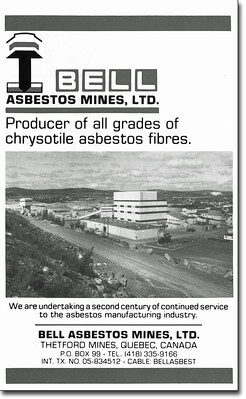
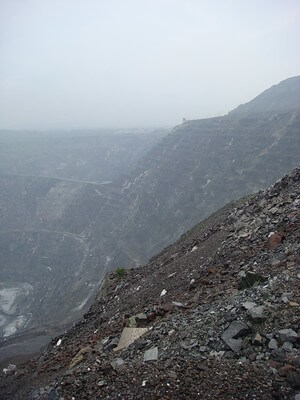
Bell Asbestos Mines operated for more than a century in Quebec’s Thetford Mines, a region rich in naturally occurring asbestos. Workers opened the mine in 1876 as one of the first large-scale sites. They extracted chrysotile fiber that companies used worldwide.
Turner & Newall took control in 1936. The firm shipped raw asbestos to the U.S. and mixed it into products like Sprayed Limpet Asbestos, cements and textiles. Insulation crews sprayed Limpet on steel beams, walls and turbines for fireproofing and sound control.
Sprayed Limpet held 60% asbestos, 38% cement and 2% mineral oil. Workers mixed fibers on-site, which released heavy asbestos exposure. The U.S. banned high-asbestos sprays in 1976. Miners, millers and applicators later faced mesothelioma risks.
Federal Mogul Corporation acquired Turner & Newall and inherited the claims. Lawsuits forced that firm into bankruptcy. It set up a trust fund to compensate people harmed by Bell asbestos.
Who Was at Risk of Asbestos Exposure From Bell Asbestos Mines?
The occupations most at risk of direct asbestos exposure from Bell Asbestos Mines were miners and millers of chrysotile asbestos. In addition to these workers, Limpet and other asbestos products by Turner & Newall exposed many construction workers and people working in sites where Limpet was applied.
Higher Risk Jobs
Carpenters
Chemical plant workers
Construction workers
Electricians
Factory workers
HVAC workers
Insulation workers
Metal workers
Millers
Miners
Painters
Power plant workers
Refinery workers
Teachers
Many workers in these occupations faced frequent and prolonged contact with toxic asbestos fibers, increasing their risk of developing serious health conditions. People in these jobs must become aware of the risks and take appropriate safety measures to reduce exposure.
Bell Asbestos Mines Asbestos Products
Bell Asbestos Mines produced raw chrysotile asbestos fiber. Turner & Newall used this fiber to manufacture several asbestos products.
Bell Asbestos Mines Asbestos-Containing Products
Asbestos adhesives
Asbestos cement
Asbestos insulation materials
Asbestos paper
Asbestos textiles, including yarn and cloth
Sprayed Limpet Asbestos
Workers sprayed Limpet Asbestos in schools, public buildings, churches and hospitals. They also used it in manufacturing plants, auto assembly lines, metal factories, power plants and oil refineries.
Recommended Reading
Your web browser is no longer supported by Microsoft. Update your browser for more security, speed and compatibility.
If you are looking for mesothelioma support, please contact our Patient Advocates at (855) 404-4592
Fact Checked
Our fact-checking process begins with a thorough review of all sources to ensure they are high quality. Then we cross-check the facts with original medical or scientific reports published by those sources, or we validate the facts with reputable news organizations, medical and scientific experts and other health experts. Each page includes all sources for full transparency.
Reviewed
Asbestos.com is the nation’s most trusted mesothelioma resource
The Mesothelioma Center at Asbestos.com has provided patients and their loved ones the most updated and reliable information on mesothelioma and asbestos exposure since 2006.
Our team of Patient Advocates includes a medical doctor, a registered nurse, health services administrators, veterans, VA-accredited Claims Agents, an oncology patient navigator and hospice care expert. Their combined expertise means we help any mesothelioma patient or loved one through every step of their cancer journey.
More than 30 contributors, including mesothelioma doctors, survivors, health care professionals and other experts, have peer-reviewed our website and written unique research-driven articles to ensure you get the highest-quality medical and health information.
About The Mesothelioma Center at Asbestos.com
Assisting mesothelioma patients and their loved ones since 2006.
Helps more than 50% of mesothelioma patients diagnosed annually in the U.S.
A+ rating from the Better Business Bureau.
5-star reviewed mesothelioma and support organization.
My family has only the highest compliment for the assistance and support that we received from The Mesothelioma Center. This is a staff of compassionate and knowledgeable individuals who respect what your family is experiencing and who go the extra mile to make an unfortunate diagnosis less stressful. Information and assistance were provided by The Mesothelioma Center at no cost to our family.
Asbestos.com. (2026, January 13). Bell Asbestos Mines Trust Fund and Lawsuits. Retrieved October 26, 2026, from https://www.asbestos.com/companies/bell-asbestos-mines-ltd/
MLA
"Bell Asbestos Mines Trust Fund and Lawsuits." Asbestos.com, 13 Jan 2026, https://www.asbestos.com/companies/bell-asbestos-mines-ltd/.
Chicago
Asbestos.com. "Bell Asbestos Mines Trust Fund and Lawsuits." Last modified January 13, 2026. https://www.asbestos.com/companies/bell-asbestos-mines-ltd/.
My primary support since being diagnosed with Mesothelioma, over 2 years ago, has been this company. Their monthly nationwide support group has been a tremendous help for me. I have learned about others' treatments and have been able to freely discuss mine, knowing others walk the same walk as I do and fully understand. Karen Selby, the nurse and patient advocate, has helped me so much. I call her and she delivers. She's experienced in Thoracic surgeries, is supportive, kind, knowledgeable, and makes a patient feel very cared for! The whole staff are polite, caring, and will help with Mesothelioma victims' many needs. I feel very blessed to have this Organization by my side as I live with this cancer.
I found out about The Mesothelioma Center while researching Peritoneal Mesothelioma days after being diagnosed with malignant cancer. While a lot of the 'Mesothelioma' websites are actually law firms just trying to get your business, theirs is a user-friendly, comprehensive website set up to aid patients, their loved ones, and/or caregivers with all things related to a cancer diagnosis from asbestos exposure. I was soon put in touch with one of their doctors, Snehal Smart, M.D., who immediately sent me a packet of general information, a book on surviving Mesothelioma, and offered me assistance in finding doctors, reputable law firms, financial help, support groups, and so much more! The Mesothelioma Center's website is, in my opinion, the best resource for anyone suffering from cancer due to asbestos. Dr. Smart is amazing! She is very knowledgeable and helpful, but she is also a very kind, caring doctor who appears to go the distance whether she is researching a pertinent topic, making suggestions, providing contacts, or just being a good listener on the other end of the phone. In addition, Dr. Smart referred me to a law firm who is now fighting to get me compensation for the negligence of those defendants whose products exposed me to asbestos and caused my subsequent cancer. Thank you, TMC and Dr. Smart, for helping me determine the best treatment plan for my cancer and being part of my miracle. I am currently cancer-free and back to being a mom to my precious daughter. The Mesothelioma Center, their website, and their staff rock!!
I just want to take this time to thank Mesothelioma Center for all the information you provide. The survival stories are inspiring and give hope where hope is needed! Thanks to you, I have met many others on the site and continue to converse with them. Keep up the good work. I am always looking forward to your posts! Thank you, Richard Delisle.
My brother was recently diagnosed with mesothelioma. I began researching it online. The information I received from The Mesothelioma Center is all-inclusive. No need to look anywhere else! The first phone call was with Karen, and she answered all my questions with ease. She also had a calming effect by presenting all the options available for my brother and his family. Thank you!
My father was recently diagnosed with mesothelioma. We, as a family, were devastated. We were uncertain where to even start, so we reached out to The Mesothelioma Center. They were absolutely amazing. They provided physicians in our area who specialize in this type of cancer because it is so rare. They also set us up with a firm who specializes in getting funds that are set aside to help with our medical bills. I’m so glad we made the phone call. They were very knowledgeable, supportive, sincere, and true patient advocates.
D. Carl Money is an attorney at Nemeroff Law. He has devoted his career to fighting for workers diagnosed with mesothelioma and their families. Money has more than 25 years of experience fighting for people with asbestos-related diseases. He’s licensed in Texas, New York, England and Wales and belongs to various legal organizations across the U.S. and U.K.
Fact-checked and verified content:
Our fact-checking process begins with a thorough review of all sources to ensure they are high quality. Then we cross-check the facts with original medical or scientific reports published by those sources, or we validate the facts with reputable news organizations, medical and scientific experts and other health experts. Each page includes all sources for full transparency.
Please read our editorial guidelines to learn more about our content creation and review process.