A mesothelioma lawsuit is a legal claim patients or their families file against companies responsible for asbestos exposure. People diagnosed with mesothelioma or lung cancer can seek average compensation ranging from $1 million to $2 million.
A total of 2,035 mesothelioma lawsuits were filed in the U.S. in 2025, according to KCIC’s Asbestos Litigation: 2025 Year in Review. This was a 5.5% increase in mesothelioma filings from 2024 and mesothelioma lawsuits made up 48% of overall asbestos lawsuit filings.
In late 2025, juries awarded record-breaking talc-related verdicts. A Baltimore jury awarded $1.5 billion in Craft v. Johnson & Johnson in December 2025 and a Los Angeles jury awarded $966 million in Moore v. Johnson & Johnson in October 2025.
Status of Asbestos Lawsuits
October 2026: The U.S. Supreme Court declined to hear Norfolk Southern’s latest challenge to a Pennsylvania law that allows companies registered in the state to be sued there over claims from anywhere, even by out-of-state plaintiffs. The case was filed by Robert Mallory, a former freight-car mechanic who said spraying boxcar pipes with asbestos and handling other carcinogens caused his cancer. The decision keeps Pennsylvania courts open to out-of-state asbestos claims against registered companies.
September 2026: American International Industries asked a Seattle court to move a couple’s talc lawsuit to a Texas federal court and pause the case. The company says the claims connect to BMI Oldco Inc.’s bankruptcy, where a Texas court will decide if BMI’s talc contained enough asbestos to cause disease.
August 2026: Johnson & Johnson offered up to $5.5 billion to settle roughly 76,000 talc-related ovarian cancer claims, following a bankruptcy court’s rejection of its earlier $10 billion Red River Talc proposal. Mesothelioma-related talc lawsuits continue separately.
July 2026: The Illinois Appellate Court affirmed a $45 million verdict against Johnson & Johnson and Kenvue Inc. Judges rejected the company’s bid to overturn or reduce the award in a mesothelioma case linked to talc-based baby powder.
Asbestos lawsuits serve a dual purpose. First, they hold companies accountable for exposing workers and consumers to asbestos. Second, they help patients and families cover medical bills and other expenses related to their cancer.
Pleural mesothelioma survivor Kim M. tells us that her reason for filing an asbestos lawsuit was to hold these companies accountable. “They need to know that this was a bad thing. Their lack of taking care of the situation has caused a person to be in a position where their life is potentially cut short because of the exposure to something that they knew.”
Filing a mesothelioma lawsuit allows patients and families to recover compensation from the companies whose asbestos products caused their illness. It offers more than financial relief, it provides a pathway to justice, closure and support during a challenging time. While the primary benefit is often compensation to cover medical and living expenses, other important advantages include emotional healing and holding negligent companies accountable.
Key Facts About Mesothelioma Lawsuits
Mesothelioma trials can result in multimillion-dollar verdicts.
Many mesothelioma cases settle out of court, with average payouts ranging nationally from $1 million to $2 million.
Patients diagnosed with mesothelioma can usually file a personal injury claim.
Families who lost a loved one to mesothelioma may file a wrongful death claim.
Deadlines limit when you can file claims. Mesothelioma lawyers can help you file if you’re eligible.
Many asbestos product manufacturers were aware of the health risks but failed to protect workers and consumers. For those who were exposed to asbestos because of this negligence, a lawsuit becomes a powerful tool in seeking justice. A qualified asbestos attorney can help you decide whether to pursue a lawsuit and can guide you through the process. Their expertise can help you receive monetary damages that may build you a more secure financial future for your loved ones.
Do I need to know the exact details of my asbestos exposure to qualify for a mesothelioma legal case?
A lot of people have this question. There’s a lot of confusion because people say, hey, look, I have idea. And in some cases, even you’ll have wives or loved ones who are secondarily exposed, meaning that they got exposed to products that were brought home in the hair or on the clothing of a loved one. So they certainly don’t know what kind of asbestos they were around. The important thing to understand is the attorneys know this very, very well. There’s not a lot of attorneys that do this, but the ones that do it tend to be experts in it. So they’re gonna understand where you are exposed? What kind of job sites had a lot of asbestos at them? What kind of products had a lot of asbestos in them? And what they do typically is they’ll sit down you. And they’ll work up your job history or your loved one’s job history or a parent or something like that that you might have been exposed second rarely through. And they’ll say, Hey, look, where do they work? What kind of products were they around? What jobs did they do? And they can figure it out that way. The attorneys know this very, very well. And even if whatever reason you were secondarily exposed and your loved ones are dead. So you think I might not have a claim. Usually what they’ll do in that situation is they’ll find co workers of your loved one. And they’ll look up for those people, and they’ll talk to those people and figure out what your loved one did at work. So it’s very, very common. People don’t know, but the lawyers really understand this process very well and make it very smooth for you.
What’s the difference between an experienced asbestos lawyer and other personal injury lawyers?
One of the big differences between somebody who’s relatively new handling asbestos cases versus folks that have been doing this for a while is once you have developed information about the various companies that manufacture asbestos containing products, and you sort of have the playbook. You know what questions to ask. You know what products, are the most dangerous and why they’re the most dangerous. And so having that information and having had prior cases with a variety of different companies really makes a difference in what type of recovery you’re able to make for your clients.
What Factors Determine Compensation from a Mesothelioma Lawsuit?
[MUSIC PLAYING] The factors that go into compensation for asbestos cases are commonly, what types of products were used? Was asbestos used during the period when a victim may have used those products? How often did they use them? And how many different types of products can they remember?
Mesothelioma Survivors Who Have Filed Asbestos Lawsuits
Epifanio F. (Peritoneal Mesothelioma): Figueroa was exposed to asbestos-containing auto parts during his career in automotive work. Diagnosed in 2016, he says filing a claim helped his family immensely. He was able to build a home for himself and his wife, and support loved ones. “It’s actually been a game changer for us. Also, I’ve been able to help my family, which I couldn’t before,” he said. “I have been able to leave a legacy for my kids and my grandkids.”
Kim M. (Pleural Mesothelioma): Exposed to asbestos in art and automotive shop classrooms during middle and high school, Madril felt nervous about filing a lawsuit in 2019. She found the experience less daunting than expected: “I was very anxious and scared about it. And in the end, I thought, hey, it wasn’t that bad. And I think if you have the right support, the right legal team, if you don’t have any expectations, it makes the process much easier.”
$30B+ IN TRUST FUNDS AVAILABLE
File Your Mesothelioma Claim
When filing a mesothelioma claim, the right legal representation is everything. We’ll connect you to a top lawyer who will help you secure financial compensation.
Mesothelioma lawsuits fall into 3 primary categories: personal injury lawsuits, wrongful death lawsuits and product liability lawsuits. Each type serves different purposes depending on the plaintiff and the situation. Class action lawsuits were once common in asbestos litigation, but courts now handle most mesothelioma lawsuits as individual claims because each patient’s exposure history and diagnosis are unique.
Asbestos personal injury and wrongful death lawsuits frequently involve multiple legal approaches. While often filed under negligence, alleging a company failed to warn or protect individuals from asbestos, they often also include product liability claims because of the inherent danger of the asbestos-containing products themselves.
Personal Injury Lawsuit
In a personal injury lawsuit, a mesothelioma patient files a lawsuit to seek compensation from the companies responsible for their asbestos exposure and illness. Mesothelioma lawsuits can name various companies responsible for exposing them to the carcinogenic mineral. If the lawsuit is successful, the mesothelioma patient receives compensation for their injury.
Timing can affect your eligibility for a personal injury lawsuit. Each state has a different mesothelioma statute of limitations, which sets a time limit of typically around 2 or 3 years for a plaintiff to file a lawsuit. The statute of limitations usually begins to run from the date a patient is diagnosed with mesothelioma.
Expert Insight
I think it’s important for patients to know that it’s a group decision as to how a case is handled. We provide the legal advice, but we also put together a range of different options depending upon what a client is physically capable of doing.
A wrongful death lawsuit is filed by the estate of a deceased mesothelioma patient. Money awarded from an asbestos case filed after death may include compensation for medical bills, funeral expenses, lost financial support, loss of companionship and past pain and suffering.
If a mesothelioma patient files a personal injury lawsuit but dies before resolution, it can often be converted to a wrongful death lawsuit. The estate can then continue pursuing the mesothelioma lawsuit. The estate is the recipient of any funds awarded in this lawsuit or the settlement proceeds.
Product Liability Lawsuit
Mesothelioma lawsuits may be considered product liability claims because they allege an asbestos-containing product caused a personal injury or wrongful death. The areas of product liability law involved in asbestos lawsuits include negligence, strict liability and breach of warranty.
Once exposure to an asbestos product has caused asbestos-related illnesses or death, the injured party or surviving loved ones may file a lawsuit. A company’s failure to warn employees and consumers about the dangers of asbestos is often the basis for liability in a lawsuit.
Asbestos Lawsuits: Beyond Mesothelioma
Mesothelioma gets the most attention in asbestos litigation, but it isn’t the only disease that qualifies for an asbestos lawsuit. People diagnosed with other asbestos-related conditions can usually file legal claims against the companies responsible for their exposure.
Asbestos-Related Diseases That May Qualify for a Lawsuit
Asbestosis: A chronic lung disease that develops after prolonged asbestos exposure. It causes scarring of the lung tissue and can lead to serious breathing problems.
Lung cancer: Asbestos exposure significantly raises the risk of lung cancer, especially in people who also smoke. People diagnosed with asbestos-related lung cancer can often file a claim against the companies whose products caused their exposure.
Pleural plaques and pleural thickening: These conditions affect the lining of the lungs and can develop years after asbestos exposure. They may qualify for compensation depending on the severity and the jurisdiction where you file.
Ovarian cancer: Research links some ovarian cancers to asbestos-contaminated talcum powder products. Several significant verdicts have involved plaintiffs diagnosed with ovarian cancer after decades of talc use.
Other cancers: Asbestos exposure has also been linked to cancers of the larynx, pharynx and stomach.
Plaintiffs must prove asbestos exposure, connect that exposure to their illness and identify the companies responsible. The key differences involve how courts evaluate causation and the strength of the scientific evidence linking the disease to asbestos.
Filing deadlines, called statutes of limitations, also vary depending on the disease and the state where you file. Speak with an experienced asbestos attorney as soon as possible. The statute of limitations can begin running from the date of diagnosis and waiting too long can limit your right to file. An experienced asbestos attorney can evaluate your diagnosis, review your exposure history and help you understand whether you qualify for a claim.
Who Qualifies to File a Mesothelioma Lawsuit?
Anyone diagnosed with or who lost a family member to mesothelioma or another asbestos-related disease can typically file a mesothelioma lawsuit. Anyone filing an asbestos lawsuit must provide documentation proving they or their loved ones had asbestos exposure and received a diagnosis of mesothelioma or other asbestos-related disease.
Documentation to Support Your Lawsuit
Affidavits or testimony from co-workers and others familiar with the exposure
Documentation of household or secondary exposure, such as evidence that a family member encountered asbestos through a worker’s clothing or equipment
Employment records showing asbestos exposure history
Medical reports and diagnosis confirmation
Military service records for veterans exposed during duty
Product identification records, such as product labels or safety data sheets
Skilled law firms have investigators who research your work history and evaluate other places where you may have encountered asbestos. Attorneys gather evidence to help prove your case during what’s called the discovery phase.
What Could Affect My Eligibility to File an Asbestos Lawsuit?
Several key factors can affect your eligibility to file an asbestos or mesothelioma lawsuit. These factors determine whether you can pursue legal claims and receive compensation.
Factors Affecting Your Filing Eligibility
Identification of responsible parties: Your attorney will need to identify and demonstrate which companies or entities are liable for your asbestos exposure. This process often involves extensive investigation and expert testimony.
Jurisdictional rules: Laws vary from state to state and can affect filing procedures, deadlines and available damages.
Medical diagnosis: A confirmed diagnosis of mesothelioma or another asbestos-related illness is essential. Your medical records, a pathology report and a physician’s statement connecting your diagnosis to asbestos are often required.
Proof of asbestos exposure: You must demonstrate how, when and where you were exposed with employment records, coworker testimony, military service records and documentation of environmental exposure or asbestos product use.
Quality and availability of evidence: Lack of documentation or difficulty proving exposure can limit eligibility or reduce compensation amounts.
Statute of limitations: Each state sets legal deadlines called statutes of limitation that limit when you can file your claim. These typically range from 1 to 6 years from the date of diagnosis or the date of death for wrongful death claims. Filing as early as possible is crucial to preserving your rights.
It’s important to consult with a specialized mesothelioma attorney soon after diagnosis. Early legal guidance ensures your case is properly evaluated and all necessary factors are addressed to protect your rights.
Special Eligibility Circumstances
Family Members
Spouses, children and estate representatives may be able to file wrongful death claims against the companies responsible for asbestos exposure. If a personal injury claim was in progress at the time of death, it can often convert to a wrongful death claim.
Veterans
Military veterans can file VA disability claims and civil lawsuits against asbestos manufacturers at the same time. Filing one usually doesn’t prevent you from filing the other, and pursuing both can maximize the compensation available to you.
Survivor Experience
I was happy to learn that you can get financial assistance from companies that have asbestos in their products.
Carla F., peritoneal mesothelioma survivor
Verified Asbestos.com Survivor
How to File a Mesothelioma Lawsuit
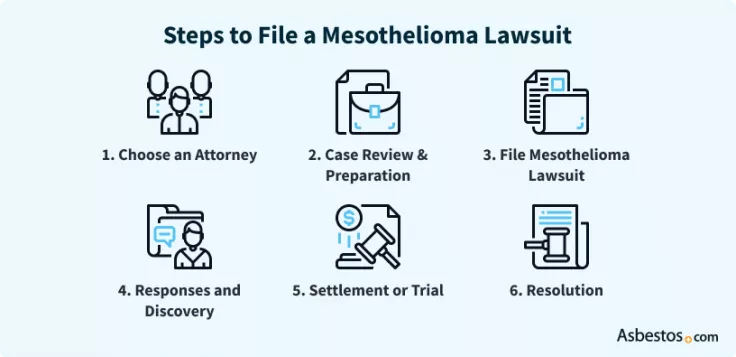
Filing a mesothelioma lawsuit typically takes 12 to 18 months. The process follows 6 key steps: choosing an attorney, case review, filing the complaint, discovery, settlement or trial and receiving your final settlement or verdict.
Filing can feel overwhelming, but the right attorney will manage the process for you from start to finish. Most people don’t need to go to court in person. Your legal team handles the heavy lifting while you focus on your health and your family.
Your attorney will walk you through every step of the mesothelioma lawsuit process.
1. Choose an Attorney
An experienced asbestos attorney is the most important decision you’ll make in this process. Top mesothelioma law firms offer free consultations and won’t charge you anything unless they win your case. Here are some things to gather before your initial consultation.
Gather These Before Your First Consultation
A list of jobs you’ve held and industries you’ve worked in
Military service records, if applicable
Names of co-workers who can speak to your work environment
Names of employers, jobsites or products you remember working with
Your mesothelioma diagnosis records and pathology report
Don’t worry if you can’t remember every detail. A good mesothelioma law firm will investigate your asbestos exposure history and fill in the gaps. Most firms will travel to your home at no extra charge.
Typical timeline: Initial consultation can happen within days of your first call.
2. Case Review and Preparation
Your attorney will conduct a full case evaluation, which you can complete over the phone, virtually or in person. They’ll ask about your diagnosis, your work history and how you believe you were exposed to asbestos. This step helps your attorney understand which companies to pursue and which type of claim best fits your situation.
A reputable law firm won’t rush this process. They want to build the strongest possible case for you before filing anything.
Typical timeline: 2 to 4 weeks, depending on the complexity of your exposure history.
3. File the Lawsuit
Your attorney will research which lawsuit and compensation options best fit your needs. They’ll prepare all the documentation, file the complaint with the appropriate court and notify the defendants. They’ll also identify whether you qualify for asbestos trust fund claims, which can move faster than a lawsuit.
Typical timeline: Your attorney can file within weeks of completing your case review, depending on the jurisdiction.
Exclusive Content
Kim S.: Finding An Attorney
It makes you angry that your parent, spouse, sibling, they did nothing wrong. They went to a job, they provided for their family, and then these manufacturers of things just do whatever they want, and then we have to pay for it later. Well, we shouldn’t have to.
Asbestos.com, their organization will help you find those people to help you get the finances, income, so that you can take care of your parent, your spouse, whoever it may be with the mesothelioma. When you’re dealing with a diagnosis that can be very expensive, so oftentimes you don’t know if your insurance is gonna pay for your healthcare. Are you gonna be able to afford your copays?
What is it gonna look like in six months or a year from now? When you’re looking for a lawyer specific to mesothelioma, it’s very difficult to know whether they truly specialize in mesothelioma law. And that is so important when it comes to mesothelioma patients.
It’s a very unique skill set. Mesothelioma cases, they’re extremely complex and there’s so many law firms out there, that would gladly take a case in, but there’s very few law firms that actually know how to litigate these cases to verdict. When you come to the Mesothelioma Center at Asbestos.com, we’ve already done the background checks and the research for you.
So we’re actually just kind of handholding you and saying, We’ve done that legwork. Let us help you get to the experts. Make the phone call, talk to someone that understands what you’re going through, and realize that it’s not a lawsuit.
It’s about somebody’s life.
4. Responses and Discovery
Each defendant receives a copy of your complaint and typically has around 30 days to respond. Defendants rarely admit fault. They typically deny allegations and argue that someone else is responsible. Your attorney will respond on your behalf.
During discovery, both sides gather evidence. Your attorney will collect employment records, medical records and expert testimony. Your attorney will schedule depositions during this phase, where you and the defendants answer questions under oath. Many depositions happen from your home.
Typical timeline: Discovery can take several months to more than a year, depending on the number of defendants and the complexity of the case.
5. Settlement or Trial
Before trial, defendants may offer a settlement to resolve the case. Your attorney will negotiate on your behalf and advise you. Most mesothelioma cases settle before trial. Settlements average $1 million to $2 million, according to legal experts.
If your case goes to trial, you may not need to appear in person. Trial verdicts can reach significantly higher amounts but take longer to receive.
Typical timeline: Settlement negotiations can begin at any point. Trials can add 1 or more years to the process.
6. Resolution
If you win at trial, defendants usually have between 30 and 180 days to file an appeal. They’re often required to post a bond for the full verdict amount while the appeal proceeds. If they lose the appeal, you’ll receive payment. If your case settles, your attorney will send you a release document to sign and notarize. After that, payment typically arrives within a few months.
Typical timeline: Payment after a settlement usually arrives within 1 to 3 months of signing the release. Trial payments may take longer if defendants appeal.
Average Mesothelioma Lawsuit Timeline
Stage
Typical Duration
Choosing an attorney and case review
1–4 weeks
Filing the complaint
1–2 weeks
Discovery phase
6–12 months
Settlement negotiation
1–3 months
Trial (if required)
Additional 6–12 months
Resolution and payment
1–3 months after verdict
Most mesothelioma attorneys work on a contingency fee basis, meaning there are no upfront fees to file a lawsuit. Attorneys collect a fee only if they win compensation for you. Initial consultations are free.
Expert Insight
“It’s so important for mesothelioma patients to go through the litigation process. They can tell their story in front of a jury of their peers to say it’s not right that a corporation knew or should have known about a poison they were putting into their products and did it anyway.”
Jim Kramer, mesothelioma lawyer
Asbestos Lawsuit Trends and Statistics
Asbestos lawsuit filings returned to pre-pandemic levels for the first time in 2025, reaching 4,244 total filings, according to KCIC’s latest report. This exceeds the total for 2019, which was 4,174.
Talc exposure has been one of the biggest shifts in asbestos litigation. In KCIC’s 2016 report, 2016, the only mention of talc lawsuits was in the conclusion. It noted, “While certain trends are unlikely to change… we will continue to monitor these filings, along with the impact of emerging trends such as lung cancer and talc filings, for future reports.” In 2025, talc exposure appears in more than 40% of all mesothelioma filings.
Year
Mesothelioma
Lung Cancer
Other Cancer
Non-Malignant
Unknown
Total
2022
1,896
1,356
65
276
113
3,706
2023
1,940
1,577
65
267
80
3,929
2024
1,929
1,692
8476
232
76
4,013
2025
2,035
1,714
109
272
114
4,244
Source:
KCIC Asbestos Litigation: 2025 Year in Review
Mesothelioma Lawsuits by State
Where you file a mesothelioma lawsuit can affect how much compensation you receive and how long the process takes. Each state sets its own rules for asbestos litigation, including statute of limitations deadlines, available damages and court procedures. Some states handle far more asbestos cases than others, which means their courts have more experience with this type of litigation.
Most states give you 2 to 3 years from the date of your mesothelioma diagnosis to file a personal injury lawsuit. For wrongful death claims, the statute of limitation may be different. Filing as early as possible protects your rights and gives your attorney more time to build a strong case.
You may not file in the state where you live. If your exposure happened in another state or the defendant is based elsewhere, you may file in a different state. An experienced mesothelioma lawyer will guide you based on the specific details of your case.
Top 5 Filing Jurisdictions in 2025
Jurisdiction
2025 Filings
Madison County, Illinois
872
St. Clair County, Illinois
657
New York, New York
399
Philadelphia, Pennsylvania
380
Cook County, Illinois
239
Source:
KCIC Asbestos Litigation: 2025 Year in Review
Notable Mesothelioma Lawsuits
Some of the most significant asbestos verdicts in recent years have reached tens of millions of dollars. Most cases settle before trial, with settlements averaging $1 million to $2 million, according to legal experts. When cases go to trial, verdicts can reach significantly higher amounts. The average asbestos verdict in 2023 was $20.7 million, according to an analysis of that year’s legal cases.
Recent Significant Asbestos Verdicts
$1.5 billion: A Baltimore jury awarded this amount to Cherie Craft, who developed peritoneal mesothelioma after years of using Johnson & Johnson baby powder in December 2025. It’s the largest talc-related mesothelioma verdict on record.
$966 million: A Los Angeles jury awarded $966 million ($950 million in punitive damages) to the family of Mae K. Moore in a Johnson & Johnson talc baby powder case in October 2025.
$117 million: A New York jury awarded this amount in May 2025 ($78 million for pain and suffering, $39 million for loss of companionship) to a 72-year-old World Trade Center steel worker and Marine who developed pleural mesothelioma.
$51 million: The California 2nd District Court of Appeals upheld this verdict against Avon in February 2026. The lawsuit claims Rita-Ann Chapman developed mesothelioma after using Avon talc-based cosmetic products from childhood through most of her life.
$40 million: A California jury ordered Johnson & Johnson to pay this amount to two women in December 2025. Their case claims long-term use of J&J’s talc-based baby powder caused their ovarian cancer.
$34.2 million: A Portland, Oregon, jury held John Crane Inc. liable in this mesothelioma verdict in September 2025. The lawsuit claimed a shipyard worker developed mesothelioma after exposure to John Crane’s asbestos-containing products.
Verdict amounts have historically varied widely depending on the specific circumstances of each case. You and your attorney can discuss typical settlement amounts, average verdict amounts and the details of your individual case as you navigate the litigation process together. The state where you file can also affect your compensation. An experienced mesothelioma attorney can help you and your family identify the best jurisdiction for your asbestos claim.
Other Notable Verdicts
A Los Angeles Superior Court jury held Algoma Hardwoods Inc. liable for a person’s mesothelioma diagnosis. The lawsuit claims the person developed mesothelioma through secondary exposure, encountering asbestos dust carried home on a spouse’s work clothing.
A jury awarded this amount to a long-time talcum powder user who developed mesothelioma after exposure to talcum powder contaminated with asbestos.
A jury awarded this amount to the family of a janitor who developed mesothelioma. The lawsuit claims his exposure resulted from work at an Avon manufacturing facility.
Johns-Manville’s 1982 Chapter 11 bankruptcy filing shaped modern asbestos litigation. The company became the first in U.S. history to file for bankruptcy over asbestos claims, facing more than 16,000 lawsuits at the time. The filing followed the landmark Borel v. Fibreboard decision in 1973, the first successful lawsuit to hold asbestos manufacturers liable for failing to warn workers of the dangers of their products. Johns-Manville, a defendant in Borel, created the first asbestos trust fund in 1988, initially funding it with $2.5 billion. That trust set the model for more than 60 active asbestos trust funds operating today.
Settlement vs. Trial: How Most Mesothelioma Cases Resolve
A settlement is a negotiated agreement between the plaintiff and the defendant company that provides faster, more certain compensation without the risk of a trial. A trial verdict comes from a judge or a jury and can result in a higher award, but it usually takes longer and carries more uncertainty.
Attorneys and plaintiffs can’t predict a jury’s decision, and defendants can appeal a verdict, further delaying payment. More than 95% of mesothelioma cases resolve through settlement, meaning most people never step foot in a courtroom.
Common Defendant Companies in Mesothelioma Lawsuits
Many mesothelioma lawsuits name the same companies. Many of these manufacturers produced asbestos-containing products across multiple industries for decades. Most faced bankruptcy over asbestos claims and now operate asbestos trust funds that eligible claimants can file against.
Frequently Named Asbestos Companies
Armstrong World Industries | Industry: Flooring, insulation and ceiling products | Status: Active trust fund (Armstrong World Industries Asbestos Trust, est. 2007)
Celotex Corporation | Industry: Roofing, insulation and building materials | Status: Active trust fund (Celotex Asbestos Settlement Trust, est. 1998)
Combustion Engineering | Industry: Power systems and industrial engineering | Status: Active trust fund (Combustion Engineering Asbestos Personal Injury Trust, est. 2005)
Georgia-Pacific| Industry: Construction materials and drywall | Status: No trust fund established. Subsidiary Bestwall Gypsum filed for Chapter 11 bankruptcy in 2017. The case is still in proceedings and no trust fund has formed yet. Claimants can’t currently sue Georgia-Pacific directly while the bankruptcy process continues.
Johns-Manville| Industry: Insulation and construction products | Status: Active trust fund (Manville Personal Injury Settlement Trust, est. 1988)
Owens Corning | Industry: Insulation and construction materials | Status: Active trust fund (Owens Corning/Fibreboard Asbestos Personal Injury Trust, est. 2006)
U.S. Gypsum| Industry: Drywall and building materials | Status: Active trust fund (USG Asbestos Personal Injury Trust, est. 2006)
W.R. Grace| Industry: Construction products and specialty chemicals | Status: Active trust fund (WRG Asbestos PI Trust, est. 2014)
An experienced mesothelioma attorney can help you determine which companies contributed to your exposure. They’ll help you identify every available source of compensation, including trust funds, lawsuits or both. Most people with mesothelioma had exposure to products from multiple companies, which means they may qualify for claims against more than one trust fund or defendant.
Common Questions About Mesothelioma Lawsuits
What are mesothelioma lawsuits?
A mesothelioma lawsuit is a legal claim people with mesothelioma or their families file against the companies that made asbestos products. These claims say the companies are responsible for the asbestos exposure that caused their illness. Plaintiffs can get money for medical bills, legal fees or lost wages.
How long does a mesothelioma lawsuit take?
Mesothelioma lawsuits vary widely in timeline depending on the jurisdiction, the number of defendants and whether the case settles or goes to trial. Most cases resolve within 1 to 2 years, though some may take longer. Filing as soon as possible after a diagnosis gives your attorney the most time to build a strong case and pursue the best outcome.
As Carl Money, mesothelioma attorney at Nemeroff Law Firm, tells us, “A mesothelioma lawsuit may take anywhere from a year or more, depending on the jurisdiction where the lawsuit was filed.”
How much will I need to pay a mesothelioma lawyer?
A free case evaluation is the first step, and it costs nothing to find out where you stand. If you move forward, your attorney fronts all case costs, including filing fees and expert witness fees, which can be significant in mesothelioma litigation. Those costs are deducted from your settlement or verdict at the end. The contingency fee model means your lawyer only gets paid when you do, aligning their interests directly with yours.
As Carl Money, mesothelioma attorney at Nemeroff Law Firm, tells us, “It does not cost anything to hire a mesothelioma attorney. A mesothelioma attorney represents you on a contingency fee basis (no win, no fee) so that you have no out-of-pocket costs. The mesothelioma attorney only receives a fee if they obtain compensation for you and your heirs.”
What should you expect from a mesothelioma lawsuit?
A mesothelioma lawsuit is one of the most direct ways to hold asbestos companies accountable for the harm they caused. It also gives patients and families an opportunity to have their story heard. Your attorney handles every aspect of the case, from gathering records to negotiating with defendants on your behalf. Their goal is to secure the compensation and justice you and your family deserve.
As Carl Money, mesothelioma attorney at Nemeroff Law Firm, tells us, “You should expect to meet with an attorney so that they can obtain a contract, authorizations for medical records and employment records, and take notes about your history of asbestos exposure.”
Will I need to travel?
Mesothelioma attorneys offer both in-home and virtual consultations, making it easy to get started from wherever you are. Your attorney manages all court appearances, so you never need to set foot in a courtroom. Your legal team keeps you updated throughout the entire process by phone or video, so you stay informed without the burden of travel.
As Carl Money, mesothelioma attorney at Nemeroff Law Firm, tells us, “Generally, you do not need to travel. The attorney will come to your house and obtain all necessary information to pursue litigation and file claims against the asbestos trusts.”
Who are the parties involved in a mesothelioma lawsuit?
Mesothelioma lawsuits are often filed against companies that manufactured, distributed, or used asbestos-containing products without disclosing its risks to people.
Can I file an asbestos lawsuit if I don’t have mesothelioma?
Yes. People diagnosed with other asbestos-related diseases can also file a lawsuit against the companies responsible for their exposure. Qualifying conditions include: lung cancer, asbestosis, pleural plaques and pleural thickening. The legal process follows the same general framework as a mesothelioma lawsuit. You’ll need to prove asbestos exposure and connect it to your diagnosis. An experienced asbestos attorney can review your case and help you understand your options. Speak with an asbestos attorney to understand your eligibility based on your specific diagnosis and exposure history.
What is the average asbestos lawsuit settlement in 2026?
The average mesothelioma lawsuit settlement ranges from $1 million to $2 million, while trial verdicts average $20.7 million according to Mealey’s Litigation Report data. Fewer than 5% of cases reach a jury. Trust fund claims average $300,000 to $400,000 per claim and people can file with multiple trusts. The amount you receive depends on factors like the strength of your case and the defendants involved.
How long do asbestos lawsuits take to settle?
Most mesothelioma lawsuits settle within 6 to 12 months. Most people who file a trust fund claim receive compensation within a few months. Cases that go to trial take longer, sometimes several years. If you’re seriously ill, your attorney can ask the court to expedite the process. Filing as early as possible gives your legal team the most time to build a strong case and pursue the best outcome for your family.
Can family members file a mesothelioma lawsuit after death?
Yes. When a person diagnosed with mesothelioma passes away, surviving family members can file a wrongful death lawsuit against the companies responsible for asbestos exposure. An estate representative can also file asbestos trust fund claims on behalf of the deceased. Eligible family members typically include a spouse, children, dependents and siblings. Each state sets its own deadlines for wrongful death claims, so speaking with an attorney as soon as possible is important.
Recommended Reading
Your web browser is no longer supported by Microsoft. Update your browser for more security, speed and compatibility.
If you are looking for mesothelioma support, please contact our Patient Advocates at (855) 404-4592
Fact Checked
Our fact-checking process begins with a thorough review of all sources to ensure they are high quality. Then we cross-check the facts with original medical or scientific reports published by those sources, or we validate the facts with reputable news organizations, medical and scientific experts and other health experts. Each page includes all sources for full transparency.
Reviewed
Asbestos.com is the nation’s most trusted mesothelioma resource
The Mesothelioma Center at Asbestos.com has provided patients and their loved ones the most updated and reliable information on mesothelioma and asbestos exposure since 2006.
Our team of Patient Advocates includes a medical doctor, a registered nurse, health services administrators, veterans, VA-accredited Claims Agents, an oncology patient navigator and hospice care expert. Their combined expertise means we help any mesothelioma patient or loved one through every step of their cancer journey.
More than 30 contributors, including mesothelioma doctors, survivors, health care professionals and other experts, have peer-reviewed our website and written unique research-driven articles to ensure you get the highest-quality medical and health information.
About The Mesothelioma Center at Asbestos.com
Assisting mesothelioma patients and their loved ones since 2006.
Helps more than 50% of mesothelioma patients diagnosed annually in the U.S.
A+ rating from the Better Business Bureau.
5-star reviewed mesothelioma and support organization.
My family has only the highest compliment for the assistance and support that we received from The Mesothelioma Center. This is a staff of compassionate and knowledgeable individuals who respect what your family is experiencing and who go the extra mile to make an unfortunate diagnosis less stressful. Information and assistance were provided by The Mesothelioma Center at no cost to our family.
Lahav, J. (2026, October 8). Mesothelioma & Asbestos Lawsuits. Asbestos.com. Retrieved October 12, 2026, from https://www.asbestos.com/mesothelioma-lawyer/lawsuit/
Lahav, Joe. "Mesothelioma & Asbestos Lawsuits." Asbestos.com. Last modified October 8, 2026. https://www.asbestos.com/mesothelioma-lawyer/lawsuit/.
File a Mesothelioma Lawsuit
Take the first step in filing a mesothelioma lawsuit and pursue the compensation that can help support you and your family.
Attorneys are available to discuss your case today
Over $30 billion available for asbestos victims. Time limits may apply
5.0 Rating170+ Google Reviews
A+ RatedBetter Business Bureau
20 YearsServing Exposure Victims
I can't thank Amy enough for all the information she sent me. Checking in a couple times a week to see how things were going and answering any questions I had. She put us in touch with our lawyer and that has been great Thank you to the Mesothelioma Center for everything. When you get a diagnosis of cancer you don't even know where to start and they've been great.
My husband reached out to the Mesothelioma Center upon my diagnosis. Within a minute I was contacted by a most encouraging woman, Amy Pelegrin. It was just luck that my husband happen to take the chance to reach out being we felt so lost. She helped us so much by taking the time to talk with me, as well as sending information which came the very next day. Doors opened that I had no idea were there and I am so very grateful.
The patient advocate Vanessa handled everything for us at first. We were having insurance issues and problems coordinating with the specialist. She took that problem off our hands so we could concentrate on our mom. So grateful to the mesothelioma center.
Whitney Ray Di Bona brings a unique perspective to The Mesothelioma Center's content on Asbestos.com. As both a practicing attorney and consumer safety advocate, she has encountered asbestos-related cases throughout her legal career. She draws on her experience in mass tort litigation and background as a former prosecutor to ensure the accuracy and helpfulness of content for mesothelioma survivors and their families.
Fact-checked and verified content:
Our fact-checking process begins with a thorough review of all sources to ensure they are high quality. Then we cross-check the facts with original medical or scientific reports published by those sources, or we validate the facts with reputable news organizations, medical and scientific experts and other health experts. Each page includes all sources for full transparency.
Please read our editorial guidelines to learn more about our content creation and review process.