A mesothelioma or asbestos lawsuit is a legal claim against the companies responsible for asbestos exposure. People diagnosed with mesothelioma or lung cancer can file, and families can file after a loved one dies. Most cases settle without going to trial.
Patients can file a personal injury claim, and families who lost a loved one can file a wrongful death claim
2 types of claims
Deadlines limit when you can file, and a mesothelioma lawyer can check whether you’re still eligible
Time limits apply
Share of mesothelioma cases that settle out of court
95%+
Typical length of a mesothelioma lawsuit
12 to 18 months
Expert & Survivor Perspectives
“The first thing that people need to understand is, in most cases, you’re going to settle long before trial. Most of these cases do not go to trial … You don’t usually have to go to court… A lot of times you can meet your lawyers … telephonically, so you don’t have to go to court very often … So if people are worried about getting up on the stand in front of a judge or jury, they don’t usually have to worry about that either.”
Joe Lahav, lawyer and legal advisor at The Mesothelioma Center
“There are a number of different reasons why it’s so important for mesothelioma patients to go through the litigation process. The first is to ensure that their family members will be taken care of long into the future. And that includes the possible high cost of medical treatment that the victim may incur during the treatment of their disease. And the next is being able to tell their story in front of a jury of their peers to say it’s not right that a corporation knew or should have known about a poison they were putting into their products and did it anyway.”
Jim Kramer, mesothelioma attorney and partner at Simmons Hanly Conroy
“I would tell other families considering legal action to be brave and to move forward, because the changes that it makes to your life, not only for you, but for those that you may leave behind, it changes you.”
Brunilda V., wife of mesothelioma survivor Epifanio F.
Lawsuits filed: 2,035 mesothelioma lawsuits in 2025, up 5.5% from 2024 (KCIC)
Talc cases: More than 40% of mesothelioma filings involve talc exposure (KCIC)
Lawyer response time: An experienced mesothelioma lawyer aims to meet new clients within 24 hours and file a case within 1 week
Settlement: More than 95% of mesothelioma cases resolve through settlement, so most people never go to court.
Expert Take
Jim Kramer: What Is the Process of a Mesothelioma Lawsuit?
Mesothelioma attorney Jim Kramer explains the mesothelioma lawsuit process in an exclusive interview with Asbestos.com.
1:04 |
[MUSIC PLAYING] Typically, once mesothelioma victims are diagnosed, they don’t know what to do next. The process, as we explain it, is very simple, and we try to help them as much as we can. The next thing that happens is talking to the person you want to represent you, learning about all the types of exposures that may have occurred 20, 30, 40 years in the past. Once that occurs, the lawyer takes over, files the case, and does the due diligence of which companies might be responsible for the asbestos exposure for this individual. From there, depositions may occur if the client wants to go in that direction, or there’s also the option of filing with certain bankruptcy trusts. Eventually, depending on how the case progresses, the case may go to trial, in which case, we provide the best possible trial advocacy to compensate the victim. [MUSIC PLAYING]
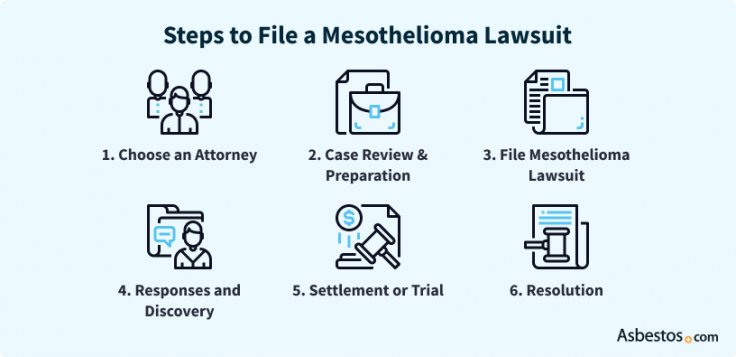
Filing a mesothelioma lawsuit typically takes 12 to 18 months. The process follows 6 key steps: choosing an attorney, case review, filing the complaint, discovery, settlement or trial and receiving your final settlement or verdict.
Filing can feel overwhelming, but the right attorney will manage the process for you from start to finish. Most people don’t need to go to court in person. Your legal team handles the heavy lifting while you focus on your health and your family.
Your attorney will walk you through every step of the mesothelioma lawsuit process.
1. Choose an Attorney
An experienced asbestos attorney is the most important decision you’ll make in this process. Top mesothelioma law firms offer free consultations and won’t charge you anything unless they win your case. Here are some things to gather before your initial consultation.
Gather These Before Your First Consultation
A list of jobs you’ve held and industries you’ve worked in
Military service records, if applicable
Names of co-workers who can speak to your work environment
Names of employers, jobsites or products you remember working with
Your mesothelioma diagnosis records and pathology report
Don’t worry if you can’t remember every detail. A good mesothelioma law firm will investigate your asbestos exposure history and fill in the gaps. Most firms will travel to your home at no extra charge.
Typical timeline: Initial consultation can happen within days of your first call.
2. Case Review and Preparation
Your attorney will conduct a full case evaluation, which you can complete over the phone, virtually or in person. They’ll ask about your diagnosis, your work history and how you believe you were exposed to asbestos. This step helps your attorney understand which companies to pursue and which type of claim best fits your situation.
A reputable law firm won’t rush this process. They want to build the strongest possible case for you before filing anything.
Typical timeline: 2 to 4 weeks, depending on the complexity of your exposure history.
3. File the Lawsuit
Your attorney will research which lawsuit and compensation options best fit your needs. They’ll prepare all the documentation, file the complaint with the appropriate court and notify the defendants. They’ll also identify whether you qualify for asbestos trust fund claims, which can move faster than a lawsuit.
Typical timeline: Your attorney can file within weeks of completing your case review, depending on the jurisdiction.
4. Responses and Discovery
Each defendant receives a copy of your complaint and typically has around 30 days to respond. Defendants rarely admit fault. They typically deny allegations and argue that someone else is responsible. Your attorney will respond on your behalf.
During discovery, both sides gather evidence. Your attorney will collect employment records, medical records and expert testimony. Your attorney will schedule depositions during this phase, where you and the defendants answer questions under oath. Many depositions happen from your home.
Typical timeline: Discovery can take several months to more than a year, depending on the number of defendants and the complexity of the case.
5. Settlement or Trial
Before trial, defendants may offer a settlement to resolve the case. Your attorney will negotiate on your behalf and advise you. Most mesothelioma cases settle before trial. Settlements average $1 million to $2 million, according to legal experts.
If your case goes to trial, you may not need to appear in person. Trial verdicts can reach significantly higher amounts but take longer to receive.
Typical timeline: Settlement negotiations can begin at any point. Trials can add 1 or more years to the process.
6. Resolution
If you win at trial, defendants usually have between 30 and 180 days to file an appeal. They’re often required to post a bond for the full verdict amount while the appeal proceeds. If they lose the appeal, you’ll receive payment. If your case settles, your attorney will send you a release document to sign and notarize. After that, payment typically arrives within a few months.
Typical timeline: Payment after a settlement usually arrives within 1 to 3 months of signing the release. Trial payments may take longer if defendants appeal.
Average Mesothelioma Lawsuit Timeline
Stage
Typical Duration
Choosing an attorney and case review
1–4 weeks
Filing the complaint
1–2 weeks
Discovery phase
6–12 months
Settlement negotiation
1–3 months
Trial (if required)
Additional 6–12 months
Resolution and payment
1–3 months after verdict
Most mesothelioma attorneys work on a contingency fee basis, meaning there are no upfront fees to file a lawsuit. Attorneys collect a fee only if they win compensation for you. Initial consultations are free.
Expert Insight
“It’s so important for mesothelioma patients to go through the litigation process. They can tell their story in front of a jury of their peers to say it’s not right that a corporation knew or should have known about a poison they were putting into their products and did it anyway.”
Jim Kramer, mesothelioma attorney and partner at Simmons Hanly Conroy
$30B+ IN TRUST FUNDS AVAILABLE
File Your Mesothelioma Claim
When filing a mesothelioma claim, the right legal representation is everything. We’ll connect you to a top lawyer who will help you secure financial compensation.
Anyone diagnosed with or who lost a family member to mesothelioma or another asbestos-related disease can typically file a mesothelioma lawsuit. Anyone filing an asbestos lawsuit must provide documentation proving they or their loved ones had asbestos exposure and received a diagnosis of mesothelioma or other asbestos-related disease.
Documentation to Support Your Lawsuit
Affidavits or testimony from co-workers and others familiar with the exposure
Documentation of household or secondary exposure, such as evidence that a family member encountered asbestos through a worker’s clothing or equipment
Employment records showing asbestos exposure history
Medical reports and diagnosis confirmation
Military service records for veterans exposed during duty
Product identification records, such as product labels or safety data sheets
Skilled law firms have investigators who research your work history and evaluate other places where you may have encountered asbestos. Attorneys gather evidence to help prove your case during what’s called the discovery phase.
What Could Affect My Eligibility to File an Asbestos Lawsuit?
Several key factors can affect your eligibility to file an asbestos or mesothelioma lawsuit. These factors determine whether you can pursue legal claims and receive compensation.
Factors Affecting Your Filing Eligibility
Identification of responsible parties: Your attorney will need to identify and demonstrate which companies or entities are liable for your asbestos exposure. This process often involves extensive investigation and expert testimony.
Jurisdictional rules: Laws vary from state to state and can affect filing procedures, deadlines and available damages.
Medical diagnosis: A confirmed diagnosis of mesothelioma or another asbestos-related illness is essential. Your medical records, a pathology report and a physician’s statement connecting your diagnosis to asbestos are often required.
Proof of asbestos exposure: You must demonstrate how, when and where you were exposed with employment records, coworker testimony, military service records and documentation of environmental exposure or asbestos product use.
Quality and availability of evidence: Lack of documentation or difficulty proving exposure can limit eligibility or reduce compensation amounts.
Statute of limitations: Each state sets legal deadlines called statutes of limitations that limit when you can file your claim. Most states typically allow 2 to 3 years from diagnosis, and wrongful death deadlines may differ. Filing as soon as possible after a diagnosis gives you the best chance of meeting your state's deadline.
It’s important to consult with a specialized mesothelioma attorney soon after diagnosis. Early legal guidance ensures your case is properly evaluated and all necessary factors are addressed to protect your rights.
Special Eligibility Circumstances
Family Members
Spouses, children and estate representatives may be able to file wrongful death claims against the companies responsible for asbestos exposure. If a personal injury claim was in progress at the time of death, it can often convert to a wrongful death claim.
Veterans
Military veterans can file VA disability claims and civil lawsuits against asbestos manufacturers at the same time. Filing one usually doesn’t prevent you from filing the other, and pursuing both can maximize the compensation available to you.
Types of Lawsuits
Types of Mesothelioma Lawsuits
Mesothelioma lawsuits fall into 3 primary categories: personal injury lawsuits, wrongful death lawsuits and product liability lawsuits. Each type serves different purposes depending on the plaintiff and the situation. Class action lawsuits were once common in asbestos litigation, but courts now handle most mesothelioma lawsuits as individual claims because each patient’s exposure history and diagnosis are unique.
Asbestos personal injury and wrongful death lawsuits frequently involve multiple legal approaches. While often filed under negligence, alleging a company failed to warn or protect individuals from asbestos, these cases also often include product liability claims because of the inherent danger of the asbestos-containing products themselves.
Personal Injury Lawsuit
In a personal injury lawsuit, a mesothelioma patient files a lawsuit to seek compensation from the companies responsible for their asbestos exposure and illness. Mesothelioma lawsuits usually name various companies responsible for exposing them to the carcinogenic mineral. If the lawsuit is successful, the mesothelioma patient receives compensation for their injury.
Timing can affect your eligibility for a personal injury lawsuit. Each state has a different mesothelioma statute of limitations, which sets a time limit of typically 2 or 3 years for a plaintiff to file a lawsuit. The statute of limitations starts from the date a patient is diagnosed with mesothelioma. A mesothelioma lawyer can confirm how much time you have to file, and our Patient Advocates can connect you with one.
Wrongful Death Lawsuit
A wrongful death lawsuit is filed by the estate of a deceased mesothelioma patient. Money awarded from an asbestos case filed after death may include compensation for medical bills, funeral expenses, lost financial support, loss of companionship and past pain and suffering.
If a mesothelioma patient files a personal injury lawsuit but dies before resolution, it can often be converted to a wrongful death lawsuit. The estate can then continue pursuing the mesothelioma lawsuit. The estate is the recipient of any funds awarded in this lawsuit or the settlement proceeds.
Product Liability Lawsuit
Mesothelioma lawsuits may be considered product liability claims because they allege an asbestos-containing product caused a personal injury or wrongful death. The areas of product liability law involved in asbestos lawsuits include negligence, strict liability and breach of warranty.
Once exposure to an asbestos product has caused asbestos-related illnesses or death, the injured party or surviving loved ones may file a lawsuit. A company’s failure to warn employees and consumers about the dangers of asbestos is often the basis for liability in a lawsuit.
Survivor Experience
I was happy to learn that you can get financial assistance from companies that have asbestos in their products.
Carla F., peritoneal mesothelioma survivor
Verified Asbestos.com Survivor
Asbestos Lawsuits: Beyond Mesothelioma
You can file an asbestos lawsuit if you've been diagnosed with an asbestos-related disease. In addition to mesothelioma, diseases such as asbestos-related lung cancer and ovarian cancer qualify. You'll need a confirmed diagnosis and evidence of your exposure. Exposure alone, without a diagnosis, usually isn't enough to sue.
Asbestos-Related Diseases That May Qualify for a Lawsuit
Asbestosis: A chronic lung disease that develops after prolonged asbestos exposure. It causes scarring of the lung tissue and can lead to serious breathing problems.
Lung cancer: Asbestos exposure significantly raises the risk of lung cancer, especially in people who also smoke. People diagnosed with asbestos-related lung cancer can often file a claim against the companies whose products caused their exposure.
Pleural plaques and pleural thickening: These conditions affect the lining of the lungs and can develop years after asbestos exposure. They may qualify for compensation depending on the severity and the jurisdiction where you file.
Ovarian cancer: Research links some ovarian cancers to asbestos-contaminated talcum powder products. Several significant verdicts have involved plaintiffs diagnosed with ovarian cancer after decades of talc use.
Other cancers: Asbestos exposure has also been linked to cancers of the larynx, pharynx and stomach.
Plaintiffs must prove asbestos exposure, connect that exposure to their illness and identify the companies responsible. The key differences involve how courts evaluate causation and the strength of the scientific evidence linking the disease to asbestos.
Filing deadlines, called statutes of limitations, also vary depending on the disease and the state where you file. Speak with an experienced asbestos attorney as soon as possible. The statute of limitations can begin running from the date of diagnosis and waiting too long can limit your right to file. An experienced asbestos attorney can evaluate your diagnosis, review your exposure history and help you understand whether you qualify for a claim.
Expert Insight
I think it’s important for patients to know that it’s a group decision as to how a case is handled. We provide the legal advice, but we also put together a range of different options depending upon what a client is physically capable of doing.
Samuel Meirowitz, mesothelioma attorney and partner at Meirowitz & Wasserberg
Why File?
Why Should Someone File a Mesothelioma Lawsuit?
Filing a mesothelioma lawsuit allows patients and families to recover compensation from the companies whose asbestos products caused their illness. It offers more than financial relief, it provides a pathway to justice, closure and support during a challenging time. While the primary benefit is often compensation to cover medical and living expenses, other important advantages include emotional healing and holding negligent companies accountable.
Key Facts About Mesothelioma Lawsuits
Mesothelioma trials can result in multimillion-dollar verdicts.
Many mesothelioma cases settle out of court, with average payouts ranging nationally from $1 million to $2 million.
Patients diagnosed with mesothelioma can usually file a personal injury claim.
Families who lost a loved one to mesothelioma may file a wrongful death claim.
Deadlines limit when you can file claims. Mesothelioma lawyers can help you file if you’re eligible.
Many asbestos product manufacturers were aware of the health risks but failed to protect workers and consumers. For those who were exposed to asbestos because of this negligence, a lawsuit becomes a powerful tool in seeking justice. A qualified asbestos attorney can help you decide whether to pursue a lawsuit and can guide you through the process. Their expertise can help you receive monetary damages that may build you a more secure financial future for your loved ones.
Do I need to know the exact details of my asbestos exposure to qualify for a mesothelioma legal case?
A lot of people have this question. There’s a lot of confusion because people say, hey, look, I have idea. And in some cases, even you’ll have wives or loved ones who are secondarily exposed, meaning that they got exposed to products that were brought home in the hair or on the clothing of a loved one. So they certainly don’t know what kind of asbestos they were around. The important thing to understand is the attorneys know this very, very well. There’s not a lot of attorneys that do this, but the ones that do it tend to be experts in it. So they’re gonna understand where you are exposed? What kind of job sites had a lot of asbestos at them? What kind of products had a lot of asbestos in them? And what they do typically is they’ll sit down you. And they’ll work up your job history or your loved one’s job history or a parent or something like that that you might have been exposed second rarely through. And they’ll say, Hey, look, where do they work? What kind of products were they around? What jobs did they do? And they can figure it out that way. The attorneys know this very, very well. And even if whatever reason you were secondarily exposed and your loved ones are dead. So you think I might not have a claim. Usually what they’ll do in that situation is they’ll find co workers of your loved one. And they’ll look up for those people, and they’ll talk to those people and figure out what your loved one did at work. So it’s very, very common. People don’t know, but the lawyers really understand this process very well and make it very smooth for you.
What’s the difference between an experienced asbestos lawyer and other personal injury lawyers?
One of the big differences between somebody who’s relatively new handling asbestos cases versus folks that have been doing this for a while is once you have developed information about the various companies that manufacture asbestos containing products, and you sort of have the playbook. You know what questions to ask. You know what products, are the most dangerous and why they’re the most dangerous. And so having that information and having had prior cases with a variety of different companies really makes a difference in what type of recovery you’re able to make for your clients.
What Factors Determine Compensation from a Mesothelioma Lawsuit?
[MUSIC PLAYING] The factors that go into compensation for asbestos cases are commonly, what types of products were used? Was asbestos used during the period when a victim may have used those products? How often did they use them? And how many different types of products can they remember?
Mesothelioma Cases: The Investigative Approach
Hi. My name is Danielle. I am a board certified patient advocate and VA accredited claims agent here at the Mesothelioma Center from asbestos.com. Today we're here to discuss mesothelioma and the investigative approach.
So mesothelioma is a cancer that's caused from exposure to asbestos and it typically develops decades after someone's been exposed which leads to exposure being difficult to prove at times. Some patients have worked for numerous employers, they've had different occupations, and lived in different states. Today I'm joined by Sam Meirowitz and Daniel Wasserberg of Meirowitz and Wasserberg.
These are two attorneys that have been in the industry for a few decades working with mesothelioma cancer patients and their families. We're going to discuss how they investigate exposure and help patients move forward with the claims process. Dan, can you please introduce yourself today?
Yes, I'm Daniel Wasserberg. I've been practicing attorney for twenty two years. Been doing asbestos for the last two decades, as you mentioned.
I started my practice in Texas and then moved to New York and expanded to a nationwide practice. I'm personally licensed in five jurisdictions, but our firm, and our asbestos docket in particular, has attorneys who are licensed all over the country. And Sam?
I'm Sam Meirowitz. I actually started out as a prosecutor, representing people that were victims of crimes. And then I moved into working with people that were exposed to asbestos.
And I feel in the same way that they're also victims of corporate crime. So it really makes me feel passionate about the work that I do. And like Daniel, I've been practicing for over twenty years and licensed in multiple jurisdictions.
Thank you. So we'll get started talking about how we investigate these cases. And my first question is what makes a mesothelioma case unique?
What makes a mesothelioma case unique is the fact that the person is always diagnosed a decade or more after they've been exposed to asbestos. So we say that the injury occurred when they were diagnosed, but the cause of the injury was many, many years ago, and so that requires a unique investigative approach. Yeah, and we have to go back in time and try to recreate what the work history was in order to figure out all the different ways that the person was exposed to asbestos.
And that takes time. It takes investigation. It takes talking to people, sometimes sitting down and hearing stories about what kind of work different people did and who they did it with. Essentially you're getting their life story to understand everything that they've done throughout their life.
I mean, some patients I talk to, they worked 50 ago, so… We absolutely are getting their life story even more than they realize what they would be telling us. Yeah, lot of times they're just like, I have no idea how I was exposed to asbestos, how are you gonna know?
And that's why we're experts in this because we know all the different asbestos containing products and so when we sit down and we do a work history with them, we can ask them, hey, what are different types of specific tasks that you would do on the job? And then we ask them, hey, did you ever do this? Did you ever do that? Yes, no, yes, no.
And then we build from there. And what about your patients that had no occupational exposure? That say they've never worked with asbestos, what kind of conversation is that?
We all hear about mesothelioma and asbestos so often that it sounds like an open and obvious danger, but it's not. It's really more of a hidden defect or a hidden danger. So what we have to do is, we have to talk to the people, find out what products they used.
For example, maybe it was talcum powder, shouldn't have had any asbestos in it, wasn't supposed to have any asbestos in it, but unfortunately often did. That's just an example of a hidden asbestos danger. Yeah, I mean, what I think a lot of people don't realize, and I get asked this all the time, you know, what is asbestos?
What is it? Is it some kind of chemical that's made in a lab? You know, no. It's a naturally occurring mineral fiber.
So it didn't bother anyone until we mined it and took it out of the ground. The weird thing about it is it doesn't doesn't smell funny. It doesn't really irritate your skin.
So it's not something that your body would ordinarily know to stay away from. Like for example, you know not to drink bleach, right? Because it smells really strong, it feels like it's toxic.
So that's something that your body says, no, I'm not gonna mess with that. Or if something's super hot, you don't want to touch it. But with asbestos you just don't realize how dangerous it is.
Yeah, which is, I mean we talk to patients that don't know how they were exposed or have secondary exposure, so their spouse coming home with asbestos on their clothes and they don't know. So that leads to needing to ask a lot of questions to figure out exposure. Oh yeah, one of the big cases we had, the woman who we ended up representing thought she was exposed to asbestos from Christmas tree flocking, but it turned out that she wasn't even alive during the time period when Christmas tree flocking did contain asbestos.
Unfortunately, it did contain asbestos for a period of time. What turned out was she had a secondary exposure from her father, but she wasn't even thinking about that when we started the case. Yeah, which I find very, very common.
A lot of patients think it's one avenue and it turns out to be 10 avenues or something completely different than they thought. So using an experienced firm helps identify that exposure. Or some bizarre thing that you would never think about.
Like, for example, there were actually cigarette filters that contained one of the most potent forms of asbestos. And people thought that they were actually doing a good thing by getting an asbestos filtered cigarette because they were told that this was healthier and didn't realize that they were actually sucking in really, really potent asbestos fibers even worse than the tobacco that they were smoking. Yeah.
Marketed as the safer cigarette because of the asbestos filter in And the people had no idea. You know, people had no idea. So you have to sit down and have a conversation with people.
That's why sometimes when we meet, we sit on the couch for hours with these people and go through their whole history and like, really, why do you care about that? And we're like, well, we'll see. Yeah, lot of people don't know what contained asbestos.
Yep. And people, back to your original question, people will be surprised that we could stay for a long time and the time just flies by. You know, they think, wow, you were here for like two, three hours and I learned so much about myself.
Yeah. How do you piece together a person's history when they've worked for multiple employers, had different occupations, worked in different states? How do you go about figuring out who to pursue and really piecing together the puzzle for them?
Yeah, the way that I like to do it is when I come to your home and meet with you, I break the meeting into three parts. And what I'll do is I'll probably start with medical and then we'll go to what's going to be the longest part of the meeting if you have an extensive work history. And then after work history, I'll do probably explain the legal side, how I represent you.
But that work history piece is the longest part. And during that, we can either work backwards from the present day all the way to your first job or we can start with your job and work up to the present day. But either way, we're going to try to go through your whole work history and identify how you were exposed to asbestos because asbestos caused the mesothelioma, and by doing that, we typically are able figure out pretty quickly how a person was exposed.
Now sometimes it was non occupational and that's a different story. We also have to go outside of the work history to figure that out. Yeah, and if it is occupational, a lot of times what we'll do is ask, do you have any coworkers that you worked with that we can talk to that are willing to give us information?
Because sometimes they may remember something that your actual client doesn't remember. And so they can sometimes fill in the pieces to the puzzle that would be so much easier than trying to potentially have to order documents that were records that don't exist anymore. Oftentimes, like you said, it's years and years and years after the actual work history, like the work exposures.
So there's no like video of what people are doing. It's really just learning from investigation. And are family members just as valuable as coworkers to the investigation at times?
Oh yeah, it depends what kind of case, but absolutely. Particularly in cases where it's a non occupational exposure or say a talcum powder case, the family member is going to be critically important. Sometimes a family member is also critically important in an occupational case, but I'm just emphasizing that'd be even more so when it's outside of the work history.
Yeah, and the family members also, I notice will… The spouse will remember like, hey. Do you remember Jimmy? Like, you forgot about Jimmy. Like, I remember his his wife.
We used to play whatever together. And then finds a way to actually get in touch with that coworker. So having the family around a lot of times can be super helpful.
Sometimes you just need a person's son or daughter to just keep them focused and keep the meeting moving forward. And sometimes family members work together. You'll a son or a daughter that worked with a parent and can fill in blanks as well.
Those are some really good points to understand why it's important to have family present in these meetings. And coworkers, if they can make the meetings, great. But you can probably get in touch with them at a later time to verify some exposure and get more details to pursue a case.
100%. And, you know, with the children, we do sometimes have to ask them to kindly leave the room because attorney client privilege only applies to the attorney and the mesothelioma victim and their spouse. So there are times when we have to ask them not to be present.
They don't always understand that, so I just like to mention that. Yeah. I mean, there's informational sessions where you're trying to gather information, and that's helpful to have them around.
But then when you're talking about case strategy, you don't want them around. And it's really just like Daniel said, to preserve the attorney client privilege. And then like you said, when we're having an initial meeting, we're not asking them to bring in coworkers and stuff like that.
It's really just getting who might they remember. Although I think Daniel one time went from a… Literally went from a sign up to meet with a potential coworker.
Do you remember that? I think that was in the South. I can't remember what case that was. Yeah.
It turned out that we went to meet this man and I said, you look really familiar to me. And he said, no, I don't think we've ever met before. And I said, do you have a brother?
He's like, I got a couple brothers. And turned out I had deposed his brother. Interesting.
It's been all over. Yeah. The stories are Yeah. Always And what about so we talk about records and coworkers and family members.
Now, I talk to patients that'll you know, you're talking about exposure and they're like, oh, well, my company's not in business anymore, or the building I worked in or the factory I worked in are destroyed. So how do you get these records if the companies aren't around, or the names have changed, ownerships changed, those types of things? More often than not, it has changed or been demolished or been recreated in some way.
I mean, we're talking about fifty years plus for the kind of industrial job sites that you mentioned. I mean, it could be less than that. But in most cases, we're not going to be able to have current era site inspection where the place looks like it did when the person worked there.
However, really good at investigating, I guess you could call it forensic investigating, and we go back and recreate a picture, and we do that with documents, we do that with historical information, and we do that with the person's memory. I mean, we do rely on our client's memory a great deal, I think more than they realize that it's going to be before they've actually hired us. Wouldn't you say so?
Totally. Everything Daniel said is true. But then on top of that, if they did work at some large factory that some massive corporation, some large international corporation in manufacturing, production, something like that. A lot of times what we do on the back end is we go and we get discovery.
We pursue in court discovery against those companies and those… And we force those companies to produce documents that show what they had at certain locations. So that's in unique circumstances we can do that.
But like Daniel said, a lot of the small mom and pop shops, you're just not going be able to do that. Yeah, just to develop a contrast. We represent a lot of U. S. Navy veterans.
If you have a Navy case, most of the time we will be able to get records. We'll be able to get personal records, ship records, and other records. Contrast that with a factory, say, in Syracuse or Rochester, New York that was torn down decades ago.
It can be a deeper dive and a big dig, but we are typically able to get information through work history records, through documentation. So it comes union Union records, asbestos abatement records, information at the local library, other coworkers who work there, and our clients' memories. Yeah.
And the larger non military facilities like big paper mills or big power plants, those are the types of facilities that we are able to usually get documents from the companies themselves, even if a plant closes down. And in situations where if a plant closes down because of some type of toxic pollution, then there's all kinds of environmental protection documents that you can get as well. And are there cases you've done, let's say, twenty years ago that will help you make a case for a new patient today?
Absolutely. That's kind of the nature of asbestos litigation. If I understand your question correctly, you know, somebody worked at a job site, I don't want to name any particular company, and then a decade or two later I'm representing somebody from the same building, absolutely, yes.
That information can be useful both in terms of just from a common sense approach of refreshing some person's recollection And also, it could be evidence in the next case if those companies were there and they were at the deposition and cross examined the person who was testifying or the documents were, you know, made formal exhibits somehow. It could be actual evidence. Yeah, mean we have a head start in that situation.
We've already worked up the job site. So we have leads on coworkers. Like Daniel said, have leads on documents.
It puts us in a much better position. But it doesn't mean that we need to have had prior cases at a site. We're always working up new job sites almost every day.
Okay. Yeah, mean, sounds like And old. And old.
New, right? Yeah, it just sounds like there's numerous ways to get these documents and help move a case forward. So there's not much burden on the patient other than them sharing verbally what they know, and then you do the rest on the Yeah, back clients are not going out and investigating.
We're doing all that work. They're focused on their health. The most important thing. Course.
And that's what they hire us to do. What would you say to someone who's worried that they don't have a case because they're just so unsure of their exposure history or remembering details from twenty to fifty years ago? What I would say to the person is please don't try to be your own lawyer or attorney.
You have to let a professional asbestos lawyer interview you and talk to you in order for you to have any idea whether or not you have a case. And you might have to speak to more than one, to be honest, if the first one doesn't figure it out. But again and again we see people who have decided on their own that they don't have a case because they're not sure how they were exposed.
And I'll just tell you, we've gotten 3,000,000, 4,000,000, $5,000,000, maybe even more for people who thought they didn't have a case. Yeah, to piggyback on that, a lot of times, you know, they'll rely upon their doctors and they'll think, Well, my doctor doesn't know how I was exposed to asbestos or how I, you know, why I got this. And the thing is, is that the doctor's focus is in treating the disease.
It's not going backwards in time and figuring out how it happened. Their job is to help deal with the future. What can we do to make your life better going forward?
And so we look backward and try to figure out how it happened, the causation, the exposure, and all of those things. And that's not really the doctor's role, right? When your car breaks down, do you try to figure out what's wrong with it?
Oh, me? Absolutely not. Don't No, call go to person auto mechanic and you ask the auto mechanic, what's wrong with my car?
Please come and talk to us. We're here to help. We want to investigate. This is what we love to do. This is what we've trained our entire team to do.
We're here to help you figure out how you were exposed to asbestos and ultimately to get you compensation to help you with your medical and personal life. Yeah, mean the other thing is that one thing that I hear over and over again is, Oh, am I going to have to go into court? Oh, I don't want to do that. Right?
And they worry about all of the involvement. That's the word they use oftentimes. I don't want to be involved in a whole bunch of court stuff, right?
Most cases do not go to trial. So the only involvement that they ever really have is us preparing them for a statement that just talks about their work history. And that's about it. We handle all the other stuff.
So they're actually surprised a lot of times about how little involvement they actually have to have. And the statement that they have to give, they get nervous about it in the beginning and then realize very quickly that it's actually an opportunity for them to talk about their life's work. And nine out of 10 times they really enjoy it.
In fact, don't think I've had too many clients say to me, Wow, I really hated that process. Most of the time they really enjoy being able to talk about what they did because a lot of our clients love what they did. I have represented attorneys who thought they didn't have a case.
So they needed an asbestos lawyer to help them figure out what their case was really about. And I'm talking to one lawyer right now who says, you know, the company that I worked for, they never used asbestos. And I'm trying to figure out a soft landing to explain to him that actually they did because it's kind of a source of pride for him that they didn't use asbestos, but we actually can prove that they did use asbestos.
So just because you don't think you have a case, just because you're even an attorney who doesn't think you have a case, let a person who spent the last two decades investigating asbestos cases and who's on the modern cutting edge of the asbestos litigation figure out whether or not you have a case. Yeah, and I always tell patients, I mean, there's the medical and legal side, it's rare cancer, it's rare litigation, so it's few and far to find an expert when it comes to getting treated properly as well as when it comes to litigating a case or finding your exposure. And to touch on what you said, Sam, yes, a lot of patients'
concern is time is of the essence. They want to spend their time with their family. They want to focus on their health and the thought of lawyers in court and all these things.
But it's usually just a misunderstanding. So taking the time to speak with their patient advocate or with a lawyer that's experienced helps ease their mind into moving forward with talking with someone to figure out exposure. Yeah, we're super conscious of that part of it and we assure the family that we're not going to do anything to get in the way of their medical treatment.
And oftentimes the sooner that we're able to get involved, the easier it is to plan around that. So timing is of the essence in that sense, because it allows us to be able to get with the court, let the court know what's going on, and schedule things. If you wait to the last minute, it makes it a lot harder.
Yeah. We have to be careful here because we don't want to sound like we won't try a case. We will try a case if a client wants to.
Right. But the number of clients who end up having to go into a courtroom is few and far between. And it's typically because they want to.
If the client doesn't want to go to court, that's fine because the great majority of cases resolve. And I can say I've only ever been thanked by patients for informing them that this is an option and helping them get to the right lawyer. Know, your patients that don't want to do this at first because of all these worries we discussed.
Usually within months, they're so grateful that they took that step to talk to someone and figure this out, make sure their family's taken care of and those types of things. There's literally no downside to sitting down and having the conversation. Our fee process is you only pay if you get a recovery, so there's no out of pocket costs.
So just having the conversation is there's no downside to it. If we don't win, you don't pay. Right.
So it's always worth someone's time to have that conversation. So what sets Meirowitz and Wasserberg apart from other firms in the way you investigate a case? Well, look, Daniel and I are still really involved in the process.
So even though we don't handle every aspect of every single case because we couldn't possibly do it, we have a great team of people that have taken our core values and applied them in the cases. And we take if somebody is exposed to if somebody has mesothelioma, it means they were exposed to asbestos in some way. And we feel like it's our job to figure it out.
Right? And so some firms, they may not if it's if it's not clear, if it's not easy, if it's not obvious, it may not be something that they want to put their time and effort into. For us, we feel like every patientclient deserves the best investigation and the most thoughtful creative process to figure out how to help them.
And I think that's where it starts. It's client focused. In our core values and our mission statement, it's all about client first.
And when you think that way, then it inspires you and it impassions you to figure out where is this puzzle going, right? It's like a detective story. You've got to figure out what are the pieces to the puzzle that cause this person to get sick.
And we look at it as a challenge and a passion. Yeah, I know I speak for both of us, but for me, I became an attorney because I wanted to help people. And that's my passion, is helping people.
I know that sometimes the fact that this is about money and compensation can tilt how people view the subject matter. But really, at the end of the day, all we want to do is help. And so because of that, when Sam and I started the law firm, we wanted to be able to provide the best level of service, client communication, representation.
So even today, where our firm has become more of a prominent, well known asbestos law firm nationally, I think we do provide that boutique level of service that people really want. I mean, let's be honest. This is the worst situation that can happen to you, basically.
And you're in your hardest time, your darkest hour, and you want to know that someone's out there fighting for you, we provide our cell phone numbers to our clients. We insist that our attorneys provide their cell phone numbers to their mesothelioma clients. If you're a mesothelioma client of Meirowitz and Wasserberg, you're going to have your attorney's cell phone number.
You're going to be able to get in touch with your lawyer, with the paralegal for the lawyer, whoever it is that you need to speak to. And that is something that we take a lot of pride in, and we make sure that the client knows that we care about them. I mean, we develop personal relationships with the people.
Mean, you know, Danielle. We've had clients that are… Have been clients for a long time.
Their cases are over, and they're they're they're sending us holiday wishes. I mean, we still keep in touch with their families. Sometimes I'll go out to lunch with a client that still lives close to my office in Fort Lauderdale.
I mean, really feels like a family practice even though it's grown into a much larger national practice. And I think that I mean, look, there's some firms where the owners of the firm don't even know that the client exists. So here, you always will be able to get one of us on the phone if need be.
And I do think that makes a big difference. Yeah. When we started, our motto was we represent people, not corporations.
That's still true today. It's still our motto today. But what it means is we're not representing companies. We're not billing by the hour.
We're sitting down with you in your living room bonding, talking, going through the hard stuff. We may have to learn really personal things about our clients. And the point is we're going to get to know each other, we're going to develop a personal relationship, and it's going to change how you view the attorney client relationship.
I mean, had one client. I walked into the meeting and she said, If the dog likes you, you're hired. Right? And so you know what I'm talking about, Rosemary.
Anyway, I was really nervous because I was like, Well, what if the dog doesn't like me? I'm still going to be the best lawyer for this. But the dog ended up like me.
For years now, I ask, how's the dog doing? You know, you develop relationships and that's what we love. That's the part of this practice that we really love is being able to be there for these families, getting to know them, getting to know their children, and just being part of their lives and feeling like we've done something that helps them.
Yeah, it's very clear that Meirowitz and Wasserberg is very passionate, has empathy, and the level of expertise you have is really why patients continue to use your firm over and over. So I really want to thank you for your time today in explaining the investigative process to help patients understand the importance of talking with an experienced law firm. If anyone would like to reach out to learn more about how to pursue a case or to connect with Sam and Dan, can you give us a call here at asbestos.com.
Thank you again for your time. Thanks Danielle. Thank you.
Mesothelioma Survivors Who Have Filed Asbestos Lawsuits
Mesothelioma survivors who filed lawsuits say the legal option provided them and their families much-needed compensation. Several survivors who filed asbestos lawsuits have shared their stories with us about their experience with their attorneys and how compensation helped their families for years to come.
Epifanio was exposed to asbestos-containing auto parts during his career in automotive work. Diagnosed in 2016, he says filing a claim helped his family immensely. He was able to build a home for himself and his wife, and support loved ones. “It’s actually been a game changer for us. Also, I’ve been able to help my family, which I couldn’t before,” he said. “I have been able to leave a legacy for my kids and my grandkids.”
Exposed to asbestos in art and automotive shop classrooms during middle and high school, Madril felt nervous about filing a lawsuit in 2019. She found the experience less daunting than expected: “I was very anxious and scared about it. And in the end, I thought, hey, it wasn’t that bad. And I think if you have the right support, the right legal team, if you don’t have any expectations, it makes the process much easier.”
Latest Lawsuits
Latest Mesothelioma Lawsuit Updates
A total of 2,035 mesothelioma lawsuits were filed in the U.S. in 2025, according to KCIC’s Asbestos Litigation: 2025 Year in Review. This was a 5.5% increase in mesothelioma filings from 2024, and mesothelioma lawsuits made up 48% of overall asbestos lawsuit filings.
In late 2025, juries awarded record-breaking talc-related verdicts. A Baltimore jury awarded $1.5 billion in Craft v. Johnson & Johnson in December 2025 and a Los Angeles jury awarded $966 million in Moore v. Johnson & Johnson in October 2025.
Status of Asbestos Lawsuits
November 2026:
A Massachusetts jury awarded nearly $1.9 million to the family of Winifred “Missy” Haddad, who died of mesothelioma after years of using Johnson & Johnson baby powder. About $1.4 million in prejudgment interest brought the total award to more than $3.3 million.
October 2026:
The U.S. Supreme Court declined to hear Norfolk Southern’s latest challenge to a Pennsylvania law that allows companies registered in the state to be sued there over claims from anywhere, even by out-of-state plaintiffs. The case was filed by Robert Mallory, a former freight-car mechanic who said spraying boxcar pipes with asbestos and handling other carcinogens caused his cancer. The decision keeps Pennsylvania courts open to out-of-state asbestos claims against registered companies.
September 2026:
American International Industries asked a Seattle court to move a couple’s talc lawsuit to a Texas federal court and pause the case. The company says the claims connect to BMI Oldco Inc.’s bankruptcy, where a Texas court will decide if BMI’s talc contained enough asbestos to cause disease.
August 2026:
Johnson & Johnson offered up to $5.5 billion to settle roughly 76,000 talc-related ovarian cancer claims, following a bankruptcy court’s rejection of its earlier $10 billion Red River Talc proposal. Mesothelioma-related talc lawsuits continue separately.
Asbestos lawsuits serve a dual purpose. First, they hold companies accountable for exposing workers and consumers to asbestos. Second, they help patients and families cover medical bills and other expenses related to their cancer.
Pleural mesothelioma survivor Kim M. tells us that her reason for filing an asbestos lawsuit was to hold these companies accountable. “They need to know that this was a bad thing. Their lack of taking care of the situation has caused a person to be in a position where their life is potentially cut short because of the exposure to something that they knew.”
Kim S., the daughter of a mesothelioma patient, shares how Asbestos.com helped her find the right mesothelioma attorney for her parent.
It makes you angry that your parent, spouse, sibling, they did nothing wrong. They went to a job, they provided for their family, and then these manufacturers of things just do whatever they want, and then we have to pay for it later. Well, we shouldn’t have to.
Asbestos.com, their organization will help you find those people to help you get the finances, income, so that you can take care of your parent, your spouse, whoever it may be with the mesothelioma. When you’re dealing with a diagnosis that can be very expensive, so oftentimes you don’t know if your insurance is gonna pay for your healthcare. Are you gonna be able to afford your copays?
What is it gonna look like in six months or a year from now? When you’re looking for a lawyer specific to mesothelioma, it’s very difficult to know whether they truly specialize in mesothelioma law. And that is so important when it comes to mesothelioma patients.
It’s a very unique skill set. Mesothelioma cases, they’re extremely complex and there’s so many law firms out there, that would gladly take a case in, but there’s very few law firms that actually know how to litigate these cases to verdict. When you come to the Mesothelioma Center at Asbestos.com, we’ve already done the background checks and the research for you.
So we’re actually just kind of handholding you and saying, We’ve done that legwork. Let us help you get to the experts. Make the phone call, talk to someone that understands what you’re going through, and realize that it’s not a lawsuit.
It’s about somebody’s life.
Trends and Statistics
Asbestos Lawsuit Trends and Statistics
Asbestos lawsuit filings returned to pre-pandemic levels for the first time in 2025, reaching 4,244 total filings, according to KCIC’s latest report. This exceeds the total for 2019, which was 4,174.
Talc exposure has been one of the biggest shifts in asbestos litigation. In KCIC’s 2026 report, 2016, the only mention of talc lawsuits was in the conclusion. It noted, “While certain trends are unlikely to change… we will continue to monitor these filings, along with the impact of emerging trends such as lung cancer and talc filings, for future reports.” In 2025, talc exposure appears in more than 40% of all mesothelioma filings.
Asbestos Lawsuit Filings by Disease, 2022–2025
Year
Mesothelioma
Lung Cancer
Other Cancer
Non-Malignant
Unknown
Total
2022
1,896
1,356
65
276
113
3,706
2023
1,944
1,582
65
270
78
3,939
2024
1,929
1,692
84
232
76
4,013
2025
2,035
1,714
109
272
114
4,244
Source: KCIC Asbestos Litigation: 2025 Year in Review
Lawsuits by State
Mesothelioma Lawsuits by State
Where you file a mesothelioma lawsuit can affect how much compensation you receive and how long the process takes. Each state sets its own rules for asbestos litigation, including statute of limitations deadlines, available damages and court procedures. Some states handle far more asbestos cases than others, which means their courts have more experience with this type of litigation.
Most states typically give you 2 to 3 years from the date of your mesothelioma diagnosis to file a personal injury lawsuit. For wrongful death claims, the statute of limitation may be different. Filing as early as possible protects your rights and gives your attorney more time to build a strong case.
You may not file in the state where you live. If your exposure happened in another state or the defendant is based elsewhere, you may file in a different state. An experienced mesothelioma lawyer will guide you based on the specific details of your case.
Top 5 Filing Jurisdictions in 2025
Jurisdiction
2025 Filings
Madison County, Illinois
872
St. Clair County, Illinois
657
New York, New York
399
Philadelphia, Pennsylvania
380
Cook County, Illinois
239
Source: KCIC Asbestos Litigation: 2025 Year in Review
Notable Lawsuits
Notable Mesothelioma Lawsuits
Some of the most significant asbestos verdicts in recent years have reached tens of millions of dollars. Most cases settle before trial, with settlements averaging $1 million to $2 million, according to legal experts. When cases go to trial, verdicts can reach significantly higher amounts. Trial verdicts averaged $20.7 million, according to 2024 Mealey’s Litigation Report data.
Recent Significant Asbestos Verdicts
$51 million: The California 2nd District Court of Appeals upheld this verdict against Avon in February 2026. The lawsuit claims Rita-Ann Chapman developed mesothelioma after using Avon talc-based cosmetic products from childhood through most of her life.
$32 million: A Los Angeles jury awarded this amount in June 2026 to the family of Maria Lozano, who died from pleural mesothelioma after decades of using Johnson & Johnson baby powder. The lawsuit claimed asbestos in the talc-based product caused her cancer.
$12.75 million: A Los Angeles County jury awarded this amount in March 2026 to the family of a physician who died from mesothelioma after using talc-based cosmetic products. The jury found Port Jervis Laboratories failed to warn about asbestos risks linked to the talc used in products it manufactured.
$10.2 million: A Minnesota jury awarded this amount in May 2026 to Daniel Heyer and his wife after Heyer developed mesothelioma. The lawsuit claimed asbestos-contaminated body and foot powders contributed to his diagnosis.
$10 million: A New Orleans jury awarded this amount in August 2026 to the family of Lynne Roy, who died from mesothelioma after decades of talc use. The jury found Johnson & Johnson and other talc companies shared responsibility for her asbestos exposure.
$5 million: A Georgia jury awarded this amount in October 2026 to Donald Gregory Lassiter, who developed mesothelioma after years of maintaining and repairing motocross motorcycles. The lawsuit claimed asbestos exposure from motorcycle components made by Yamaha and Honda contributed to his illness.
Modern asbestos verdicts have roots in landmark cases that established manufacturers’ liability and shaped today’s legal framework. The 1973 Borel v. Fibreboard decision was the first successful lawsuit to hold asbestos manufacturers liable for failing to warn workers of product dangers. Johns-Manville, a Borel defendant facing more than 16,000 lawsuits, became the first U.S. company to file for bankruptcy over asbestos claims in 1982. In 1988, it established the first asbestos trust with $2.5 billion, setting the model for more than 60 active trusts today.
Verdict amounts have historically varied widely depending on the specific circumstances of each case. You and your attorney can discuss typical settlement amounts, average verdict amounts and the details of your individual case as you navigate the litigation process together. The state where you file can also affect your compensation. An experienced mesothelioma attorney can help you and your family identify the best jurisdiction for your asbestos claim.
Settlement vs. Trial: How Most Mesothelioma Cases Resolve
A settlement is a negotiated agreement between the plaintiff and the defendant company that provides faster, more certain compensation without the risk of a trial. A trial verdict comes from a judge or a jury and can result in a higher award, but it usually takes longer and carries more uncertainty.
Attorneys and plaintiffs can’t predict a jury’s decision, and defendants can appeal a verdict, further delaying payment. More than 95% of mesothelioma cases resolve through settlement, meaning most people never step foot in a courtroom.
Common Defendant Companies in Mesothelioma Lawsuits
Many mesothelioma lawsuits name the same companies. Many of these manufacturers produced asbestos-containing products across multiple industries for decades. Most faced bankruptcy over asbestos claims and now operate asbestos trust funds that eligible claimants can file against.
Frequently Named Asbestos Companies
Armstrong World Industries Industry: Flooring, insulation and ceiling products Status: Active trust fund (Armstrong World Industries Asbestos Trust, est. 2007)
Celotex Corporation Industry: Roofing, insulation and building materials Status: Active trust fund (Celotex Asbestos Settlement Trust, est. 1998)
Combustion Engineering Industry: Power systems and industrial engineering Status: Active trust fund (Combustion Engineering Asbestos Personal Injury Trust, est. 2005)
Georgia-Pacific Industry: Construction materials and drywall Status: No trust fund established. Subsidiary Bestwall Gypsum filed for Chapter 11 bankruptcy in 2017. The case is still in proceedings and no trust fund has formed yet. Claimants can’t currently sue Georgia-Pacific directly while the bankruptcy process continues.
Johns-Manville Industry: Insulation and construction products Status: Active trust fund (Manville Personal Injury Settlement Trust, est. 1988)
Owens Corning Industry: Insulation and construction materials Status: Active trust fund (Owens Corning/Fibreboard Asbestos Personal Injury Trust, est. 2006)
U.S. Gypsum Industry: Drywall and building materials Status: Active trust fund (USG Asbestos Personal Injury Trust, est. 2006)
W.R. Grace Industry: Construction products and specialty chemicals Status: Active trust fund (WRG Asbestos PI Trust, est. 2014)
An experienced mesothelioma attorney can help you determine which companies contributed to your exposure. They’ll help you identify every available source of compensation, including trust funds, lawsuits or both. Most people with mesothelioma had exposure to products from multiple companies, which means they may qualify for claims against more than one trust fund or defendant.
What Patients and Families Say
5 out of 5 stars
I can’t thank Amy enough for all the information she sent me. Checking in a couple times a week to see how things were going and answering any questions I had. She put us in touch with our lawyer and that has been great Thank you to the Mesothelioma Center for everything. When you get a diagnosis of cancer you don’t even know where to start and they’ve been great.
My husband reached out to the Mesothelioma Center upon my diagnosis. Within a minute I was contacted by a most encouraging woman, Amy Pelegrin. It was just luck that my husband happen to take the chance to reach out being we felt so lost. She helped us so much by taking the time to talk with me, as well as sending information which came the very next day. Doors opened that I had no idea were there and I am so very grateful.
The patient advocate Vanessa handled everything for us at first. We were having insurance issues and problems coordinating with the specialist. She took that problem off our hands so we could concentrate on our mom. So grateful to the mesothelioma center.
Yes, if you’ve been diagnosed with an asbestos-related disease. Mesothelioma, lung cancer, asbestosis and pleural plaques or thickening can all qualify. Exposure alone, without a diagnosis, usually isn’t enough. You’ll need medical records confirming your diagnosis and evidence of how you were exposed. An asbestos attorney can review your case for free.
Most states typically give you 2 to 3 years from your diagnosis to file a personal injury lawsuit, and wrongful death deadlines can differ. Because deadlines vary by state, ask a mesothelioma lawyer to confirm your deadline during a free case review.
Most mesothelioma lawsuits typically take 12 to 18 months from filing to resolution, and many settle sooner. Cases that go to trial can take a year or more, depending on the jurisdiction and the number of defendants. Filing as soon as possible after a diagnosis gives your attorney the most time to build a strong case and pursue the best outcome.
As Carl Money, mesothelioma attorney at Nemeroff Law Firm, tells us, “A mesothelioma lawsuit may take anywhere from a year or more, depending on the jurisdiction where the lawsuit was filed.”
A free case evaluation is the first step, and it costs nothing to find out where you stand. If you move forward, your attorney fronts all case costs, including filing fees and expert witness fees, which can be significant in mesothelioma litigation. Those costs are deducted from your settlement or verdict at the end. The contingency fee model means your lawyer only gets paid when you do, aligning their interests directly with yours.
As Carl Money, mesothelioma attorney at Nemeroff Law Firm, tells us, “It does not cost anything to hire a mesothelioma attorney. A mesothelioma attorney represents you on a contingency fee basis (no win, no fee) so that you have no out-of-pocket costs. The mesothelioma attorney only receives a fee if they obtain compensation for you and your heirs.”
The average mesothelioma lawsuit settlement ranges from $1 million to $2 million, while trial verdicts averaged $20.7 million, according to 2024 Mealey’s Litigation Report data. Fewer than 5% of cases reach a jury. Trust fund claims average $300,000 to $400,000 per claim and people can file with multiple trusts. The amount you receive depends on factors like the strength of your case and the defendants involved.
Yes. If a loved one dies of mesothelioma, family members can file a wrongful death lawsuit against the companies responsible for their exposure. An estate representative can also file asbestos trust fund claims for the person who died. Eligible family members usually include a spouse, children or other dependents, depending on state law. Deadlines apply, so call an attorney soon.
The sources on all content featured in The Mesothelioma Center at Asbestos.com include medical and scientific studies, peer-reviewed studies and other research documents from reputable organizations.
Joe Lahav is a lawyer and legal advisor at The Mesothelioma Center, where he also served as a Patient Advocate for seven years. Joe lost his mother to cancer and understands the emotional toll mesothelioma can have on families.
Expertise in asbestos litigation, asbestos trust funds and asbestos legislation
Licensed in Washington, D.C. and Florida
Graduated from University of Florida College of Law (J.D.)
Member of the D.C. Bar and The Florida Bar
Joe Lahav is a lawyer and legal advisor at The Mesothelioma Center, where he also served as a Patient Advocate for seven years. Joe lost his mother to cancer and understands the emotional toll mesothelioma can have on families.
Expertise in asbestos litigation, asbestos trust funds and asbestos legislation
Licensed in Washington, D.C. and Florida
Graduated from University of Florida College of Law (J.D.)
Take the first step in filing a mesothelioma lawsuit and pursue the compensation that can help support you and your family.
Attorneys are available to discuss your case today
Over $30 billion available for asbestos victims. Time limits may apply
5.0 Rating170+ Google Reviews
A+ RatedBetter Business Bureau
20 YearsServing Exposure Victims
How to Cite Asbestos.com’s Article
APA
Lahav, J. (2026, November 24). Mesothelioma & Asbestos Lawsuits. Asbestos.com. Retrieved November 24, 2026, from https://www.asbestos.com/mesothelioma-lawyer/lawsuit/
Lahav, Joe. "Mesothelioma & Asbestos Lawsuits." Asbestos.com. Last modified November 24, 2026. https://www.asbestos.com/mesothelioma-lawyer/lawsuit/.
Asbestos.com is the nation’s most trusted mesothelioma resource
The Mesothelioma Center at Asbestos.com has provided patients and their loved ones the most updated and reliable information on mesothelioma and asbestos exposure since 2006.
Our team of Patient Advocates includes a medical doctor, a registered nurse, health services administrators, veterans, VA-accredited Claims Agents, an oncology patient navigator and hospice care expert. Their combined expertise means we help any mesothelioma patient or loved one through every step of their cancer journey.
More than 30 contributors, including mesothelioma doctors, survivors, health care professionals and other experts, have peer-reviewed our website and written unique research-driven articles to ensure you get the highest-quality medical and health information.
About The Mesothelioma Center at Asbestos.com
Assisting mesothelioma patients and their loved ones since 2006.
Helps more than 50% of mesothelioma patients diagnosed annually in the U.S.
A+ rating from the Better Business Bureau.
5-star reviewed mesothelioma and support organization.
My family has only the highest compliment for the assistance and support that we received from The Mesothelioma Center. This is a staff of compassionate and knowledgeable individuals who respect what your family is experiencing and who go the extra mile to make an unfortunate diagnosis less stressful. Information and assistance were provided by The Mesothelioma Center at no cost to our family.
Whitney Ray Di Bona brings a unique perspective to The Mesothelioma Center's content on Asbestos.com. As both a practicing attorney and consumer safety advocate, she has encountered asbestos-related cases throughout her legal career. She draws on her experience in mass tort litigation and background as a former prosecutor to ensure the accuracy and helpfulness of content for mesothelioma survivors and their families.
Fact-checked and verified content:
Our fact-checking process begins with a thorough review of all sources to ensure they are high quality. Then we cross-check the facts with original medical or scientific reports published by those sources, or we validate the facts with reputable news organizations, medical and scientific experts and other health experts. Each page includes all sources for full transparency.
Please read our editorial guidelines to learn more about our content creation and review process.