Pleural plaques are the most common sign of asbestos exposure. They’re benign areas of thickened tissue in the lung lining's outer layer. Pleural plaques don't cause mesothelioma or other asbestos-related diseases. But they can signal a greater risk of disease.
Learn more about pleural mesothelioma and the steps you can take to fight this disease.
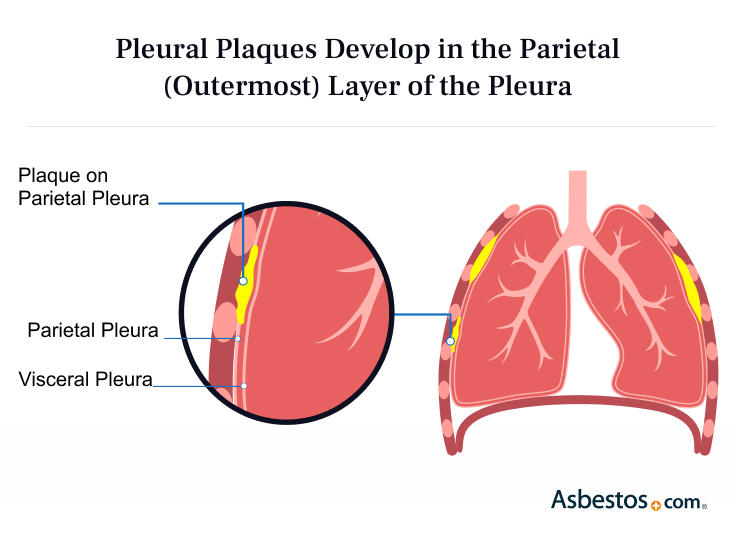
Pleural plaques are thick areas of tissue that form when asbestos fibers get stuck in the pleura, which is the lining around the lungs. The pleura consists of two layers: the visceral pleura (inner layer attached to the lung surface) and the parietal pleura (outer layer attached to the chest wall). Pleural plaques form almost exclusively on the parietal pleura, particularly in areas exposed to the most mechanical stress during breathing.
Key Facts About Pleural Plaques
Pleural plaques aren’t malignant. But they’re a diagnostic factor for pleural mesothelioma.
CT scans can detect pleural plaques with 95% to 100% accuracy.
Pleural plaques are usually 2 mm to 5 mm thick and form 20-30 years after exposure to asbestos.
Calcification occurs in 10-15% of pleural plaques. This makes them more visible on imaging and confirms chronic asbestos exposure.
Most people with pleural plaques don’t have symptoms and can live for years without problems, though some feel pain or a grating feeling when they breathe. Doctors also call them “hyaline pleural plaques” because they contain tissue found in cartilage. These plaques form after long-term asbestos exposure and can raise the risk of pleural mesothelioma or asbestos-related lung cancer.
“Asbestos fibers can damage tissue in a local area and cause scarring over time, and that’s called a plaque,” Sean Marchese, RN, tells us. “As plaques develop, they can cause stiffening and harder tissue on the pleura and that restricts the amount of motion that the lungs can use to expand and contract while someone’s breathing”.
Pleural plaques develop on the outermost layer of the lining around the lungs called the pleura.
How Are Pleural Plaques Caused?
Asbestos exposure causes pleural plaques. When someone breathes in asbestos fibers, the fibers collect in the lining of the lungs and irritate the tissue. The body’s immune system may also react, with special cells called pleural macrophages, adding to the damage. Pleural plaques usually show up 20 to 30 years after exposure.
These thickened areas in the pleura don’t always lead to mesothelioma. However, a 2022 study in the journal Chest found that having pleural plaques on both sides of the chest, along with nodules and fluid buildup, can be signs of mesothelioma.
500+ SPECIALISTS AVAILABLE
Get to the Right Doctor, Faster
Connect with top-rated doctors specializing in mesothelioma treatment, who will personalize treatment options based on your diagnosis.
Most people with pleural plaques don’t have symptoms, but some feel chest pain or have trouble breathing. These problems often come from asbestos exposure and the harm it causes to the lungs. Sometimes, pleural plaques show up along with other asbestos-related diseases like mesothelioma.
Symptoms of Pleural Plaques
Chronic coughing
Coughing up blood
Trouble breathing
Pleural plaques aren’t as serious as mesothelioma, but they can show that someone had a lot of asbestos exposure. When doctors check breathing problems with imaging scans, they may find pleural plaques or pleural thickening.
How Are Pleural Plaques Diagnosed?
Doctors use imaging scans like X-rays and CT scans to find pleural plaques. Each scan works differently to show if plaques are in the lining of the lungs.
Common Imaging Tests
CT Scans: A CT scan is the most accurate test for diagnosing pleural plaques. It’s 95% to 100% correct. The test can reveal plaques anywhere in the chest, even if they’re not calcified.
X-rays: X-rays may show calcified pleural plaques, but they often miss non-calcified plaques. This is especially true in harder-to-see areas like the mediastinum or anterior chest wall. Plaques may show an incomplete border sign (sharp inner edge, hazy outer edge). CT scans are more sensitive for subtle plaques.
These imaging scans can also find pleural mesothelioma. Doctors often discover mesothelioma or other asbestos-related diseases while checking for other conditions that cause similar symptoms.
Jack Riordan
Verified Asbestos.com Survivor
Mesothelioma Survivor Was First Diagnosed With Pleural Plaques 30 Years Ago
Jack Riordan was diagnosed 30 years ago with pleural plaques, an asbestos-related condition. When shortness of breath became an issue, he knew it might be severe. He had spent much of his career working with asbestos insulation, doing asbestos abatement and general contracting. He said of his mesothelioma diagnosis, “I knew this was a possibility a long time before.”
Doctors usually don’t treat pleural plaques right away unless they affect lung function. Pleural plaques rarely cause major pulmonary function decline, but extensive or bilateral plaques can lead to mild restrictive lung defects. Stiff pleura can limit chest wall expansion during deep breaths and reduce lung capacity. Treatment is often not needed because pleural plaques do not spread like mesothelioma tumors.
People with pleural plaques can keep their lungs healthy with some lifestyle changes. It’s important to talk to a doctor first, but these changes might help.
Lifestyle Changes to Improve Lung Function
Create and follow a healthy diet plan
Taking on a routine exercise regimen
Quit smoking
You can ask your doctor for lung function tests. These tests can help you plan the best way to make lifestyle changes.
“Unfortunately, there’s no great treatment options for pleural plaques. It’s more of a sign of an underlying disease like asbestosis or mesothelioma, that there’s damage happening to that tissue. It’s typically treated symptomatically, which means that breathing treatments or oxygen can help lower the symptoms.”
Sean Marchese, registered nurse and oncology medical writer
Common Questions About Pleural Plaques
Are pleural plaques related to cancer?
Pleural plaques are not a form of cancer, although pleural plaques and fibrous thickening may increase your risk of pleural mesothelioma and lung cancer.
Do pleural plaques increase the risk of developing lung cancer?
Yes, pleural plaques can raise the risk of developing asbestos lung cancer. This is because pleural plaques are an indication of prolonged asbestos exposure, which can cause lung cancer.
What’s the difference between pleural plaques and pleural thickening?
Pleural plaques are separate, well-defined focal areas of scarring. They form in small, localized spots on the parietal pleura. Diffuse pleural thickening, by contrast, is a continuous sheet of scarring. It covers large areas of the pleural surface and often involves the visceral pleura (the layer directly on the lung).
While both are noncancerous and caused by asbestos exposure, diffuse pleural thickening more commonly causes breathing problems. It is also more closely associated with the development of pleural mesothelioma. Pleural plaques are generally asymptomatic markers of past exposure.
Can pleural plaques lead to other lung conditions?
No, but they can raise the risk of more dangerous asbestos-related conditions like mesothelioma, asbestosis and asbestos-lung cancer.
Find a Specialist Near You
Begin your search for a doctor in your area.
Get started by selecting location, type, specialty or language.
Recommended Reading
Your web browser is no longer supported by Microsoft. Update your browser for more security, speed and compatibility.
If you are looking for mesothelioma support, please contact our Patient Advocates at (855) 404-4592
Fact Checked
Our fact-checking process begins with a thorough review of all sources to ensure they are high quality. Then we cross-check the facts with original medical or scientific reports published by those sources, or we validate the facts with reputable news organizations, medical and scientific experts and other health experts. Each page includes all sources for full transparency.
Reviewed
Asbestos.com is the nation’s most trusted mesothelioma resource
The Mesothelioma Center at Asbestos.com has provided patients and their loved ones the most updated and reliable information on mesothelioma and asbestos exposure since 2006.
Our team of Patient Advocates includes a medical doctor, a registered nurse, health services administrators, veterans, VA-accredited Claims Agents, an oncology patient navigator and hospice care expert. Their combined expertise means we help any mesothelioma patient or loved one through every step of their cancer journey.
More than 30 contributors, including mesothelioma doctors, survivors, health care professionals and other experts, have peer-reviewed our website and written unique research-driven articles to ensure you get the highest-quality medical and health information.
About The Mesothelioma Center at Asbestos.com
Assisting mesothelioma patients and their loved ones since 2006.
Helps more than 50% of mesothelioma patients diagnosed annually in the U.S.
A+ rating from the Better Business Bureau.
5-star reviewed mesothelioma and support organization.
My family has only the highest compliment for the assistance and support that we received from The Mesothelioma Center. This is a staff of compassionate and knowledgeable individuals who respect what your family is experiencing and who go the extra mile to make an unfortunate diagnosis less stressful. Information and assistance were provided by The Mesothelioma Center at no cost to our family.
Asbestos.com. (2026, February 13). Pleural Plaques and Asbestos. Retrieved May 15, 2026, from https://www.asbestos.com/mesothelioma/pleural-plaques/
MLA
"Pleural Plaques and Asbestos." Asbestos.com, 13 Feb 2026, https://www.asbestos.com/mesothelioma/pleural-plaques/.
Chicago
Asbestos.com. "Pleural Plaques and Asbestos." Last modified February 13, 2026. https://www.asbestos.com/mesothelioma/pleural-plaques/.
The Patient Advocates are absolutely amazing and helpful! I am so very pleased with the information and the emotional support that I have received from everyone! When I felt all hope was lost, Amy gave me great information and was so compassionate. I do not feel alone, and I know there is strong support for anyone dealing with this tragic disease. I received a FREE information package, including a recipe book, information on the disease, a toll-free number to contact for assistance, and a book with the answers to 100 questions that are commonly asked. This information alone was worth my time! I read for hours and hours, and just that alone—knowledge—can be a great comfort. To fully understand this disease, to just have the knowledge!!! Thank you all!! Thank you so, so much.
I found out about The Mesothelioma Center while researching peritoneal mesothelioma days after being diagnosed with the malignant cancer. While a lot of the 'Mesothelioma' websites are actually law firms just trying to get your business, theirs is a user-friendly, comprehensive website set up to aid patients, their loved ones, and/or caregivers with all things related to a cancer diagnosis from asbestos exposure. I was soon put in touch with one of their doctors, Snehal Smart, M.D., who immediately sent me a packet of general information, a book on surviving mesothelioma, and offered me assistance in finding doctors, reputable law firms, financial help, support groups, and so much more! The Mesothelioma Center's website is, in my opinion, the best resource for anyone suffering from cancer due to asbestos. Dr. Smart is amazing! She is very knowledgeable and helpful, but she is also a very kind, caring doctor who goes the distance whether she is researching a pertinent topic, making suggestions, providing contacts, or just being a good listener on the other end of the phone. In addition, Dr. Smart referred me to a law firm who is now fighting to get me compensation for the negligence of those defendants whose products exposed me to asbestos and caused my subsequent cancer. Thank you, TMC and Dr. Smart, for helping me determine the best treatment plan for my cancer and being part of my miracle. I am currently cancer-free and back to being a mom to my precious daughter. The Mesothelioma Center, their website, and their staff rock!!
I reached out and talked to Aaron a couple of weeks before my diagnosis of malignant mesothelioma. He was very helpful and gave me a lot of information at that time. I have talked to him several times since and always gotten my questions answered. Aaron is very knowledgeable and has been very helpful and supportive. He also sent me a comprehensive packet of information, including info on nutrition, legal help, and medical resources.
My brother was recently diagnosed with mesothelioma. I began researching it online. The information I received from The Mesothelioma Center is all-inclusive. No need to look anywhere else! The first phone call was with Karen, and she answered all my questions with ease. She also had a calming effect by presenting all the options available for my brother and his family. Thank you!
My Dad was diagnosed with mesothelioma, and thankfully The Mesothelioma Center was the first place I called. Snehal Smart answered the phone immediately and was very helpful. She immediately sent us an information packet and answered questions. She followed up each week to see how things were going and if we had any questions. She also connected us with a lawyer. I highly recommend this Center.
Dr. Raja Flores is chairman of the Department of Thoracic Surgery at Mount Sinai Hospital and a professor of surgery at the Icahn School of Medicine in New York City. He is a world leader in the treatment of pleural mesothelioma.
Fact-checked and verified content:
Our fact-checking process begins with a thorough review of all sources to ensure they are high quality. Then we cross-check the facts with original medical or scientific reports published by those sources, or we validate the facts with reputable news organizations, medical and scientific experts and other health experts. Each page includes all sources for full transparency.
Please read our editorial guidelines to learn more about our content creation and review process.