Stage 1 mesothelioma is the earliest stage of the cancer and has the most treatment options. The tumor is localized in the patient's chest or abdomen lining and symptoms are mild, often mistaken for other illnesses. If identified, timely treatment can improve patients’ prognosis and quality of life.
Learn more about mesothelioma, asbestos and the steps you can take to fight this disease.
Sean Marchese: The difference between a late-stage and an early-stage mesothelioma diagnosis
The prognosis for someone with early stage mesothelioma is the best for any patient that will have been diagnosed with the disease. Early stage mesothelioma patients have the best treatment options, including surgery. And they have the longest survivability, usually one to two years or beyond.
Sean Marchese: The difference between a late-stage and an early-stage mesothelioma diagnosis
The prognosis for someone with early stage mesothelioma is the best for any patient that will have been diagnosed with the disease. Early stage mesothelioma patients have the best treatment options, including surgery. And they have the longest survivability, usually one to two years or beyond.
“The prognosis for someone with early-stage mesothelioma is the best for any patient who has been diagnosed with the disease. Early-stage mesothelioma patients have the best treatment options, including surgery. And they have the longest survivability, usually 1 to 2 years or beyond.”
Sean Marchese, registered nurse and oncology medical writer
“The earlier a patient gets diagnosed with mesothelioma, when the tumor has not gone to lymph nodes or hasn’t gone to other organs, the more the patient has options in terms of treatment and the better the prognosis.”
Dr. Jacques Fontaine, director of the Mesothelioma Research and Treatment Center at Moffitt Cancer Center
“Any time you move, you cough, you laugh, you bend over or you get in a car with an active case of pleurisy you feel pain. With pleurisy case No. 3, I presented myself to the ER. After my surgery, I was told my mesothelioma was stage 1-B. …I am not going to let mesothelioma define who I am. It might be part of my life now, but it’s not going to control me on a daily basis.”
Kevin H., pleural mesothelioma survivor
Median survival: People who get treatment live an average of 12 to 21 months, though many live much longer.
Substages: Stage 1 pleural mesothelioma splits into stage 1A and stage 1B, based on how far tumors have spread.
Survival rate: The 5-year survival rate for pleural mesothelioma is about 23%. Studies show peritoneal mesothelioma patients treated with cytoreductive surgery and HIPEC can reach 5-year survival rates of 50% or higher.
Symptoms: Most people with stage 1 mesothelioma don’t have any symptoms.
Treatment: Doctors most often combine surgery with chemo and immunotherapy in a multimodal approach.
“The prognosis for someone with early-stage mesothelioma is the best for any patient who has been diagnosed with the disease. Early-stage mesothelioma patients have the best treatment options, including surgery. And they have the longest survivability, usually 1 to 2 years or beyond.”
Sean Marchese, registered nurse and oncology medical writer
“The earlier a patient gets diagnosed with mesothelioma, when the tumor has not gone to lymph nodes or hasn’t gone to other organs, the more the patient has options in terms of treatment and the better the prognosis.”
Dr. Jacques Fontaine, director of the Mesothelioma Research and Treatment Center at Moffitt Cancer Center
“Any time you move, you cough, you laugh, you bend over or you get in a car with an active case of pleurisy you feel pain. With pleurisy case No. 3, I presented myself to the ER. After my surgery, I was told my mesothelioma was stage 1-B. …I am not going to let mesothelioma define who I am. It might be part of my life now, but it’s not going to control me on a daily basis.”
Kevin H., pleural mesothelioma survivor
Median survival: People who get treatment live an average of 12 to 21 months, though many live much longer.
Substages: Stage 1 pleural mesothelioma splits into stage 1A and stage 1B, based on how far tumors have spread.
Survival rate: The 5-year survival rate for pleural mesothelioma is about 23%. Studies show peritoneal mesothelioma patients treated with cytoreductive surgery and HIPEC can reach 5-year survival rates of 50% or higher.
Symptoms: Most people with stage 1 mesothelioma don’t have any symptoms.
Treatment: Doctors most often combine surgery with chemo and immunotherapy in a multimodal approach.
What Is Stage 1 Mesothelioma?
Stage 1 mesothelioma is the earliest stage of mesothelioma cancer. Tumors remain where they first developed, which differs for each type of mesothelioma, and haven’t spread to lymph nodes or distant organs. It’s the most treatable stage, with a 5-year survival rate of approximately 22.5% for pleural mesothelioma and up to 87% for peritoneal mesothelioma. Symptoms are often mild and easily mistaken for common conditions like the flu or a cold, which makes early detection challenging.
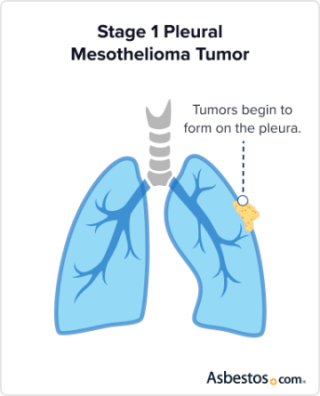
Asbestos fibers lead to tumor development on the pleural lining.
Doctors divide stage 1 pleural mesothelioma into substages based on how far tumors have spread. In stage 1A, tumors stay on one side of the lining around the lung (the pleura) and don’t involve the lung’s surface. In stage 1B, tumors have spread to the lung’s surface, diaphragm or pericardium, but still only on one side of the chest. Both substages are considered surgically treatable in eligible patients. Doctors often find stage 1A and 1B mesothelioma during imaging tests ordered for other health conditions.
There are several staging systems for evaluating cancer and tracking how far it has spread. Tumor-node-metastasis is the most commonly used system for staging pleural mesothelioma, the most common form of this cancer.
Peritoneal mesothelioma affects the lining of the abdomen and is the second most common type. Pericardial mesothelioma forms in the lining of the heart (pericardium) and testicular mesothelioma affects the lining of the testes. Both are very rare. There isn’t an official mesothelioma staging system for these cancers, but doctors generally consider them at an early stage if the cancer hasn’t spread.
I’ve kind of embraced it. I don’t feel sorry for myself. I’m not mad. I’m not sad. I’m actually very much at peace with all of this. Mesothelioma is something I have, but it’s not defining who I am.
Kevin H., pleural mesothelioma survivor
Symptoms of Stage 1 Mesothelioma
At stage 1 mesothelioma, most patients have no symptoms. When early symptoms do appear, they’re usually mild and easily mistaken for common illnesses.
For example, a 63-year-old man had shortness of breath and chest tightness. A CT scan showed pleural thickening and nodular lesions.
Case Study: Patient’s Stage 1 Mesothelioma Symptoms
Body aches
Chest pain
Chest tightness
Fever
Persistent dry cough
Shortness of breath
A biopsy confirmed the presence of lymphohistiocytoid MPM, a stage 1A mesothelioma, necessitating surgery. This followed a final diagnosis of sarcomatoid MPM, stage 1B mesothelioma. With the accurate diagnosis of the cancer, quick treatment was successful.
This patient’s symptoms mimicked other illnesses such as pneumonia, flu or lung cancer, which could easily have led to misdiagnosis. However, abnormal mass tissues in the chest area and pleural effusions on imaging tests proved otherwise. When there are common signs of a tumor forming in the chest or lung area, a biopsy can confirm the presence of mesothelioma.
FREE MESOTHELIOMA GUIDE
Expert Guidance for Your Mesothelioma Journey
Get answers about treatment, top doctors, and financial support from the nation’s most trusted mesothelioma resource.
Diagnosing stage 1 mesothelioma is difficult because early symptoms are mild and overlap with common illnesses. Doctors confirm a stage 1 diagnosis through imaging scans (CT, PET or MRI) to locate the tumor and determine the stage the cancer has advanced to and a biopsy with an expert pathologist’s report to confirm mesothelioma and the specific cell type.
People with a history of asbestos exposure are encouraged to undergo mesothelioma screening to detect any warning signs of cancer. Early diagnosis can improve treatment outcomes.
Dr. Jeffrey Velotta, a thoracic surgeon at Kaiser Permanent, shares with us, “There’s a misconception that a lot of people have, that when someone is diagnosed with mesothelioma, it’s stage 4 disease and it’s spread to multiple parts of the body. Not usually. The majority of the time it goes to one side of the chest.”
Kevin H.
Verified Asbestos.com Survivor
Repeat Pleurisy Leads to Stage 1B Mesothelioma Diagnosis
Kevin Hession experienced 4 bouts of pleurisy and underwent exploratory surgery before being diagnosed with stage 1B pleural mesothelioma in 2021. With his rare early-stage diagnosis, Kevin was able to begin chemo quickly and continues treatment today. Now he stays active and focuses on enjoying life.
Stage 1 mesothelioma treatment is the least aggressive of any stage and offers the best chance at long-term survival. The most common stage 1 treatment plan is a multimodal approach. This typically combines surgery (pleurectomy with decortication for pleural patients or cytoreduction with HIPEC for peritoneal patients) with chemotherapy and immunotherapy.
Mesothelioma treatment for stage 1 includes surgery, chemotherapy, radiation, immunotherapy and clinical trials. For better outcomes, doctors can combine approaches with multimodal therapy. This stage offers the most mesothelioma treatment options.
Stage 1 Mesothelioma Treatments
Surgery: Often the primary treatment for stage 1 mesothelioma, surgery usually removes visible tumors.
Chemotherapy: Doctors administer this treatment independently or in combination with surgery. It involves injecting drugs directly into the bloodstream or the affected area to kill the cancer cells.
Radiotherapy: Administered after surgery, radiation therapy uses high-energy X-rays to kill the cancer cell or shrink the tumor.
Immunotherapy: This type of cancer treatment boosts a person’s body’s immune system to target and destroy cancerous cells.
Multimodal therapy: This treatment combines radiation, surgery and/or chemotherapy options. A 2021 report shows that multimodal treatment may improve the life expectancy of stage 1 and stage 2 pleural mesothelioma patients.
Clinical trials: These test emerging therapies or experimental drugs to discover more effective ways to treat cancer.
The best way to treat stage 1 mesothelioma is by combining several therapies. However, various factors will influence your choice of and options for treatment. These include your overall health, age, cancer type and location of the tumor. For example, some pleural mesothelioma patients have been able to prolong their survival rate by opting for pleurectomy and decortication.
Mesothelioma specialist and thoracic surgeon Dr. Jacques Fontain told us, “When mesothelioma is limited to the chest and hasn’t spread to the lymph nodes, I usually recommend a combination of chemotherapy and surgery, and in some cases, radiation. This approach can offer the best chance at extending survival.”
Exclusive Content
Dr. Jacques Fontaine: Early-Stage vs Late-Stage Mesothelioma Treatment Options
The earlier a patient gets diagnosed with mesothelioma, when the tumor has not gone to lymph nodes or has not gone to other organs, the more the patient has options in terms of treatment and the better the prognosis.
Unfortunately, mesothelioma sometimes is a difficult diagnosis to make and patients get diagnosed when the cancer is at a later stage, stage three or stage four mesothelioma.
In those circumstances, treatment options are fewer, still exist, and we still have hope. But of course, the treatment options sometimes are fewer than if it was early stage. Specifically when it comes to surgery. Surgery can sometimes in selected patients help an early stage mesothelioma. Then later stage mesothelioma surgery should be geared towards palliating symptoms, making patients more comfortable, allowing patients to have a better quality of life rather than trying to get all the disease out. The goal of the surgery in stage three or stage four mesothelioma is to improve their quality of life.
Stage 1 Mesothelioma Prognosis and Survival Rates
The 5-year survival rate for stage 1 pleural mesothelioma is approximately 24%, according to the American Cancer Society, and patients who receive treatment live an average of 12 to 21 months. For stage 1 peritoneal mesothelioma, the 5-year survival rate is approximately 65%, and patients undergoing cytoreductive surgery with HIPEC may live longer than 5 years. Factors such as the type of mesothelioma, cell type, available treatments, age and overall health impact survival rates.
The 2025 National Comprehensive Cancer Network Guidelines explain that surgery is the primary treatment for early-stage malignant mesothelioma to achieve complete tumor removal.
Early diagnosis of stage 1 mesothelioma is critical because surgical and multimodal therapies will be more effective than in later stages.
“This is very important because these are patients that we tend to be more aggressive in multimodal treatment with because they have limited disease to the pleural lining; therefore, it’s important to know their clinical staging from the beginning.”
Dr. Jeffrey Velotta,
thoracic surgeon at Kaiser Permanente Oakland Medical Center
Commonly Asked Questions About Stage 1 Mesothelioma
How long can you live with stage 1 mesothelioma?
Stage 1 mesothelioma patients live an average of 12 to 21 months after diagnosis, though many live much longer with aggressive treatment. The 5-year survival rate is approximately 24% for pleural mesothelioma and up to 65% for peritoneal mesothelioma. Outcomes improve significantly when patients receive surgery combined with chemo or immunotherapy.
How quickly does mesothelioma progress?
Mesothelioma can be aggressive once the symptoms start showing, generally at stage 2 or stage 3, and can spread quickly. Diagnosis in an early stage can lead to treatments that control its progress and improve the patient’s prognosis.
What is the treatment for stage 1 mesothelioma?
Stage 1 mesothelioma treatment usually combines surgery with chemo or immunotherapy, an approach called multimodal therapy. Common surgeries include pleurectomy with decortication for pleural mesothelioma and cytoreduction with HIPEC for peritoneal mesothelioma. Stage 1 patients also have the broadest access to clinical trials because the cancer is still localized.
Can mesothelioma be cured if caught early?
Mesothelioma is incurable. However, patients in the first stage may manage it through the right treatments, including surgery, radiation and chemotherapy.
What does stage 1 mesothelioma feel like?
Most stage 1 mesothelioma patients feel no symptoms at all. When early symptoms appear, they’re mild and usually include shortness of breath, a persistent dry cough, mild chest or abdominal pain and unexplained fatigue. These symptoms are easily mistaken for asthma, pneumonia or general aging, which is why early diagnosis is rare.
Recommended Reading
Your web browser is no longer supported by Microsoft. Update your browser for more security, speed and compatibility.
If you are looking for mesothelioma support, please contact our Patient Advocates at (855) 404-4592
Fact Checked
Our fact-checking process begins with a thorough review of all sources to ensure they are high quality. Then we cross-check the facts with original medical or scientific reports published by those sources, or we validate the facts with reputable news organizations, medical and scientific experts and other health experts. Each page includes all sources for full transparency.
Reviewed
Asbestos.com is the nation’s most trusted mesothelioma resource
The Mesothelioma Center at Asbestos.com has provided patients and their loved ones the most updated and reliable information on mesothelioma and asbestos exposure since 2006.
Our team of Patient Advocates includes a medical doctor, a registered nurse, health services administrators, veterans, VA-accredited Claims Agents, an oncology patient navigator and hospice care expert. Their combined expertise means we help any mesothelioma patient or loved one through every step of their cancer journey.
More than 30 contributors, including mesothelioma doctors, survivors, health care professionals and other experts, have peer-reviewed our website and written unique research-driven articles to ensure you get the highest-quality medical and health information.
About The Mesothelioma Center at Asbestos.com
Assisting mesothelioma patients and their loved ones since 2006.
Helps more than 50% of mesothelioma patients diagnosed annually in the U.S.
A+ rating from the Better Business Bureau.
5-star reviewed mesothelioma and support organization.
My family has only the highest compliment for the assistance and support that we received from The Mesothelioma Center. This is a staff of compassionate and knowledgeable individuals who respect what your family is experiencing and who go the extra mile to make an unfortunate diagnosis less stressful. Information and assistance were provided by The Mesothelioma Center at no cost to our family.
Landau, D. A. (2026, August 20). Stage 1 Mesothelioma. Asbestos.com. Retrieved October 26, 2026, from https://www.asbestos.com/mesothelioma/stage-1/
MLA
Landau, Daniel A. "Stage 1 Mesothelioma." Asbestos.com, 20 Aug 2026, https://www.asbestos.com/mesothelioma/stage-1/.
Chicago
Landau, Daniel A. "Stage 1 Mesothelioma." Asbestos.com. Last modified August 20, 2026. https://www.asbestos.com/mesothelioma/stage-1/.
The Patient Advocates are absolutely amazing and helpful! I am so very pleased with the information and the emotional support that I have received from everyone! When I felt all hope was lost, Amy gave me great information and was so compassionate. I do not feel alone, and I know there is strong support for anyone dealing with this tragic disease. I received a FREE information package, including a recipe book, information on the disease, a toll-free number to contact for assistance, and a book with the answers to 100 questions that are commonly asked. This information alone was worth my time! I read for hours and hours, and just that alone—knowledge—can be a great comfort. To fully understand this disease, to just have the knowledge!!! Thank you all!! Thank you so, so much.
I found out about The Mesothelioma Center while researching peritoneal mesothelioma days after being diagnosed with the malignant cancer. While a lot of the 'Mesothelioma' websites are actually law firms just trying to get your business, theirs is a user-friendly, comprehensive website set up to aid patients, their loved ones, and/or caregivers with all things related to a cancer diagnosis from asbestos exposure. I was soon put in touch with one of their doctors, Snehal Smart, M.D., who immediately sent me a packet of general information, a book on surviving mesothelioma, and offered me assistance in finding doctors, reputable law firms, financial help, support groups, and so much more! The Mesothelioma Center's website is, in my opinion, the best resource for anyone suffering from cancer due to asbestos. Dr. Smart is amazing! She is very knowledgeable and helpful, but she is also a very kind, caring doctor who goes the distance whether she is researching a pertinent topic, making suggestions, providing contacts, or just being a good listener on the other end of the phone. In addition, Dr. Smart referred me to a law firm who is now fighting to get me compensation for the negligence of those defendants whose products exposed me to asbestos and caused my subsequent cancer. Thank you, TMC and Dr. Smart, for helping me determine the best treatment plan for my cancer and being part of my miracle. I am currently cancer-free and back to being a mom to my precious daughter. The Mesothelioma Center, their website, and their staff rock!!
I reached out and talked to Aaron a couple of weeks before my diagnosis of malignant mesothelioma. He was very helpful and gave me a lot of information at that time. I have talked to him several times since and always gotten my questions answered. Aaron is very knowledgeable and has been very helpful and supportive. He also sent me a comprehensive packet of information, including info on nutrition, legal help, and medical resources.
My brother was recently diagnosed with mesothelioma. I began researching it online. The information I received from The Mesothelioma Center is all-inclusive. No need to look anywhere else! The first phone call was with Karen, and she answered all my questions with ease. She also had a calming effect by presenting all the options available for my brother and his family. Thank you!
My Dad was diagnosed with mesothelioma, and thankfully The Mesothelioma Center was the first place I called. Snehal Smart answered the phone immediately and was very helpful. She immediately sent us an information packet and answered questions. She followed up each week to see how things were going and if we had any questions. She also connected us with a lawyer. I highly recommend this Center.
Dr. Jacques Fontaine is a thoracic surgeon at Moffitt Cancer Center in Tampa, Florida, where he heads up the Mesothelioma Research and Treatment Center. He specializes in minimally invasive robotic surgery and aggressive surgeries for mesothelioma.
Fact-checked and verified content:
Our fact-checking process begins with a thorough review of all sources to ensure they are high quality. Then we cross-check the facts with original medical or scientific reports published by those sources, or we validate the facts with reputable news organizations, medical and scientific experts and other health experts. Each page includes all sources for full transparency.
Please read our editorial guidelines to learn more about our content creation and review process.