Hair dryers used by hairdressers often contained asbestos, which was used to insulate the appliance through the late 1970s. Hair dryers containing asbestos, including hand-held and hood varieties, made up 90% of annual U.S. hair dryer sales. Hairdressers were also exposed to asbestos-contaminated talc.
Quick Facts About Hairdressers and Asbestos Exposure
Asbestos-Related Disease Risk:
Low
States with Highest Employment:
California, Texas, Florida, New York, Pennsylvania
How Are Hairdressers Exposed to Asbestos?
Few people would ever associate hairdressing with occupational asbestos exposure. In the past, these workers handled hair dryers that contained asbestos insulation. Barbers and hairdressers were also exposed to asbestos-contaminated talcum powder. Repeated use of these products increased their risk of developing asbestos-related diseases.
By 1980, hair dryer manufacturers voluntarily stopped making dryers with asbestos insulation. Now that manufacturers using asbestos in products no longer produce asbestos-insulated dryers, today’s hairdressers have a much lower occupational exposure risk. Hairdressers should be cautious of older equipment that is still in use. One 2006 survey found that approximately 25% of hood-style hairdryers in U.K. salons were older models that contained asbestos. Many of the manufacturers that supply U.K. salons also supply U.S. salons, so the risk could be comparable among older salons in the United States.
While hair dryers are no longer made with asbestos, recent tests show asbestos continues to contaminate certain brands of talcum powder.
Lombardy Mesothelioma Center Occupational Risk Research
Researchers at the Lombardy Mesothelioma Registry in Italy tracked 2,989 mesothelioma cases from 2000 to 2009 and found 30 cases in hairdressers.
The researchers found occupational asbestos exposure in hairdressers is:
Likely if the hairdresser worked with a dryer model that was known to contain asbestos
Possible if they worked with unidentified dryers at least one year before asbestos was banned
Unknown if they were a hairdresser for less than a year or worked primarily as a “head-washer”
“Hairdryers are possible sources of asbestos exposure in patients with mesothelioma, and the asbestos exposure risk is higher for those who use hairdryers occupationally,” the study concluded.
Asbestos Products Associated with Hairdressers
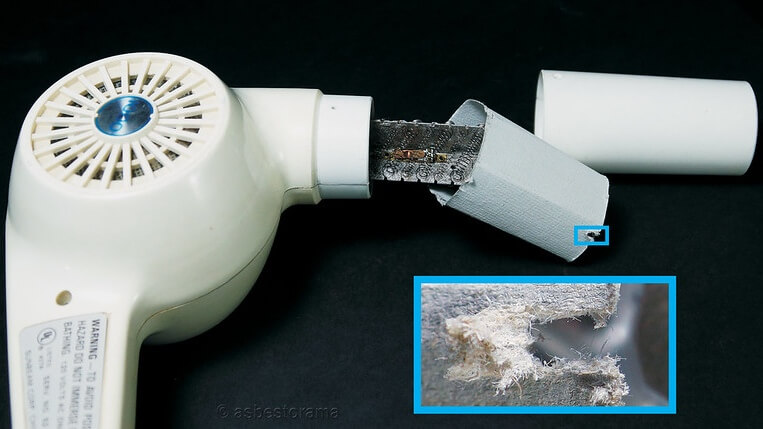
Asbestos paper insulation was used in some hair dryers.
Some of the tools that hairdressers worked with daily – hand-held hair dryers and hood-style hair dryers – once contained dangerous levels of asbestos. As with most other asbestos-containing products, the hair dryers contained asbestos to protect the internal parts from overheating and catching fire. Barbers and hairdressers were also exposed to asbestos-contaminated talcum powder.
Hairdressers were exposed to the following asbestos-contaminated products:
Asbestos-Contaminated Talcum Powder
Barbers and hairdressers use talcum powder to absorb moisture, calm irritations and easily brush cut hairs from the back of the neck. Some brands of talcum powder have been found to be contaminated with asbestos, including Johnson’s Baby Powder and Clubman brand talcum powder.
Asbestos insulation is shown in the air exhaust nozzle of this old hair dryer.
Hand-Held Hair Dryers
It is estimated that at one point, up to five million asbestos-containing hand-held dryers were in circulation. These dryers came from several different manufacturers, including Conair and Remington, and they made up approximately 90% of all annual domestic hair dryer sales.
In 1979, when the U.S. Consumer Product Safety Commission found that dryers from 11 major brands contained dangerous amounts of asbestos, each of the manufacturers issued a voluntary refund and return policy for the contaminated equipment. They all then discontinued production of asbestos-insulated dryers.
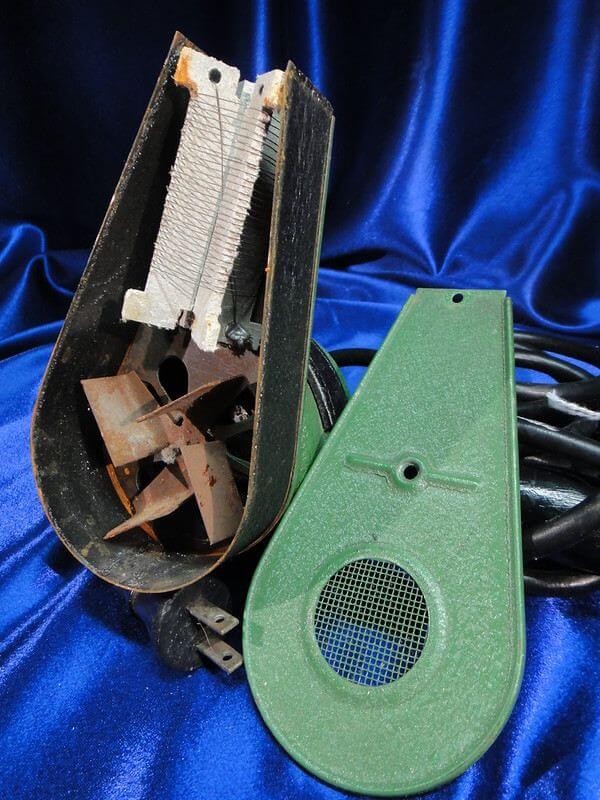
Hood-Style Hair Dryers
Hood-style (or bonnet-style) dryers from brands such as La Reine and Suter Avante also contained asbestos. Most hood hair dryers contained a simple layer of asbestos insulation along the internal heating element. In some brands, however, there was also a string of pure chrysotile asbestos that supported the heating element.
Manufacturers Who Made Products Hairdressers Used
Well-known brands, including Conair and Johnson & Johnson, have manufactured asbestos-contaminated hair dryers or talcum powder used by barbers and hairdressers.
The following manufacturers produced asbestos-containing hair dryers:
Conair
General Electric
Gillette
Indola
J.C. Penney
Korvettes
La Reine
Montgomery Ward
North American Philips Corp. (Norelco)
Remington
Salon Nelson
Schick
Schwarzkopf
Scovill
Hamilton Beach/Dominion
Regal
Sears
Sunbeam
Suter Avante
Wella
Certain manufacturers, including La Reine, Suter Avante and Regal, made asbestos-containing hooded dryers.
Several studies have found an increase in cancers (including but not limited to mesothelioma) among hairdressers, yet others failed to find a significant association. More studies have focused on the actual asbestos exposure hazards that hairdressers faced – or still face.
A 2015 case report published in the International Journal of Occupational Health described a case of peritoneal mesothelioma in a cosmetologist who used asbestos-containing hair dryers daily for work from the mid-1970s to the mid-1980s.
In 2009, in a scientific review of more than 240 studies, researchers found a 30% increase in lung cancer among hairdressers.
One research project, published in 2006, looked at the asbestos emissions that occurred during an hour of hooded hair dryer operation. Researchers found small, yet statistically insignificant asbestos emission counts below the control limit of 0.3 f/ml. They warned that they tested dryers in good condition but that older hair dryers with more friable asbestos may pose a higher exposure threat. They also encouraged salon owners to implement adequate safety measures when using dryers.
Mesothelioma is almost exclusively caused by exposure to asbestos. Asbestos exposure also causes lung cancer, laryngeal cancer, ovarian cancer and asbestosis. According to a 2022 report by the European Commission, over 70,000 workers died in 2019 from past exposure to asbestos.
If you worked as a hairdresser and develop pulmonary or digestive problems, tell your doctor about your asbestos exposure risk and request a cancer screening. Diagnosing these conditions early improves treatment outcomes. It’s also important to seek medical care from a doctor specializing in mesothelioma so you can access the latest treatments and clinical trials.
$30B+ IN TRUST FUNDS AVAILABLE
Find the Right Attorney for You
When filing a mesothelioma claim, the right legal representation is everything. We’ll connect you to a top lawyer who will help you secure financial compensation.
Legal Options for Hairdressers Exposed to Asbestos
Hair dryer manufacturers, including Conair and Korvette, have been named in asbestos lawsuits. And makers of talcum powder, including Johnson & Johnson, have been sued by barbers and hairdressers.
In July 2020, a New York judge allowed a mesothelioma talc lawsuit involving a barber to proceed after defendant Whittaker, Clark and Daniels requested to be released from the suit. After Vincent Luca died of mesothelioma, his surviving family members filed a wrongful death lawsuit against the talc supplier claiming its asbestos-contaminated talc caused Luca to develop the cancer. The outcome of the case is not published.
One California hairdresser, Genevieve Gunderson, filed an asbestos lawsuit in the early 2000s. The hairdresser also experienced secondhand exposure when she washed her husband’s asbestos-contaminated clothing. The San Francisco jury who heard her case awarded her $11.5 million in 2002 for lost income, medical expenses and pain and suffering.
Another lawsuit involved the wife of a hairdresser and truck driver. The woman, Ardyce Riggs, was a customer service worker and housewife who attributed her disease to secondhand exposure from her hairdresser husband. Riggs filed her suit in March 2012 and the outcome is unknown.
If you’ve been diagnosed with mesothelioma, it is important to find a mesothelioma lawyer to review your case and advise whether you qualify to file multiple legal claims with asbestos trust funds, in addition to a lawsuit.
If you’ve lost a loved one to mesothelioma, you are eligible to file a wrongful death lawsuit seeking compensation to cover medical expenses, lost wages and funeral costs.
Recommended Reading
Your web browser is no longer supported by Microsoft. Update your browser for more security, speed and compatibility.
If you are looking for mesothelioma support, please contact our Patient Advocates at (855) 404-4592
Fact Checked
Our fact-checking process begins with a thorough review of all sources to ensure they are high quality. Then we cross-check the facts with original medical or scientific reports published by those sources, or we validate the facts with reputable news organizations, medical and scientific experts and other health experts. Each page includes all sources for full transparency.
Reviewed
Asbestos.com is the nation’s most trusted mesothelioma resource
The Mesothelioma Center at Asbestos.com has provided patients and their loved ones the most updated and reliable information on mesothelioma and asbestos exposure since 2006.
Our team of Patient Advocates includes a medical doctor, a registered nurse, health services administrators, veterans, VA-accredited Claims Agents, an oncology patient navigator and hospice care expert. Their combined expertise means we help any mesothelioma patient or loved one through every step of their cancer journey.
More than 30 contributors, including mesothelioma doctors, survivors, health care professionals and other experts, have peer-reviewed our website and written unique research-driven articles to ensure you get the highest-quality medical and health information.
About The Mesothelioma Center at Asbestos.com
Assisting mesothelioma patients and their loved ones since 2006.
Helps more than 50% of mesothelioma patients diagnosed annually in the U.S.
A+ rating from the Better Business Bureau.
5-star reviewed mesothelioma and support organization.
My family has only the highest compliment for the assistance and support that we received from The Mesothelioma Center. This is a staff of compassionate and knowledgeable individuals who respect what your family is experiencing and who go the extra mile to make an unfortunate diagnosis less stressful. Information and assistance were provided by The Mesothelioma Center at no cost to our family.
Whitmer, M. (2026, February 12). Hairdressers and Asbestos Exposure. Asbestos.com. Retrieved October 15, 2026, from https://www.asbestos.com/occupations/hairdressers/
MLA
Whitmer, Michelle. "Hairdressers and Asbestos Exposure." Asbestos.com, 12 Feb 2026, https://www.asbestos.com/occupations/hairdressers/.
Chicago
Whitmer, Michelle. "Hairdressers and Asbestos Exposure." Asbestos.com. Last modified February 12, 2026. https://www.asbestos.com/occupations/hairdressers/.
My primary support since being diagnosed with Mesothelioma, over 2 years ago, has been this company. Their monthly nationwide support group has been a tremendous help for me. I have learned about others' treatments and have been able to freely discuss mine, knowing others walk the same walk as I do and fully understand. Karen Selby, the nurse and patient advocate, has helped me so much. I call her and she delivers. She's experienced in Thoracic surgeries, is supportive, kind, knowledgeable, and makes a patient feel very cared for! The whole staff are polite, caring, and will help with Mesothelioma victims' many needs. I feel very blessed to have this Organization by my side as I live with this cancer.
I found out about The Mesothelioma Center while researching Peritoneal Mesothelioma days after being diagnosed with malignant cancer. While a lot of the 'Mesothelioma' websites are actually law firms just trying to get your business, theirs is a user-friendly, comprehensive website set up to aid patients, their loved ones, and/or caregivers with all things related to a cancer diagnosis from asbestos exposure. I was soon put in touch with one of their doctors, Snehal Smart, M.D., who immediately sent me a packet of general information, a book on surviving Mesothelioma, and offered me assistance in finding doctors, reputable law firms, financial help, support groups, and so much more! The Mesothelioma Center's website is, in my opinion, the best resource for anyone suffering from cancer due to asbestos. Dr. Smart is amazing! She is very knowledgeable and helpful, but she is also a very kind, caring doctor who appears to go the distance whether she is researching a pertinent topic, making suggestions, providing contacts, or just being a good listener on the other end of the phone. In addition, Dr. Smart referred me to a law firm who is now fighting to get me compensation for the negligence of those defendants whose products exposed me to asbestos and caused my subsequent cancer. Thank you, TMC and Dr. Smart, for helping me determine the best treatment plan for my cancer and being part of my miracle. I am currently cancer-free and back to being a mom to my precious daughter. The Mesothelioma Center, their website, and their staff rock!!
I just want to take this time to thank Mesothelioma Center for all the information you provide. The survival stories are inspiring and give hope where hope is needed! Thanks to you, I have met many others on the site and continue to converse with them. Keep up the good work. I am always looking forward to your posts! Thank you, Richard Delisle.
My brother was recently diagnosed with mesothelioma. I began researching it online. The information I received from The Mesothelioma Center is all-inclusive. No need to look anywhere else! The first phone call was with Karen, and she answered all my questions with ease. She also had a calming effect by presenting all the options available for my brother and his family. Thank you!
My father was recently diagnosed with mesothelioma. We, as a family, were devastated. We were uncertain where to even start, so we reached out to The Mesothelioma Center. They were absolutely amazing. They provided physicians in our area who specialize in this type of cancer because it is so rare. They also set us up with a firm who specializes in getting funds that are set aside to help with our medical bills. I’m so glad we made the phone call. They were very knowledgeable, supportive, sincere, and true patient advocates.
Michelle Whitmer has covered science and medicine for Asbestos.com for more than 15 years. She has been featured in multiplatform media, including The New York Times and KYW Newsradio. Whitmer is pursuing American Medical Writers Association certification, has completed OSHA Asbestos Standard for the Construction Industry training and is CDC certified in Health Literacy.
Fact-checked and verified content:
Our fact-checking process begins with a thorough review of all sources to ensure they are high quality. Then we cross-check the facts with original medical or scientific reports published by those sources, or we validate the facts with reputable news organizations, medical and scientific experts and other health experts. Each page includes all sources for full transparency.
Please read our editorial guidelines to learn more about our content creation and review process.