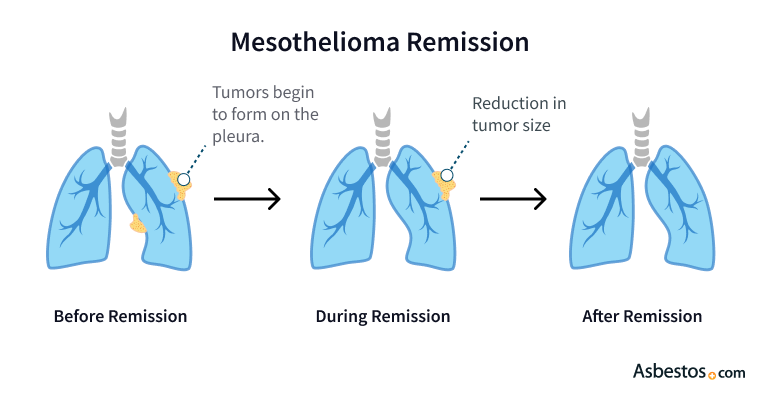
Mesothelioma remission means tumors and symptoms have decreased for at least one month. Mesothelioma recurrence is defined as a return of cancer after treatment and remission, and it is common for this type of cancer. Anti-cancer therapies help control recurrences.
Learn more about mesothelioma, asbestos and the steps you can take to fight this disease.
Dr. Andrea Wolf: Describe mesothelioma remission and recurrence.
Remission or even it's somewhat related term pure are difficult concepts in mesothelioma because pleural mesothelioma is very hard to eradicate entire early, even with some of the most extensive surgeries we do. What we find are there still circulating tumor DNA. There's still, sort of equilibrium that the body is reaching where things stay under check, but it does tend to recur.
It's sort of more common than not recurring. And so remission, I encourage patients to sort of think of this as, okay, they are done with treatment, and they're under very tight surveillance, and not to be afraid of the, shoe dropping, so to speak, not to live in fear of it recurring, but to recognize that there are diseases that can become chronic, but that they can still live with, such as heart disease, diabetes, even HIV, which historically, years ago, had been considered a fatal disease, is now considered not a life limiting disease as long as patients are under treatment and or surveillance. So what remission in mesothelioma looks like is a patient who's feeling well, doing well, not having evidence of disease on their scans, but is who is still under very close watch and recognizing that for long as they feel well and are doing well, they should live and re and know that anything that does come up will be detected early enough that interventions can be done, and they can still enjoy a long term good quality survival.
Dr. Andrea Wolf: Describe mesothelioma remission and recurrence.
Remission or even it's somewhat related term pure are difficult concepts in mesothelioma because pleural mesothelioma is very hard to eradicate entire early, even with some of the most extensive surgeries we do. What we find are there still circulating tumor DNA. There's still, sort of equilibrium that the body is reaching where things stay under check, but it does tend to recur.
It's sort of more common than not recurring. And so remission, I encourage patients to sort of think of this as, okay, they are done with treatment, and they're under very tight surveillance, and not to be afraid of the, shoe dropping, so to speak, not to live in fear of it recurring, but to recognize that there are diseases that can become chronic, but that they can still live with, such as heart disease, diabetes, even HIV, which historically, years ago, had been considered a fatal disease, is now considered not a life limiting disease as long as patients are under treatment and or surveillance. So what remission in mesothelioma looks like is a patient who's feeling well, doing well, not having evidence of disease on their scans, but is who is still under very close watch and recognizing that for long as they feel well and are doing well, they should live and re and know that anything that does come up will be detected early enough that interventions can be done, and they can still enjoy a long term good quality survival.
What Is Mesothelioma Remission?
Mesothelioma remission means the cancer tumors have decreased in size by at least half or more. It marks a significant, positive turn in your overall health. It may mean you can reduce or temporarily stop treatment. Some patients may be able to go on some form of maintenance therapy.
Remission can bring considerable emotional and physical relief after aggressive treatments. It can also inspire real hope for patients and their families.
The two types of remission include partial and complete remission. Doctors usually measure partial remission as at least a 50% reduction in tumor size. Complete remission indicates all signs of measurable cancer have disappeared. It’s rare with mesothelioma and not fully understood, but it is possible.
While mesothelioma can go into remission, recurrence often follows. Second-line treatments can help control recurrence.
As tumor mass decreases, symptoms in remission may be more manageable or eliminated altogether.
Mesothelioma survivors can live for several years in partial remission despite tumor activity. It’s something doctors must watch and can treat as a chronic but manageable condition.
Anecdotal evidence shows few survivors have lived 10-15 years or more without recurrence. This result usually stems from an early diagnosis and an aggressive treatment approach.
What Is Treatment’s Role in Mesothelioma Remission?
Treatment is essential for achieving and maintaining remission in mesothelioma. It helps to reduce or eliminate signs of the cancer and keep it from coming back. Surgery is the treatment most likely to lead to prolonged remission and improve the mesothelioma survival rate. The EPP and P/D are among the mesothelioma surgeries most likely to result in remission.
Some patients have noted partial or complete remission with other anti-cancer treatments, including systemic chemotherapy, immunotherapy, targeted therapy, and Tumor-Treating Fields.
Patients also say dietary changes, nutritional supplements and oxygen therapy helped their remission.
It is possible to recover from aggressive treatment for mesothelioma and enter remission. Some survivors have remained in remission and extended their life expectancy with mesothelioma by three to 10 years or more. About 10% of all people diagnosed with mesothelioma live longer than five years.
FREE NUTRITION GUIDE + JOURNAL
Nutrition Tips and Recipes for Mesothelioma
Access expert diet and exercise guidance designed specifically for mesothelioma patients to support treatment and overall wellness.
EPP is an extensive procedure intended to remove all visible mesothelioma tumors from the body. It extracts the affected lung and everything else at risk, such as the linings of the lung and heart. The procedure also extracts the diaphragm, which doctors later rebuild with prosthetic material.
Chemotherapy and radiation help kill the remaining cancer cells. Despite those efforts, recurrence generally happens at some point.
A 2020 Japanese study published in Oncology Letters reported most recurrences after an EPP develop three months after the procedure, compared to 20 months for another, less radical mesothelioma surgery known as pleurectomy and decortication.
What Is Pleurectomy/Decortication (P/D)?
Pleurectomy and decortication removes the lining around the lung, chest wall, heart and diaphragm. Doctors reconstruct the lining around the heart and diaphragm using mesh.
Expert Insight
Sometimes, we get stuck in the concept of having to cure cancer and don’t always understand that we can be good at controlling it. It’s much more likely to be able to control [mesothelioma], than being able to kill every last [cancer] cell. If you can do that, you can live a long time with it.
Dr. Robert Cameron, director of thoracic surgery at the Ronald Reagan UCLA Medical Center
The procedure is more tolerable than an EPP because the lung remains. But it is still an extensive surgery.
A 2020 Japanese study published in The Annals of Thoracic Surgery covering five years of data showed 63.3% of patients undergoing pleurectomy and decortication developed a recurrence an average of 19 months after surgery.
What Is Mesothelioma Recurrence?
Mesothelioma recurrence is a return of cancer after treatment. It also happens after an extended period of remission. Recurrence differs from cancer progression, which occurs when tumors grow or spread.
Despite remission, mesothelioma recurs for all patients who undergo treatment. Recurrence happens because removing or killing every cancer cell is impossible. The remaining cancer cells eventually form tumors again.
The proximity of tumors to vital organs makes it difficult to remove every cancer cell. Doctors try to delay recurrence and keep cancer cells under control for as long as possible.
How Does Mesothelioma Recurrence Occur?
Mesothelioma recurs when cancer cells survive after surgery or chemotherapy. The cancer then grows again over time. When it returns, doctors define it in three ways.
Local Recurrence
Tumors return to the same spot or close to where they were first found. This type of recurrence may be the easiest to control if tumors are small and removable with surgery.
Regional Recurrence
Tumors grow in tissues or lymph nodes near the original cancer location. If the tumors are small and limited in number, this type of recurrence may also respond well to surgery. Chemotherapy, immunotherapy, radiation therapy and targeted therapies control regional recurrences.
Distant Recurrence
Metastatic cancer has spread to tissues far from the location of the original cancer. Mesothelioma rarely spreads to distant parts of the body. Local and regional recurrence is more common. Distant recurrences may respond well to all therapies used to control regional recurrences, except for surgery.
Surgery combined with chemotherapy and radiation can delay recurrence longer than other treatments. Immunotherapy and chemotherapy are the next most effective therapies to prolong recurrence.
Are There Clinical Trials for Recurrent Mesothelioma?
Yes, researchers in clinical trials are testing new treatments for patients with recurrent mesothelioma, including new chemo and immunotherapy drugs.
Other trials research experimental therapies such as gene therapy and photodynamic therapy.
Are There Mesothelioma Survivors in Remission?
Yes, Cindy Christopher received her peritoneal mesothelioma diagnosis in 2006. She underwent extensive cytoreductive surgery and heated intraperitoneal chemotherapy (HIPEC) that same year.
“I was fortunate to find the right doctor and the right place to be. I asked questions. I did my homework,” Christopher said. “In a way, I was a guinea pig in a new protocol, and it worked. Not all cancer institutes are doing the same thing. I chose the best possible surgeon, and I told him definitively, I will be your best patient.”
Doctors diagnosed Trina Reif with peritoneal mesothelioma in 2001. Reif said recovery was challenging, but she’s proud of how far she’s come.
“I said if I could make my 20-year mark, I’d be so thrilled,” Reif said. “Every birthday is a blessing. Every year the good Lord gives me, I’m going to take.”
Recommended Reading
Your web browser is no longer supported by Microsoft. Update your browser for more security, speed and compatibility.
If you are looking for mesothelioma support, please contact our Patient Advocates at (855) 404-4592
Fact Checked
Our fact-checking process begins with a thorough review of all sources to ensure they are high quality. Then we cross-check the facts with original medical or scientific reports published by those sources, or we validate the facts with reputable news organizations, medical and scientific experts and other health experts. Each page includes all sources for full transparency.
Reviewed
Asbestos.com is the nation’s most trusted mesothelioma resource
The Mesothelioma Center at Asbestos.com has provided patients and their loved ones the most updated and reliable information on mesothelioma and asbestos exposure since 2006.
Our team of Patient Advocates includes a medical doctor, a registered nurse, health services administrators, veterans, VA-accredited Claims Agents, an oncology patient navigator and hospice care expert. Their combined expertise means we help any mesothelioma patient or loved one through every step of their cancer journey.
More than 30 contributors, including mesothelioma doctors, survivors, health care professionals and other experts, have peer-reviewed our website and written unique research-driven articles to ensure you get the highest-quality medical and health information.
About The Mesothelioma Center at Asbestos.com
Assisting mesothelioma patients and their loved ones since 2006.
Helps more than 50% of mesothelioma patients diagnosed annually in the U.S.
A+ rating from the Better Business Bureau.
5-star reviewed mesothelioma and support organization.
My family has only the highest compliment for the assistance and support that we received from The Mesothelioma Center. This is a staff of compassionate and knowledgeable individuals who respect what your family is experiencing and who go the extra mile to make an unfortunate diagnosis less stressful. Information and assistance were provided by The Mesothelioma Center at no cost to our family.
Selby, K. (2026, June 29). Mesothelioma Remission and Recurrence. Asbestos.com. Retrieved September 14, 2026, from https://www.asbestos.com/mesothelioma/remission-recurrence/
MLA
Selby, Karen. "Mesothelioma Remission and Recurrence." Asbestos.com, 29 Jun 2026, https://www.asbestos.com/mesothelioma/remission-recurrence/.
Chicago
Selby, Karen. "Mesothelioma Remission and Recurrence." Asbestos.com. Last modified June 29, 2026. https://www.asbestos.com/mesothelioma/remission-recurrence/.
The Patient Advocates are absolutely amazing and helpful! I am so very pleased with the information and the emotional support that I have received from everyone! When I felt all hope was lost, Amy gave me great information and was so compassionate. I do not feel alone, and I know there is strong support for anyone dealing with this tragic disease. I received a FREE information package, including a recipe book, information on the disease, a toll-free number to contact for assistance, and a book with the answers to 100 questions that are commonly asked. This information alone was worth my time! I read for hours and hours, and just that alone—knowledge—can be a great comfort. To fully understand this disease, to just have the knowledge!!! Thank you all!! Thank you so, so much.
I found out about The Mesothelioma Center while researching peritoneal mesothelioma days after being diagnosed with the malignant cancer. While a lot of the 'Mesothelioma' websites are actually law firms just trying to get your business, theirs is a user-friendly, comprehensive website set up to aid patients, their loved ones, and/or caregivers with all things related to a cancer diagnosis from asbestos exposure. I was soon put in touch with one of their doctors, Snehal Smart, M.D., who immediately sent me a packet of general information, a book on surviving mesothelioma, and offered me assistance in finding doctors, reputable law firms, financial help, support groups, and so much more! The Mesothelioma Center's website is, in my opinion, the best resource for anyone suffering from cancer due to asbestos. Dr. Smart is amazing! She is very knowledgeable and helpful, but she is also a very kind, caring doctor who goes the distance whether she is researching a pertinent topic, making suggestions, providing contacts, or just being a good listener on the other end of the phone. In addition, Dr. Smart referred me to a law firm who is now fighting to get me compensation for the negligence of those defendants whose products exposed me to asbestos and caused my subsequent cancer. Thank you, TMC and Dr. Smart, for helping me determine the best treatment plan for my cancer and being part of my miracle. I am currently cancer-free and back to being a mom to my precious daughter. The Mesothelioma Center, their website, and their staff rock!!
I reached out and talked to Aaron a couple of weeks before my diagnosis of malignant mesothelioma. He was very helpful and gave me a lot of information at that time. I have talked to him several times since and always gotten my questions answered. Aaron is very knowledgeable and has been very helpful and supportive. He also sent me a comprehensive packet of information, including info on nutrition, legal help, and medical resources.
My brother was recently diagnosed with mesothelioma. I began researching it online. The information I received from The Mesothelioma Center is all-inclusive. No need to look anywhere else! The first phone call was with Karen, and she answered all my questions with ease. She also had a calming effect by presenting all the options available for my brother and his family. Thank you!
My Dad was diagnosed with mesothelioma, and thankfully The Mesothelioma Center was the first place I called. Snehal Smart answered the phone immediately and was very helpful. She immediately sent us an information packet and answered questions. She followed up each week to see how things were going and if we had any questions. She also connected us with a lawyer. I highly recommend this Center.
Dr. Jacques Fontaine is a thoracic surgeon at Moffitt Cancer Center in Tampa, Florida, where he heads up the Mesothelioma Research and Treatment Center. He specializes in minimally invasive robotic surgery and aggressive surgeries for mesothelioma.
Fact-checked and verified content:
Our fact-checking process begins with a thorough review of all sources to ensure they are high quality. Then we cross-check the facts with original medical or scientific reports published by those sources, or we validate the facts with reputable news organizations, medical and scientific experts and other health experts. Each page includes all sources for full transparency.
Please read our editorial guidelines to learn more about our content creation and review process.