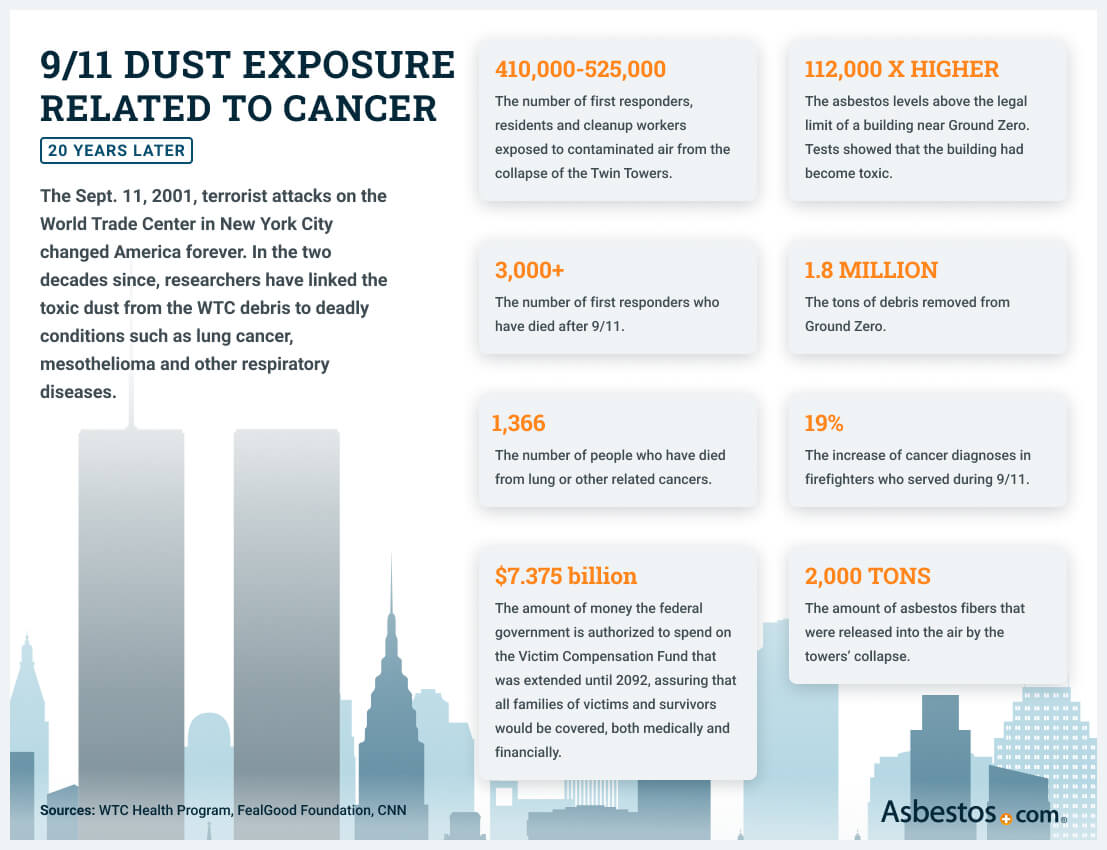
Toxic asbestos and other carcinogens flooded NYC during the September 11 attacks on the World Trade Center. First responders, survivors and residents exposed to the dust are developing health effects such as respiratory diseases and cancer.
The collapse of the twin towers on Sept. 11, 2001, released a toxic plume across lower Manhattan. It contained 400 tons of pulverized asbestos and other hazardous materials.
World Trade Center Dust Composition
50% nonfibrous construction materials
40% glass and other fibers
9.2% cellulose from disintegrated paper
0.8% asbestos
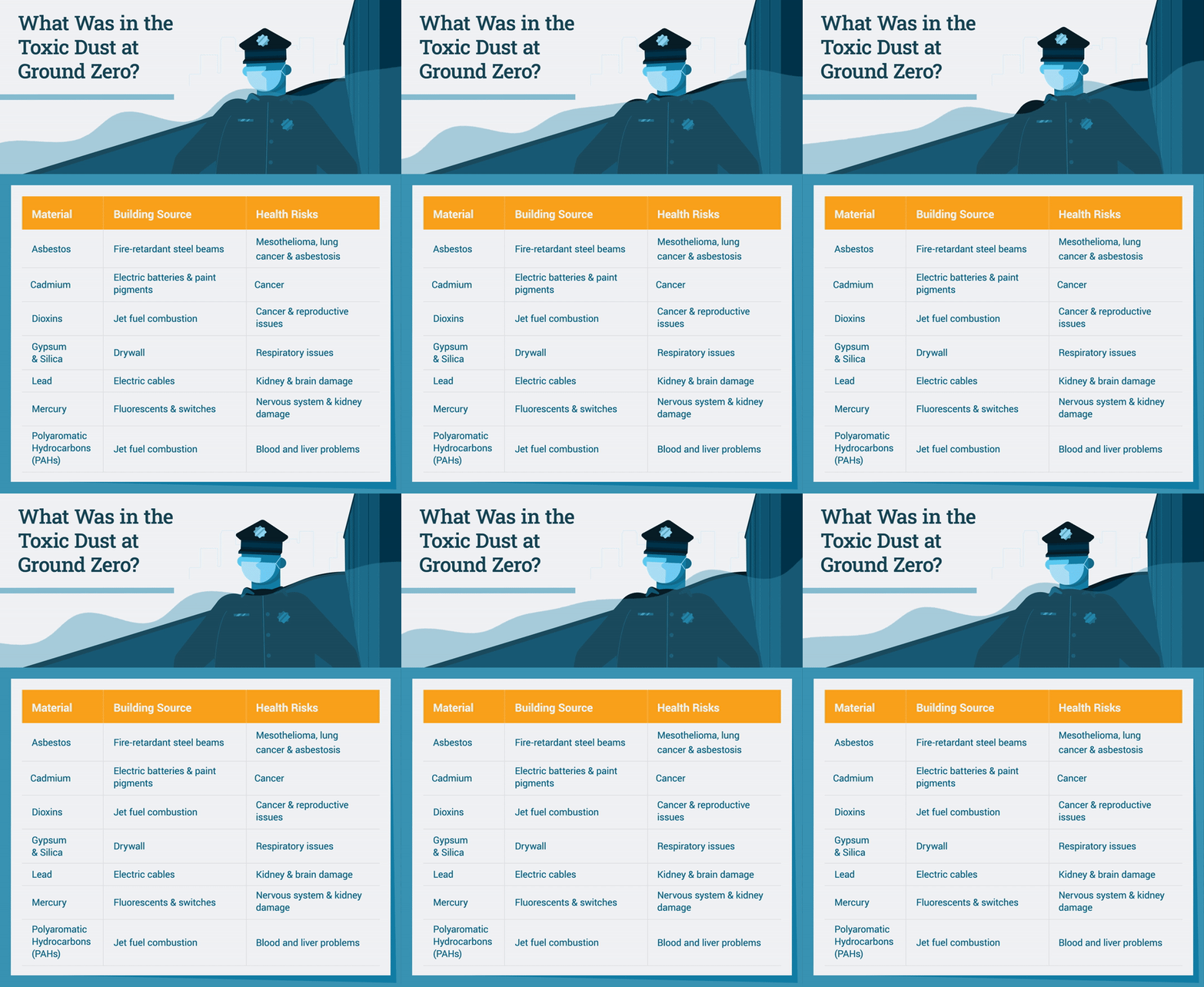
The attacks exposed an estimated 410,000 to 525,000 people to toxic dust. This number includes more than 90,000 workers involved in the rescue, recovery and cleanup efforts.The composition of the WTC dust contained pulverized glass and concrete, gypsum from drywall, asbestos fibers, steel and cellulose from paper. The intense fires that brought the towers down continued to smolder at Ground Zero until Dec. 14, 2001, over four months after the attack.
Click image to expand
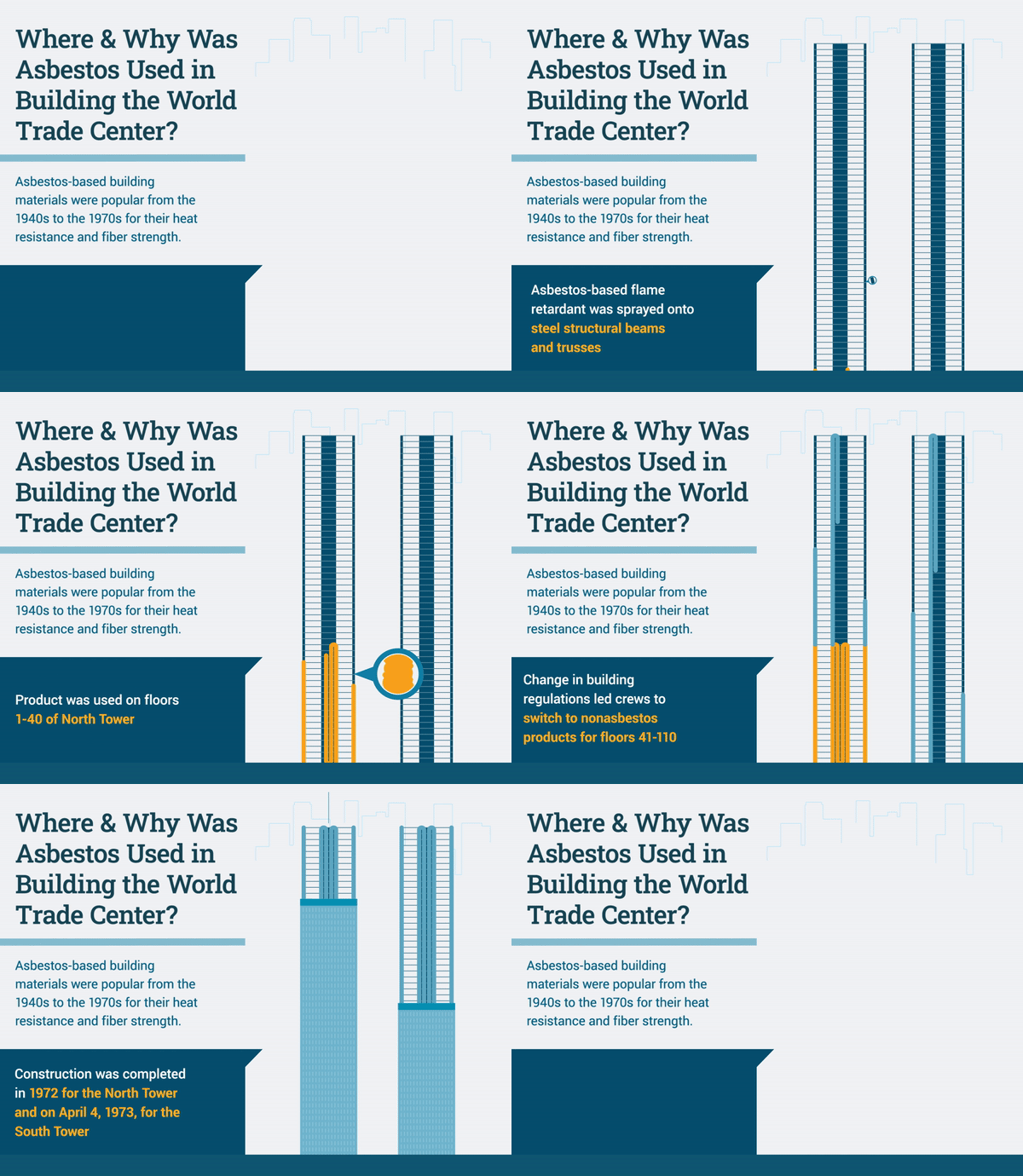
Why Was Asbestos in the World Trade Center?
During the World Trade Center construction in the late 1960s and early 1970s, developers commonly used asbestos in construction materials to strengthen and resist heat. Builders incorporated a variety of asbestos-containing products into both towers.
For example, hundreds of tons of spray-on asbestos fireproofing material was present on steel beams along the first 40 floors of the north tower. Amid construction, the builders discontinued using asbestos because of stricter regulations on the mineral.
Who Is at Risk of Health Effects?
According to the World Trade Center Health Program, anyone within a 1.5-mile radius of the center was at risk of exposure to asbestos. Other carcinogens included lead, mercury, benzene and dioxins. A 2011 study in The Lancet of firefighters exposed to this dust proved that the group is 19% more likely to develop cancer than the general population.
People Most at Risk
Cleanup workers
First responders, including firefighters and paramedics
Search and rescue workers
Survivors and residents
As of 2025, nearly 7,000 people, including firefighters, police officers, medical personnel, survivors and work crews, have died since that day as a result of their exposure, far surpassing the 2,753 who died on the day of the attacks.
Health Effects from Exposure to 9/11 Dust
The World Trade Center Health Registry tracks the health effects of 9/11 dust exposure. According to the registry, those health effects include respiratory diseases, gastrointestinal conditions, cancer and psychological conditions. By March 2024, the registry had certified these conditions among more than 132,530 responders and survivors.
2025 Health Survey Facts
15% of certified members have asthma, which can worsen with asbestos and other airborne fibers.
2,405 cases of asbestosis and other interstitial lung diseases have been certified.
25% have been diagnosed with gastroesophageal reflux disease, which has a known link to toxic dust inhalation.
27% suffer from chronic rhinosinusitis, a condition often triggered by inhaled irritants like asbestos and dust.
40% received paid medical treatment through the program in 2024.
By the end of 2024, about 30% had a cancer diagnosis, up significantly from 8% in 2007.
Over 50% of cancer certifications are in responders.
Over 577,000 medical claims were approved in 2024 alone.
The most common respiratory health effect is “World Trade Center cough syndrome.” It involves chronic rhinosinusitis, asthma and bronchitis. All of these can worsen with gastrointestinal reflux disease.
Asbestos exposure can take decades to reveal itself in the form of related cancers. The latency period for mesothelioma is 20 to 60 years, meaning that some of those exposed at Ground Zero may only now be showing symptoms of the rare form of cancer.
9/11-Related Cancers and Conditions
As of 2025, more than 44,000 people had been diagnosed with 9/11-related cancer. According to the World Trade Center Health Registry, the 10 most common cancers include:
Prostate cancer
Breast cancer
Thyroid cancer
Lung cancer
Kidney cancer
Colon cancer
Nonmelanoma skin cancer
Melanoma
Lymphoma
Leukemia
Other health effects registry reports include chronic obstructive pulmonary disease, sleep apnea, musculoskeletal syndromes, sarcoidosis (an inflammatory disease), post-traumatic stress disorder, anxiety and depression. In all, more than 63,000 people have been diagnosed with a 9/11-related health condition.
Mesothelioma and 9/11 Dust
According to mesothelioma expert Dr. Raja Flores of New York’s Mount Sinai Hospital, the number of mesothelioma cases related to 9/11 dust has been minimal, but cases will likely increase soon. A 2024 study in Annals of Case Reports described 4 cases of mesothelioma among 9/11 survivors who lived near the WTC.
“We haven’t seen many yet, but we’re going to see a very significant rise in [mesothelioma] cases,” Flores said. “What I am seeing is a lot more esophageal cancers. Would they have developed anyway? Or are they a result of all the exposure? I think exposure. The patients seem a lot younger now. It’s going to be another 30 to 40 years before all this plays out.”
In 2020, 9/11 first responder and firefighter Nick Ursta died of pleural mesothelioma. Ursta and his wife spent three days at Ground Zero while sharing a mask to protect themselves from the dust. The oncology team at the University of Pittsburgh Medical Center who treated Ursta believed his exposure to 9/11 dust caused his cancer.
In 2006, first responder and paramedic Deborah Reeve died of mesothelioma at the age of 41. She developed a severe cough not long after the attacks and was diagnosed with mesothelioma in 2003. Her doctors believed her exposure to asbestos at Ground Zero led to her cancer.
Health Safety Tips Following Exposure to 9/11 Dust
Anyone exposed to 9/11 dust should closely monitor their health. Reporting early symptoms can improve mesothelioma treatment options and survival outcomes. World Trade Center Health Program doctors have recommended health tips to those exposed to 9/11 dust.
Health Tips for 9/11 Dust Exposure
Follow through with the treatments and medications prescribed by your doctor.
Get a complete medical evaluation of your respiratory and digestive system.
Get a comprehensive mental health evaluation.
Manage chronic conditions well, which can control their severity over time.
Seek multidisciplinary treatment that addresses your physical and mental health.
Responders and survivors can get annual check-ups, benefits help and medical and mental health care for 9/11-related conditions through the World Trade Center Health Program. Veterans who worked at Ground Zero may also qualify for VA health care benefits.
Compensation for Responders and Survivors
After the 10th anniversary of the 9/11 attacks, the U.S. government created the James Zadroga 9/11 Health and Compensation Act. This law helps people who got sick due to 9/11. It builds on the Victim Compensation Fund from 2001 and allocates $8.1 billion for first responders, cleanup workers, and New York City residents who faced exposure to dust after the attacks.
Thanks to the Zadroga Act and its updates, over 19,000 responders and survivors have received money from the fund. This support is crucial for those affected by the tragic events of 9/11.
Fighting for Proper Funding
In 2025, the Trump administration twice cut funding and jobs that affected the WTC Health Program. The administration made a rare reversal of the first cut over political backlash. As of April 2025, legislators are fighting the second round of cuts to an agency that supports the program.
The fight for proper funding has been a concern for decades. The Zadroga Act initially provided compensation from 2011 to 2016. In 2015, Congress reauthorized it to offer lifetime health care for people who might get illnesses like mesothelioma from 9/11 dust. But in February 2019, the fund’s manager said there was not enough money to cover all claims. They cut pending claims by 50% and new claims by 70%.
On June 11, 2019, the former host of “The Daily Show,” Jon Stewart, testified before the House Judiciary Committee to demand additional funding. The next day, the committee passed a bill to permanently reauthorize the September 11th Victim Compensation Fund and extend it until 2092.
Tens of thousands of people exposed to 9/11 dust have developed severe respiratory conditions and several types of cancer. Many have filed lawsuits to seek compensation for asbestos exposure, alleging the dust caused their health problems.
9/11 Legal Settlements
In 2010, more than 10,000 rescue and recovery workers claiming dust-related injuries opted into a $713 million court settlement from WTC Captive Insurance Co. Inc.
Previous settlements with other defendants, including the Port Authority of New York and New Jersey, bring the total settlement awards to about $810 million.
Before 2012, the Zadroga Act offered no compensation for cancer due to the lack of evidence linking it to 9/11 dust. Cancer patients can now file claims, though they may receive lower payments if they win a 9/11 lawsuit. Because of the slow development of asbestos-related cancers, lawsuits may emerge linking these conditions to 9/11 dust.
Ongoing 9/11 Dust Research
A Molecular Cancer Research study found that 9/11 prostate cancer victims had a unique increase in a specific T-cell. Researchers concluded that 9/11 dust may trigger a prostate inflammatory response, raising cancer risk. Dr. Craig Stevens, a specialist at Beaumont Cancer Institute, predicts that asbestos-related diseases from 9/11 will peak by 2041.
“It’s hard to determine absolute risk for each person, but I expect a surge in mesothelioma and lung cancer cases to start 20 years after 9/11, peaking around 40 years after,” Stevens said. “This is a looming health issue that the public currently underestimates.”
Recommended Reading
Your web browser is no longer supported by Microsoft. Update your browser for more security, speed and compatibility.
If you are looking for mesothelioma support, please contact our Patient Advocates at (855) 404-4592
Fact Checked
Our fact-checking process begins with a thorough review of all sources to ensure they are high quality. Then we cross-check the facts with original medical or scientific reports published by those sources, or we validate the facts with reputable news organizations, medical and scientific experts and other health experts. Each page includes all sources for full transparency.
Reviewed
Asbestos.com is the nation’s most trusted mesothelioma resource
The Mesothelioma Center at Asbestos.com has provided patients and their loved ones the most updated and reliable information on mesothelioma and asbestos exposure since 2006.
Our team of Patient Advocates includes a medical doctor, a registered nurse, health services administrators, veterans, VA-accredited Claims Agents, an oncology patient navigator and hospice care expert. Their combined expertise means we help any mesothelioma patient or loved one through every step of their cancer journey.
More than 30 contributors, including mesothelioma doctors, survivors, health care professionals and other experts, have peer-reviewed our website and written unique research-driven articles to ensure you get the highest-quality medical and health information.
About The Mesothelioma Center at Asbestos.com
Assisting mesothelioma patients and their loved ones since 2006.
Helps more than 50% of mesothelioma patients diagnosed annually in the U.S.
A+ rating from the Better Business Bureau.
5-star reviewed mesothelioma and support organization.
My family has only the highest compliment for the assistance and support that we received from The Mesothelioma Center. This is a staff of compassionate and knowledgeable individuals who respect what your family is experiencing and who go the extra mile to make an unfortunate diagnosis less stressful. Information and assistance were provided by The Mesothelioma Center at no cost to our family.
Whitmer, M. (2025, April 7). Asbestos, 9/11 and the World Trade Center. Asbestos.com. Retrieved August 6, 2026, from https://www.asbestos.com/world-trade-center/
MLA
Whitmer, Michelle. "Asbestos, 9/11 and the World Trade Center." Asbestos.com, 7 Apr 2025, https://www.asbestos.com/world-trade-center/.
Chicago
Whitmer, Michelle. "Asbestos, 9/11 and the World Trade Center." Asbestos.com. Last modified April 7, 2025. https://www.asbestos.com/world-trade-center/.
My primary support since being diagnosed with Mesothelioma, over 2 years ago, has been this company. Their monthly nationwide support group has been a tremendous help for me. I have learned about others' treatments and have been able to freely discuss mine, knowing others walk the same walk as I do and fully understand. Karen Selby, the nurse and patient advocate, has helped me so much. I call her and she delivers. She's experienced in Thoracic surgeries, is supportive, kind, knowledgeable, and makes a patient feel very cared for! The whole staff are polite, caring, and will help with Mesothelioma victims' many needs. I feel very blessed to have this Organization by my side as I live with this cancer.
I found out about The Mesothelioma Center while researching Peritoneal Mesothelioma days after being diagnosed with malignant cancer. While a lot of the 'Mesothelioma' websites are actually law firms just trying to get your business, theirs is a user-friendly, comprehensive website set up to aid patients, their loved ones, and/or caregivers with all things related to a cancer diagnosis from asbestos exposure. I was soon put in touch with one of their doctors, Snehal Smart, M.D., who immediately sent me a packet of general information, a book on surviving Mesothelioma, and offered me assistance in finding doctors, reputable law firms, financial help, support groups, and so much more! The Mesothelioma Center's website is, in my opinion, the best resource for anyone suffering from cancer due to asbestos. Dr. Smart is amazing! She is very knowledgeable and helpful, but she is also a very kind, caring doctor who appears to go the distance whether she is researching a pertinent topic, making suggestions, providing contacts, or just being a good listener on the other end of the phone. In addition, Dr. Smart referred me to a law firm who is now fighting to get me compensation for the negligence of those defendants whose products exposed me to asbestos and caused my subsequent cancer. Thank you, TMC and Dr. Smart, for helping me determine the best treatment plan for my cancer and being part of my miracle. I am currently cancer-free and back to being a mom to my precious daughter. The Mesothelioma Center, their website, and their staff rock!!
I just want to take this time to thank Mesothelioma Center for all the information you provide. The survival stories are inspiring and give hope where hope is needed! Thanks to you, I have met many others on the site and continue to converse with them. Keep up the good work. I am always looking forward to your posts! Thank you, Richard Delisle.
My brother was recently diagnosed with mesothelioma. I began researching it online. The information I received from The Mesothelioma Center is all-inclusive. No need to look anywhere else! The first phone call was with Karen, and she answered all my questions with ease. She also had a calming effect by presenting all the options available for my brother and his family. Thank you!
My father was recently diagnosed with mesothelioma. We, as a family, were devastated. We were uncertain where to even start, so we reached out to The Mesothelioma Center. They were absolutely amazing. They provided physicians in our area who specialize in this type of cancer because it is so rare. They also set us up with a firm who specializes in getting funds that are set aside to help with our medical bills. I’m so glad we made the phone call. They were very knowledgeable, supportive, sincere, and true patient advocates.
An occupational scientist or another expert who specializes in occupational hazards reviewed the content on this page to ensure it meets current scientific standards and accuracy.
Arti Shukla, Ph.D., is an internationally renowned asbestos researcher known for her achievements in identifying biomarkers that cause mesothelioma. She is the director of the Shukla Research Lab, as well as a professor of pathology at The University of Vermont Larner College of Medicine.
Fact-checked and verified content:
Our fact-checking process begins with a thorough review of all sources to ensure they are high quality. Then we cross-check the facts with original medical or scientific reports published by those sources, or we validate the facts with reputable news organizations, medical and scientific experts and other health experts. Each page includes all sources for full transparency.
Please read our editorial guidelines to learn more about our content creation and review process.