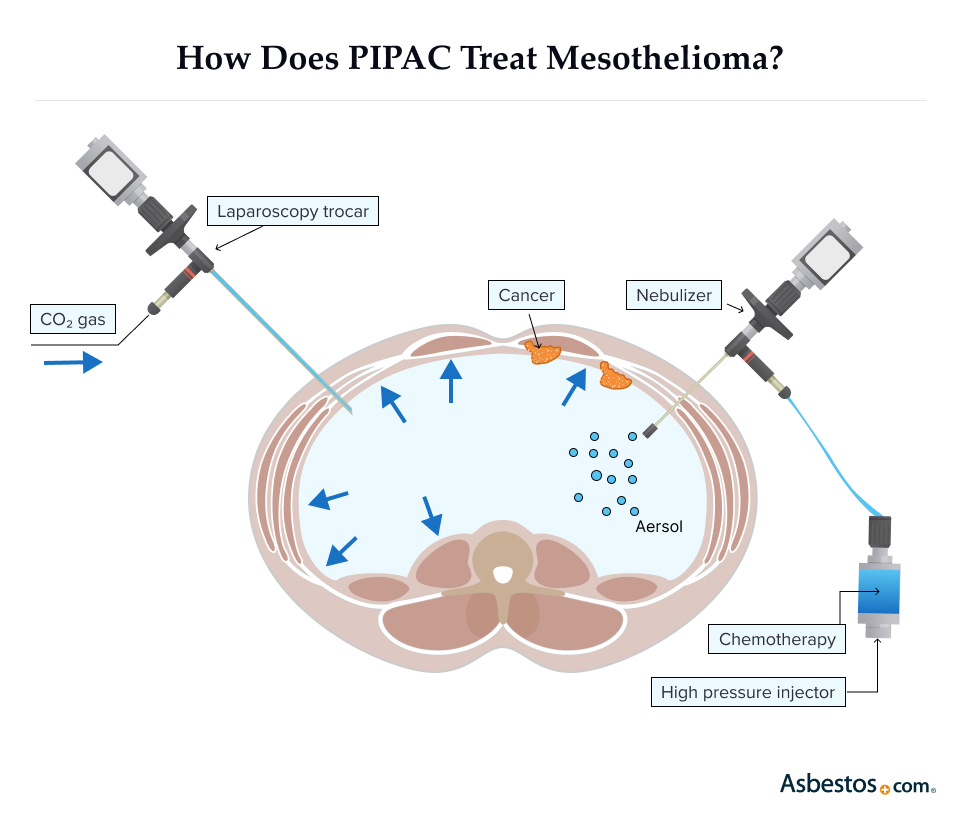
Pressurized intraperitoneal aerosolized chemotherapy is a way to deliver chemotherapy to the abdominal lining. PIPAC is different from traditional chemo because it uses pressure and turns the medicine into a mist. This may help the medicine better reach cancer cells.
Diagnosed with mesothelioma? Get a free guide to learn about the latest treatment options.
Access information on top mesothelioma treatments.
PIPAC is a mesothelioma treatment that delivers chemo directly to the abdomen using a pressurized aerosol. This means the chemo drug is turned into a fine mist.
Key Facts About PIPAC
PIPAC delivers chemo to the abdominal lining.
Chemo is turned into a mist.
PIPAC uses pressure to help the medicine spread.
PIPAC may extend survival for peritoneal mesothelioma patients.
PIPAC, which stands for pressurized intraperitoneal aerosolized chemotherapy, is a newer treatment for mesothelioma. Researchers are currently studying the new treatment to see how well it works. Doctors are hopeful PIPAC can help people with peritoneal mesothelioma. This type of mesothelioma affects the lining of the abdomen.
How Does PIPAC Treat Mesothelioma?
PIPAC for mesothelioma uses a special delivery method to treat the cancer. First, the chemo is placed directly into the abdomen. Second, a pressurized aerosol mist helps the mesothelioma chemotherapy reach more of the cancer cells.
The PIPAC procedure delivers the chemo mist throughout the abdominal cavity. This intraperitoneal chemotherapy allows the medicine to reach more of the affected areas. It may be more effective than traditional chemo for peritoneal mesothelioma.
What to Expect With PIPAC for Mesothelioma
Preparing for PIPAC is like preparing for mesothelioma surgery. You’ll undergo tests and talk to your doctors, who will tell you how to prepare. During the procedure, you’ll be asleep under anesthesia. The doctors will make small incisions in your abdomen to insert the tools needed for PIPAC.
Steps of a PIPAC Procedure
Small incisions: The surgeon makes small cuts in the abdomen.
Inserting tools: Special tools are inserted into the abdomen.
Chemotherapy delivery: The chemotherapy is turned into a mist and sprayed into the abdomen.
Absorption time: The mist is left for a certain amount of time to maximize penetration.
Closing incisions: The tools are removed, and the incisions are closed.
The delivery of chemo takes about 30 minutes. With prep, the procedure itself and post-procedure monitoring, the whole process takes about 60 to 90 minutes.
You’ll likely stay in the hospital for a few days after PIPAC. Recovery will depend on your overall health and how your body responds to the mesothelioma treatment. Your doctor will give you specific instructions for recovery.
FREE MESOTHELIOMA TREATMENT GUIDE
Expert Guidance for Your Mesothelioma Journey
Get answers about treatment, top doctors, and clinical trials from the nation’s most trusted mesothelioma resource.
PIPAC surgery offers several potential benefits for people with peritoneal mesothelioma. It’s a targeted approach that delivers chemo directly to the abdominal lining. This can potentially reduce side effects compared to traditional chemo.
Chemo is usually given through the bloodstream via an IV, which can cause whole-body or systemic side effects. Applying chemo directly allows higher doses to reach cancer cells and limits side effects in the rest of the body.
PIPAC’s Benefits for People With Mesothelioma
May reach more cancer cells than traditional chemo.
Potentially fewer side effects than traditional chemo.
May improve quality of life for some patients.
A study in BMC Cancer reported significant remission of peritoneal mesothelioma tumors in more than 51.7% of patients. About 10% of peritoneal patients went into complete remission.
These benefits may significantly improve the lives of people with mesothelioma. The success of PIPAC for mesothelioma patients is promising, offering hope for improved outcomes.
Side Effects of PIPAC
Side effects of PIPAC may include pain and fatigue. While PIPAC is designed to target mesothelioma cells, it can still affect healthy tissues.
Pressurized Intraperitoneal Aerosolized Chemo Side Effects
Abdominal pain or discomfort
Changes in bowel habits
Fatigue
Infection
Nausea and vomiting
Rare but serious side effects, such as infection, can also occur. It’s important to discuss all potential side effects with your doctor. Early detection of side effects ensures your doctor can take steps to minimize or treat them.
How to Manage Side Effects?
Your doctor will work with you to create a plan to manage any PIPEC side effects that arise. Managing side effects is an important part of PIPAC treatment.
Tips for Managing PIPAC Side Effects
Follow your doctor’s instructions carefully.
Take medications as prescribed.
Stay hydrated.
Get plenty of rest.
Eat a healthy diet.
Request anti-nausea medication if necessary.
Patients should report any side effects to their doctor promptly. Early intervention can help manage side effects more effectively.
Are You Eligible for the PIPAC Procedure?
Mesothelioma patients who are eligible for PIPAC are in relatively good overall health. PIPAC is a major procedure, and your peritoneal mesothelioma doctor will determine if you’re a good candidate.
PIPAC is still under investigation in clinical trials in the U.S. Each trial has its own rules about who can participate. These rules are called eligibility requirements. In general, you must be physically able to undergo the procedure and tolerate the chemo.
How to Receive PIPAC Treatment for Mesothelioma?
PIPAC is available through mesothelioma clinical trials. Your cancer center or a Patient Advocate can tell you about available trials in your area or nearby states. Your doctor can refer you to a mesothelioma specialist who can evaluate you for a clinical trial.
PIPAC and HIPEC deliver chemo to the abdomen in slightly different ways. HIPEC uses a liquid, while PIPAC uses an aerosol mist.
Both PIPAC and HIPEC have potential benefits and drawbacks. HIPEC for mesothelioma is a more established treatment. PIPAC is newer and is still under investigation.
Key Differences
PIPAC
HIPEC
Temperature
Room Temperature
Heated
Delivery Method
Aerosol (mist)
Liquid
Timing
Can be repeated multiple times
Typically done once during surgery
Number of Treatments
Multiple treatments may be possible
Sometimes doctors repeat the procedure
Common Questions About PIPAC
How much does PIPAC cost?
The cost of PIPAC varies. Cost depends on many factors, including where you receive treatment and your insurance coverage. Certain clinical trials may cover this new treatment. Talk to your doctor and insurance provider for more information.
Is PIPAC a cure for mesothelioma?
No, PIPAC isn’t a cure for mesothelioma. It’s a treatment that may help control this cancer and improve symptoms.
How many PIPAC sessions are needed?
The number of PIPAC sessions needed varies. Your doctor will determine the best treatment plan for you.
Does insurance cover PIPAC?
Insurance coverage for PIPAC isn’t guaranteed. Check with your insurance provider to see if it’s covered. A clinical trial may cover the cost of PIPAC.
Can PIPAC be combined with other treatments?
Yes, PIPAC may be combined with other treatments, such as surgery or traditional chemotherapy. It may also be combined with NIPEC for mesothelioma, which is another type of intraperitoneal chemo. Your doctor will decide what is best for your situation.
Recommended Reading
Your web browser is no longer supported by Microsoft. Update your browser for more security, speed and compatibility.
If you are looking for mesothelioma support, please contact our Patient Advocates at (855) 404-4592
Fact Checked
Our fact-checking process begins with a thorough review of all sources to ensure they are high quality. Then we cross-check the facts with original medical or scientific reports published by those sources, or we validate the facts with reputable news organizations, medical and scientific experts and other health experts. Each page includes all sources for full transparency.
Reviewed
Asbestos.com is the nation’s most trusted mesothelioma resource
The Mesothelioma Center at Asbestos.com has provided patients and their loved ones the most updated and reliable information on mesothelioma and asbestos exposure since 2006.
Our team of Patient Advocates includes a medical doctor, a registered nurse, health services administrators, veterans, VA-accredited Claims Agents, an oncology patient navigator and hospice care expert. Their combined expertise means we help any mesothelioma patient or loved one through every step of their cancer journey.
More than 30 contributors, including mesothelioma doctors, survivors, health care professionals and other experts, have peer-reviewed our website and written unique research-driven articles to ensure you get the highest-quality medical and health information.
About The Mesothelioma Center at Asbestos.com
Assisting mesothelioma patients and their loved ones since 2006.
Helps more than 50% of mesothelioma patients diagnosed annually in the U.S.
A+ rating from the Better Business Bureau.
5-star reviewed mesothelioma and support organization.
My family has only the highest compliment for the assistance and support that we received from The Mesothelioma Center. This is a staff of compassionate and knowledgeable individuals who respect what your family is experiencing and who go the extra mile to make an unfortunate diagnosis less stressful. Information and assistance were provided by The Mesothelioma Center at no cost to our family.
Selby, K. (2026, February 9). PIPAC for Mesothelioma. Asbestos.com. Retrieved September 21, 2026, from https://www.asbestos.com/treatment/chemotherapy/pipac/
MLA
Selby, Karen. "PIPAC for Mesothelioma." Asbestos.com, 9 Feb 2026, https://www.asbestos.com/treatment/chemotherapy/pipac/.
Chicago
Selby, Karen. "PIPAC for Mesothelioma." Asbestos.com. Last modified February 9, 2026. https://www.asbestos.com/treatment/chemotherapy/pipac/.
Most helpful, steered us in the right direction for treatment. Great source of information and support, the Center followed through on every one of our requests.
Because of their guidance, I was able to navigate getting my mother into MD Anderson when her case got put aside by mistake in all the COVID-19 craziness. Vanessa was amazing and I can’t recommend enough reaching out to them. I thought it was a gimmick to get you to hire a lawyer, but I was so wrong. They truly seemed to want to help meso patients and KNOW what you need to ask and do in order to get help.
Hearing the news about my mother's diagnosis was heartbreaking. I felt lost, I didn't know how I could help or where to seek the best medical care. I started researching specialists online and shortly after, Dr. Smart reached out to me. She has been extremely helpful and encouraging throughout this entire process. Even though we aren't located in her area, she has helped us get in contact and set up appointments with the best doctors/specialists nearby. She has always been available for any questions that we have, and she even sent us a binder full of helpful resources. The patient advocates are amazing and true to their title. Dealing with this process is not easy, but knowing that we have someone like Dr. Smart in our corner is reassuring and we are so grateful for her and The Mesothelioma Center.
My son Carlos was diagnosed with this terrible and unknown disease a few months ago. Thank God we found The Mesothelioma Center along the way, and Vanessa Blanco who provided us with information on hospitals and doctors who have been of great help. I am very grateful to them.
Extremely communicative and helped my dad get an appointment with one of the top centers in Philadelphia. I'm so grateful for this center. They assisted with information on nutrition, legal help, and scheduling appointments. Special thanks to Danielle!
Danielle DiPietro was an invaluable resource for me. Her suggestions and recommendations guided us towards stellar practitioners in our area. Without her advocacy, I feel we would have been receiving less-than-optimal medical and legal care for mesothelioma. Receiving the diagnosis was a shock and I felt lost initially. I wish everyone could take advantage of this FREE assistance.
I was very grateful and appreciative of Dr. Smart from The Mesothelioma Center. She was very helpful to my husband and me. She educated and walked us through the steps, and suggested ideas and questions to ask his doctors. She also provided me with a lot of information that I can read and educate myself about this illness. We need more people like Dr. Smart, who is very educated and you can tell she enjoys the work that she does by the way she assisted my husband and me. We thank the Lord and are grateful that we met Dr. Smart from The Mesothelioma Center.
In January of 2016, my husband was diagnosed with peritoneal mesothelioma. Our first reaction was: what is this and what can we do? He was diagnosed by an oncologist and was scheduled to start chemotherapy. When we arrived home that day, I googled mesothelioma and discovered The Mesothelioma Center had a form to fill out to request additional information. I filled it out and within an hour, I received a phone call from Karen Selby from The Mesothelioma Center asking if I needed any help. Karen was and still is my lifeline. She located a doctor at the Cleveland Clinic who performed surgery and HIPEC on peritoneal mesothelioma patients. My husband was scheduled with an appointment and his surgery was performed on March 3, 2016. He continued with follow-up appointments with the oncologist until a friend of ours passed away from it in 2017. Immediately I sent Karen an email asking if she knew any mesothelioma specialists at the clinic, and of course, I got a prompt response back with a name. Everything was going well until the last CAT scan, which showed it returned. He is now doing chemo and has his next CAT scan scheduled for the end of March with a follow-up for the results with the mesothelioma doctor. Without Karen, I am not sure my husband would still be here. She provided me with so much information along with help in various ways, too numerous to even mention. Thank you to all those who are there to help us.
Registered Nurse and Board Certified Patient Advocate
Karen Selby is a registered nurse and Board Certified Patient Advocate at The Mesothelioma Center with more than 30 years of experience in oncology and thoracic surgery. She worked as an operating room nurse in thoracic surgery at the University of Maryland for 6 years, assisting with surgeries such as lung transplants, pneumonectomies and pleurectomies. She later served as regional director of the tissue procurement program at the University of Florida. Karen joined The Mesothelioma Center in 2009, providing patients with personalized support and resources.
Fact-checked and verified content:
Our fact-checking process begins with a thorough review of all sources to ensure they are high quality. Then we cross-check the facts with original medical or scientific reports published by those sources, or we validate the facts with reputable news organizations, medical and scientific experts and other health experts. Each page includes all sources for full transparency.
Please read our editorial guidelines to learn more about our content creation and review process.