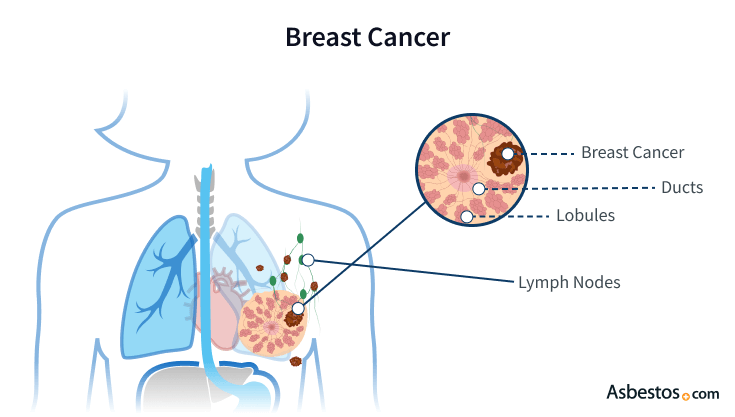
One in eight women in the U.S. is diagnosed with breast cancer. The cause of breast cancer is linked to a variety of external risk factors in addition to natural factors that are typically out of a person’s control.
Breast cancer is a disease associated with abnormal cell growth in the breast. Invasive ductal carcinoma, invasive lobular carcinoma, Paget’s disease, medullary mucinous and inflammatory breast cancer are all types of breast cancer.
Approximately 287,850 new cases of invasive breast cancer were diagnosed in 2022. Breast cancer is the most common cancer diagnosed in women, who are 100 times more likely to be diagnosed with it than men. The five-year survival rate is 91% for all types of breast cancer combined.
Breast cancer in the lymph nodes is a risk factor for metastasis.
Natural risk factors include gender, age, race, early onset of menstruation and family history and genetics. According to a 2016 study, environmental factors play a role in the risk of breast cancer including exposure to ionizing and nonionizing radiation, pesticides, polycyclic aromatic hydrocarbons and metals.
Some studies have found higher rates of breast cancer among women exposed to asbestos, although the link between the two appears thin. A study published in 2021 reinforced the evidence that chronic inflammation from asbestos could be a major risk factor in the development of breast cancer.
Asbestos Exposure and Breast Cancer
Asbestos is a carcinogen that has been linked conclusively to other health conditions such as mesothelioma cancer, but its exact correlation to breast cancer is uncertain. Although researchers have noted an elevated incidence of breast cancer in women who have been exposed to asbestos fibers, studies have not yet determined how asbestos directly affects breast tissue.
Statistical Significance
According to Dr. Debra David, many studies that have attempted to demonstrate a correlation between asbestos exposure and breast cancer fail to do so strictly because they do not achieve statistical significance, meaning there were not enough women involved in the study to make it statistically conclusive. Two international studies delivered different conclusions from each other.
Australian Study
One Australian study published in 2009 reviewed the potential association between exposure to blue asbestos and cervical, ovarian, uterine and breast cancers. Nearly 3,000 women from Wittenoom — the home of a large asbestos company operated until 1966 — were compared with the general Western Australian population.
Cervical and ovarian cancers were slightly more prevalent in former factory workers and town residents than the general population. Breast cancer rates remained the same.
British Study
A similar study that monitored cancer diagnoses in British asbestos factory workers was the only one of its kind to suggest an association between occupational asbestos exposure and elevated rates of breast cancer. This project found a slightly increased rate of breast cancer diagnoses in female factory workers who experienced significant exposure over two or more years. The study expected 10.48 deaths from breast cancer, yet 12 participants passed away from the illness.
Second British Study
Another British study, ” Prevalence of Asbestos Bodies in a Necropsy Series in East London,” examined the lungs of 178 female participants for the presence of asbestos fibers. The mineral was present in 30 percent of all women in the study, yet the majority of this percentage was found in the subgroup of women who had been diagnosed with breast cancer. Of the 82 female participants with the illness, 38 were found to have asbestos in their lungs.
Suggested Hypothesis
Authors within the study suggested that asbestos fibers may have reached the breast tissue through retrograde lymphatic flow from the lungs to the chest wall, while another study yielded another hypothesis. The second study implied that asbestos fibers may pierce the lungs and pass through the muscles that cover the chest wall, eventually reaching the breast tissue. While the evidence to support either suggestion is limited and does not speak to a causal relationship, the potential link between asbestos and breast cancer requires continued study to warrant any factual association.
Finnish Study
A Finnish study published in the American Journal of Industrial Medicine in 1999 reported on breast cancer risk in certain occupations. The study found women who were occupationally exposed to medium or high levels of asbestos were 1.3 times more likely to develop postmenopausal breast cancer than the general population.
The same elevated risk was found in women exposed to human-made vitreous fibers. Women exposed to silica dust and other mineral dust were 1.1 times more likely to develop postmenopausal breast cancer. These findings may suggest that microscopic fibers and mineral dust might increase the risk of developing breast cancer.
IARC’s Conclusion
In a 2011 study, the International Agency for Research on Cancer (IARC) evaluated more than 900 different agents and determined that no agents in the workplace, including asbestos exposure, were associated with breast cancer. Only night shift work was associated with breast cancer, which is likely connected to disruption of hormones or immune function.
500+ SPECIALISTS AVAILABLE
Get to the Right Mesothelioma Specialist, Faster
Connect with top-rated doctors specializing in mesothelioma treatment, who will personalize treatment options based on your diagnosis.
Some contributing factors that increase breast cancer risk are referred to as “partial risk factors.” Some of these may be within an individual’s control, such as alcohol consumption.
Many partial risk factors, however, are not something an individual can choose without compromising their health in other areas, for example, receiving radiation therapy to the chest. And others, such as whether or not to have children, can be deeply personal choices.
Partial risk factors include:
Consuming more than two alcoholic drinks a day
Having children after age 30
Not having children
Not breastfeeding
Taking the drug diethylstilbestrol (DES) to prevent a miscarriage
Recent use of birth control pills
Receiving hormone replacement therapy (HRT)
Receiving radiation therapy to the chest area
Exposure to toxic substances or carcinogens
According to the American Cancer Society, about 5 to 10% of breast cancer cases can be directly attributed to mutations of certain inherited genes. Many other factors, such as exposure to carcinogens, may also be out of a cancer patient’s control.
Recommended Reading
Your web browser is no longer supported by Microsoft. Update your browser for more security, speed and compatibility.
If you are looking for mesothelioma support, please contact our Patient Advocates at (855) 404-4592
Fact Checked
Our fact-checking process begins with a thorough review of all sources to ensure they are high quality. Then we cross-check the facts with original medical or scientific reports published by those sources, or we validate the facts with reputable news organizations, medical and scientific experts and other health experts. Each page includes all sources for full transparency.
Reviewed
Asbestos.com is the nation’s most trusted mesothelioma resource
The Mesothelioma Center at Asbestos.com has provided patients and their loved ones the most updated and reliable information on mesothelioma and asbestos exposure since 2006.
Our team of Patient Advocates includes a medical doctor, a registered nurse, health services administrators, veterans, VA-accredited Claims Agents, an oncology patient navigator and hospice care expert. Their combined expertise means we help any mesothelioma patient or loved one through every step of their cancer journey.
More than 30 contributors, including mesothelioma doctors, survivors, health care professionals and other experts, have peer-reviewed our website and written unique research-driven articles to ensure you get the highest-quality medical and health information.
About The Mesothelioma Center at Asbestos.com
Assisting mesothelioma patients and their loved ones since 2006.
Helps more than 50% of mesothelioma patients diagnosed annually in the U.S.
A+ rating from the Better Business Bureau.
5-star reviewed mesothelioma and support organization.
My family has only the highest compliment for the assistance and support that we received from The Mesothelioma Center. This is a staff of compassionate and knowledgeable individuals who respect what your family is experiencing and who go the extra mile to make an unfortunate diagnosis less stressful. Information and assistance were provided by The Mesothelioma Center at no cost to our family.
Dixon, S. (2026, February 9). Breast Cancer. Asbestos.com. Retrieved October 16, 2026, from https://www.asbestos.com/cancer/breast/
MLA
Dixon, Suzanne. "Breast Cancer." Asbestos.com, 9 Feb 2026, https://www.asbestos.com/cancer/breast/.
Chicago
Dixon, Suzanne. "Breast Cancer." Asbestos.com. Last modified February 9, 2026. https://www.asbestos.com/cancer/breast/.
My primary support since being diagnosed with Mesothelioma, over 2 years ago, has been this company. Their monthly nationwide support group has been a tremendous help for me. I have learned about others' treatments and have been able to freely discuss mine, knowing others walk the same walk as I do and fully understand. Karen Selby, the nurse and patient advocate, has helped me so much. I call her and she delivers. She's experienced in Thoracic surgeries, is supportive, kind, knowledgeable, and makes a patient feel very cared for! The whole staff are polite, caring, and will help with Mesothelioma victims' many needs. I feel very blessed to have this Organization by my side as I live with this cancer.
I found out about The Mesothelioma Center while researching Peritoneal Mesothelioma days after being diagnosed with malignant cancer. While a lot of the 'Mesothelioma' websites are actually law firms just trying to get your business, theirs is a user-friendly, comprehensive website set up to aid patients, their loved ones, and/or caregivers with all things related to a cancer diagnosis from asbestos exposure. I was soon put in touch with one of their doctors, Snehal Smart, M.D., who immediately sent me a packet of general information, a book on surviving Mesothelioma, and offered me assistance in finding doctors, reputable law firms, financial help, support groups, and so much more! The Mesothelioma Center's website is, in my opinion, the best resource for anyone suffering from cancer due to asbestos. Dr. Smart is amazing! She is very knowledgeable and helpful, but she is also a very kind, caring doctor who appears to go the distance whether she is researching a pertinent topic, making suggestions, providing contacts, or just being a good listener on the other end of the phone. In addition, Dr. Smart referred me to a law firm who is now fighting to get me compensation for the negligence of those defendants whose products exposed me to asbestos and caused my subsequent cancer. Thank you, TMC and Dr. Smart, for helping me determine the best treatment plan for my cancer and being part of my miracle. I am currently cancer-free and back to being a mom to my precious daughter. The Mesothelioma Center, their website, and their staff rock!!
I just want to take this time to thank Mesothelioma Center for all the information you provide. The survival stories are inspiring and give hope where hope is needed! Thanks to you, I have met many others on the site and continue to converse with them. Keep up the good work. I am always looking forward to your posts! Thank you, Richard Delisle.
My brother was recently diagnosed with mesothelioma. I began researching it online. The information I received from The Mesothelioma Center is all-inclusive. No need to look anywhere else! The first phone call was with Karen, and she answered all my questions with ease. She also had a calming effect by presenting all the options available for my brother and his family. Thank you!
My father was recently diagnosed with mesothelioma. We, as a family, were devastated. We were uncertain where to even start, so we reached out to The Mesothelioma Center. They were absolutely amazing. They provided physicians in our area who specialize in this type of cancer because it is so rare. They also set us up with a firm who specializes in getting funds that are set aside to help with our medical bills. I’m so glad we made the phone call. They were very knowledgeable, supportive, sincere, and true patient advocates.
Dr. Andrea Wolf is the Director of the New York Mesothelioma Program at Mount Sinai in New York City. She focuses on multidisciplinary treatment, clinical research, community outreach and education.
Fact-checked and verified content:
Our fact-checking process begins with a thorough review of all sources to ensure they are high quality. Then we cross-check the facts with original medical or scientific reports published by those sources, or we validate the facts with reputable news organizations, medical and scientific experts and other health experts. Each page includes all sources for full transparency.
Please read our editorial guidelines to learn more about our content creation and review process.