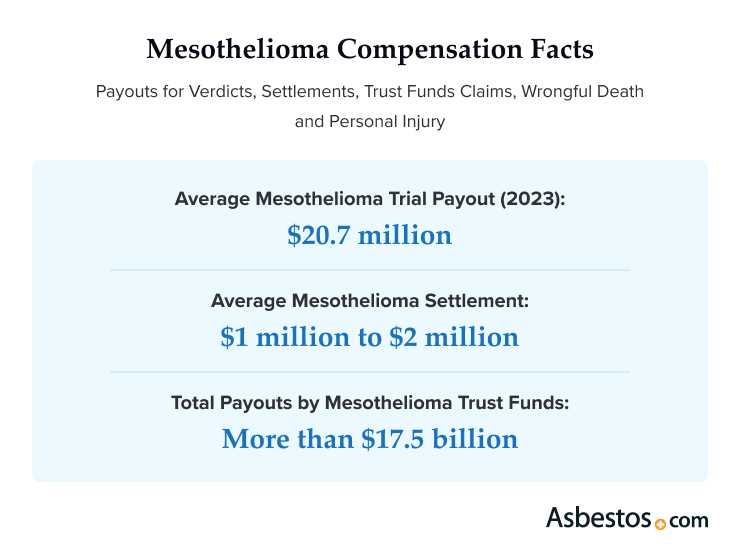
Mesothelioma compensation is usually received through negotiated lawsuit settlements, which average $1 million to $2 million. Fewer than 5% reach a trial verdict ranging from $5 million to $20.7 million. Asbestos trust fund payouts also help families cover medical expenses and lost wages.
Average mesothelioma compensation amounts vary, but settlements typically range from $1 million to $2 million and are the most common outcome of asbestos lawsuits. Most cases settle before ever going to trial.
When a mesothelioma lawsuit goes to trial, the parties may reach a settlement or a jury may decide the compensation amount. Trial verdicts generally average $20.7 million based on 2024 Mealey’s Litigation Report data, but fewer than 5% of cases reach a jury.
Factors That Affect Your Mesothelioma Compensation
Asbestos exposure history: Longer or more intense exposure, particularly across multiple job sites, can strengthen a claim and increase the number of liable parties.
Medical expenses and lost income: Documented treatment costs, lost wages and projected future care needs are factored into compensation calculations.
Mesothelioma type and stage at diagnosis: People with later-stage diagnoses often receive higher awards because of greater medical costs and impact on quality of life.
Number of defendants: Filing claims against multiple asbestos companies or trust funds can increase total compensation.
State where the claim is filed: Statutes of limitations, damage caps and court precedents vary by state and affect potential awards.
Whether the case settles or goes to trial: Trial verdicts have higher average payouts but outcomes are more uncertain with longer timelines than negotiated settlements.
Our research shows between 2021 and 2022, the average mesothelioma trial verdict was $10.6 million. Between 2018 and 2020, the average spiked to $53 million, mainly because of a single multibillion-dollar talc verdict against Johnson & Johnson. Talc lawsuits continue to impact mesothelioma compensation averages with verdict amounts currently trending higher. For example, in December 2025 a more than $1.5 billion verdict was awarded in another J&J baby powder lawsuit.
Every case is different, so compensation can differ significantly. Mesothelioma compensation generally helps cover medical bills, lost wages, travel expenses and other losses. This support provides families with financial security when a loved one can no longer work.
Types of Mesothelioma Compensation
People diagnosed with mesothelioma and their families can pursue compensation through several types of claims. People may be able to file more than one type of claim depending on the defendants involved and the details of their case. An experienced asbestos attorney can assess the best course of action for you.
Veterans with mesothelioma may also qualify for monthly tax-free VA benefits, which can provide significant financial support. Each case is different, so an experienced lawyer can help you choose the best path to maximize compensation for you and your family.
Compensation Guide
Understand Your Legal Options
Answer a few short questions to learn about the types of compensation you may be eligible for, and connect with a Patient Advocate who can help determine which options fit your family’s needs.
4 Questions in 1 minute
Want to speak to us directly?Our Patient Advocates are available 24/7.
A mesothelioma lawsuit may be filed against every responsible company, often 60 or more defendants, for asbestos exposure. Attorneys pursue each one simultaneously; settlements and verdicts may come in over time as individual defendants resolve their liability. Trust funds are another option to pursue simultaneously.
Typical timeline: 3-12 months per fund | Varies across multiple funds
Over 60 asbestos companies established trust funds to compensate people who were harmed by their asbestos products. Eligible claimants may file against multiple trusts simultaneously. Trust fund claims may be pursued alongside a lawsuit. They are separate processes and one does not reduce the other.
Typical timeline: 3-12 months | Monthly disability and healthcare
Veterans may be eligible for VA compensation separate from any legal claim. A service-connected mesothelioma diagnosis may qualify for a 100% VA disability rating, which can include monthly disability pay, VA healthcare and benefits for dependents. A VA claim does not reduce trust fund or lawsuit recovery. It’s an additional layer of support.
Want help understanding your options?A Patient Advocate will help you access all eligible types of compensation.
This tool doesn’t determine eligibility for legal options.
Asbestos Trust Funds
Many asbestos companies facing several lawsuits filed for bankruptcy and set up asbestos trust funds as part of reorganizing under Section 524(g) of the U.S. Bankruptcy Code. The companies put funds into the trusts to compensate people exposed to their asbestos products who then developed asbestos-related diseases like mesothelioma.
Trust fund payouts are generally calculated based on a scheduled value, or preset dollar amount assigned to each disease category. Mesothelioma usually receives the highest amount. Each asbestos trust fund then pays a percentage of that scheduled value, known as the payment percentage, which varies by trust. Because most mesothelioma patients were exposed to multiple companies’ products, they can often file with multiple trusts and receive separate payments from each.
Asbestos trust fund claims typically allow people to receive payouts faster than mesothelioma lawsuits because they don’t go through the court system. Most people who file a trust fund claim receive compensation within a few months, which can help families get financial support sooner.
Mesothelioma attorney Jim Kramer tells us litigation may not be possible or the best option depending on the circumstances of an individual case. He noted, “This is why asbestos trust funds are often a very good option.”
Type of Compensation
Typical Payout Range
Average Timeline to First Payment
Requires Going to Court?
Who Qualifies?
Personal injury lawsuit (settlement)
$1M to $2M
6 to 12 months
No
Anyone diagnosed with mesothelioma
Personal injury lawsuit (trial verdict)
$5M to $20.7M
1 to 3 years
Yes
Anyone diagnosed with mesothelioma
Asbestos trust fund claim
$300K to $400K
90 days
No
Anyone exposed to a bankrupt company’s asbestos products
VA benefits
$3,938 to $4,158/month
~81 days after claim approval
No
Veterans with service-connected mesothelioma
Exclusive Content
Carl Money: Compensation Options That Can Help Mesothelioma Patients
You’re going to get compensation from the trial case. Know, you’re going to all the viable asbestos companies, they’re going to come and settle the case. Or you’re to take them the verdict and win that. You’re going to get compensation from the bankrupt defendants through the asbestos trust funds, and we’ll get as many as those we possibly can.
If you’re in the military, you can file a VA claim, and you should certainly be able to get one hundred percent disability if you’ve been diagnosed with mesothelioma because nearly everybody is exposed to asbestos at some point, especially Navy people, everybody was in the Navy, to asbestos containing products, you know, 50s, 60s, and 70s if you’re in the middle, maybe in the 80s if you’re in the military. These folks are going to incur a whole bunch of medical charges. It’s going to get be very, very expensive. And so, you know, there’s no known cure for mesothelioma.
And so there’ll be experiential treatments. There’s surgeries that could go forth.
You know, there’s the chemo. And it can get very, very expensive family very, very quickly. You know, at some point, I’ll file or we’ll file bankruptcy claims early. So, you know, say there’s, we can get one hundred thousand dollars quickly for the family to help them with medical expenses so that they can try some treatment that’s out there that’s very expensive, you know, or even more. Know, if they need more, we can get more. Or you will file bankruptcy claims and get them money quicker because the trial case, you know, hopefully we can get that done within a year, but sometimes it’ll take a little longer. It depends on if you’re going to get a trial setting or not.
Mesothelioma Lawsuits
Mesothelioma compensation from lawsuits can include economic damages, such as medical bills and lost wages, as well as noneconomic damages such as pain, suffering and loss of companionship. Lawsuits involve a detailed legal process, including filing a claim, exchanging evidence and negotiating with the companies responsible for asbestos exposure.
While most cases settle before reaching court, some proceed to trial if a fair agreement isn’t reached. Throughout this process, an experienced mesothelioma lawyer manages the legal complexities and works to secure the compensation your family deserves.
$30B+ IN TRUST FUNDS AVAILABLE
Find the Right Attorney to Help You File a Lawsuit
When filing a mesothelioma lawsuit, the right legal representation is everything. We’ll connect you to a top lawyer who will help you secure financial compensation.
A settlement is when a defendant pays a plaintiff to dismiss the lawsuit. Many mesothelioma lawsuits settle before trial. Several factors affect whether your lawsuit settles.
Some defendants decide that settling a claim is cheaper than incurring more legal fees. Other defendants are willing to risk a trial because they can negotiate an asbestos settlement at any point.
A qualified asbestos law firm will negotiate settlements on your behalf. They’ll advise you about whether to take the compensation or pursue a court trial.
Perspective From a Mesothelioma Lawyer
Because settlements provide compensation faster than lawsuits, they may be a more immediate solution to pay expenses. I’ve seen verdicts typically result in higher amounts of total compensation, but the majority of lawsuits are settled before trial.
People diagnosed with mesothelioma can file legal claims such as personal injury lawsuits for compensation. Surviving family members may also have the right to file claims related to their loved one’s diagnosis or death.
An estate representative often files a wrongful death lawsuit on behalf of an estate. They may also file an asbestos trust fund claim to pursue compensation if a defendant has established one.
Who May Be Eligible for Mesothelioma Compensation
Dependent children: Children who have lost a parent may qualify to file a wrongful death claim in many states after a parent’s death.
Estate representatives: An estate representative may file a wrongful death claim on behalf of an estate.
Mesothelioma patients: People diagnosed with mesothelioma as a result of primary or secondary asbestos exposure may file a personal injury claim against asbestos companies.
Siblings: Eligibility is generally more limited for siblings and varies by state, so consulting an attorney is recommended.
Surviving spouses: A spouse who has lost a partner may qualify to file a wrongful death claim in many states after a loved one’s death.
An experienced asbestos attorney will assess your eligibility and the best type of claim to help you get mesothelioma compensation. Your lawyer will help you gather evidence of asbestos exposure and tie it to your or your loved one’s mesothelioma diagnosis.
Facing medical expenses and loss of income when she had to leave her nursing career early, survivor Kim Madril pursued financial help through mesothelioma compensation. Kim tells us, “I couldn’t work during treatment and recovery. And the surgical bill, anesthesia and hospital stay for one week with surgery was $160,000. Radiation treatment was $30,000, I think.” The compensation she received helped reduce financial stress, giving her the chance to focus on getting better.
How Legal Compensation Helps Manage Financial Burdens of a Mesothelioma Diagnosis
Filing a claim for compensation can help alleviate any financial burden that a mesothelioma patient has. It’s not just to help with treatment cost, but there’s a lot of unexpected that can come with any cancer diagnosis, especially mesothelioma, whether that be at home medical cost, an unexpected trip to the emergency room. So filing a claim for compensation early on sets up a patient for the future and having no financial worries. A patient shouldn’t have to make a decision about the treatment they’re gonna have or traveling to a center of excellence based on affordability when compensation has been put in place for the patient.
Would you encourage others to pursue financial compensation for mesothelioma?
I would encourage them to do that. I mean, No matter what, you still have your expenses that you have to pay for. Your travel expenses. You know, I mean, that’s we traveled almost a hundred miles for a treatment, you know? And you gotta eat, you gotta, you know, gas and the the wear a tear on your vehicle. And you don’t know if it’s the end of your time. You might as well be able to enjoy things in life rather than be preoccupied with how you’re gonna pay for something.
What should patients and family members expect while seeking compensation for asbestos exposure?
[MUSIC PLAYING] Once you’re diagnosed with mesothelioma, you’re probably going to get different lawyers emailing you, sending your mail, kind of like when you get a ticket. [LAUGHS] But you have to choose the best one for you because not all of the lawyers are alike. But it is very important to have all of your documentation from your medical records, your biopsy, your pathology reports, and everything. I would say make copies, like, several copies of them because the lawyers are going to want that. They’re going to want to know your work history, which I didn’t have a lot of work history because I was 21 years old. But they are going to want to know that because that is going to help them fine tune your place of exposure. So it’s very important to have all of your ducks in a row before you contact a lawyer. [MUSIC PLAYING]
How to File for Mesothelioma Compensation
You can work with a top attorney to file for mesothelioma compensation. They will manage the legal process for you and guide you every step of the way.
The right attorney will help you understand all your options for filing a mesothelioma claim. They’ll prove your history of asbestos exposure, track your expenses and ensure your claim is filed within the time limit to file, called the statute of limitations.
I asked my Patient Advocate, Missy Miller at The Mesothelioma Center, for law firm recommendations to help me afford treatment expenses. It was the best decision ever. It ended up being about more than just compensation. Let’s make these responsible entities accountable.
Kim Madril, pleural mesothelioma survivor
Mesothelioma Compensation Process
Your legal team will manage the process if you accept a defendant’s settlement offer. Both sides will report the settlement agreement to the court, which will issue an order of settlement. The defense will prepare a document called the release. Once agreed upon, your lawyer will send it to you to sign and have notarized.
Most mesothelioma lawsuits take 12 to 18 months to resolve. Asbestos trust fund claims often pay out in 90 days or less, and many people receive payments from both sources.
Steps to Filing for Compensation
Get an attorney: Speak with an asbestos law firm to find out what you could receive and the statute of limitations. They can help determine what’s best for you and your family.
Discovery period: Your attorney will discover the facts about your asbestos exposure. This process generally focuses on the places and products that led to your exposure.
Weigh your options: Consider all options for compensation. Your attorney will review your eligibility for trust funds and lawsuits.
Accept or reject settlement offers: If you file a lawsuit, you may have to consider offers to settle. Your attorney will counsel you on resolving your claim or proceeding to trial.
An experienced mesothelioma lawyer will work to maximize your compensation but won’t promise a specific amount. Compensation can cover costs insurance often doesn’t, like transportation, home health aides and complementary therapies. The amount you receive depends on several factors such as the complexity of your case and your attorney’s track record with mesothelioma claims.
VA Claims and Other Types of Financial Assistance
In addition to compensation from a mesothelioma claim, you and your family can take advantage of other financial assistance. These programs help cover ongoing expenses and provide monthly benefits for people with mesothelioma and related diseases.
Types of Financial Assistance
Community Assistance: Local organizations may provide grants to help patients and their families with transportation, lodging, food and other out-of-pocket costs that arise during treatment. Contact your local chapter of the American Cancer Society or another cancer support group for more information.
Long-Term Disability Insurance: If you have long-term disability insurance, you may be able to receive a percentage of your salary. You must submit paperwork from your doctor verifying your disability.
Medicare and Medicaid: These programs offer health care benefits for those meeting age, disability and income requirements.
Private Health Insurance: Health insurance can help offset your expenses. If you already have insurance, review your out-of-pocket deductible and copay amounts and any coverage limits.
Social Security Disability Payments: If you cannot work because of your illness and are still eligible, you can apply for Social Security Disability Benefits. The Social Security Compassionate Allowances program allows mesothelioma patients to apply for benefits under a fast-track process.
VA Claims:Veterans have a right to file a VA claim seeking compensation for any illnesses resulting from their military service. Because the VA rates mesothelioma at 100% disability, a veteran’s 2026 monthly compensation starts at $3,938.58 and increases with eligible dependents.
These programs are designed to help those with severe illnesses and their families. Some can provide mesothelioma financial assistance in just a few weeks or months, and specific programs provide ongoing monthly compensation.
Family members of mesothelioma patients may also be eligible for multiple types of compensation. For veterans’ families, VA Dependency and Indemnity Compensation provides monthly tax-free payments to eligible survivors. If a loved one has passed away, surviving spouses, children and estate representatives can also pursue wrongful death lawsuits and asbestos trust fund claims.
Perspective from a VA-Accredited Claims Agent
Expert Insight
I’ve helped many veterans with mesothelioma file for service-connected disability benefits that offer monthly income, support for their spouses, and access to specialized care at VA hospitals. It’s incredibly rewarding to guide them through a system that can feel overwhelming, and to help ensure they receive the care and benefits they’ve earned.
Aaron Munz, Veterans Department director & VA-accredited claims agent
Mesothelioma Compensation for Veterans
Many people who served in the U.S. armed forces were exposed to asbestos. Veterans who develop mesothelioma or other asbestos-related diseases and their families may be eligible for disability compensation or VA benefits through the Department of Veterans Affairs.
VA-accredited claims agents often recommend that veterans file a VA claim at the same time they file a legal claim. Waiting to file these claims separately will only cause delays. The compensation received from one generally won’t impact the other, which means you’ll receive payment quicker if you also file this type of claim.
Common Questions About Mesothelioma Compensation
Who qualifies for mesothelioma compensation?
Compensation is available for people diagnosed with mesothelioma as a result of asbestos exposure, as well as surviving family members. It can be pursued through multiple pathways, including personal injury lawsuits, asbestos trust fund claims and VA benefits for veterans. Many people qualify for more than one. You don’t need to know exactly where or when your exposure occurred. An experienced mesothelioma lawyer can investigate your work history to identify liable parties.
Carl Money, a mesothelioma attorney at The Nemeroff Law Firm, adds, “Compensation is available for people who have been exposed to asbestos and have been diagnosed with mesothelioma, as well as spouses, children and heirs through litigation in the courts and by filing claims with the asbestos trusts.”
What types of compensation can family members receive?
If your loved one has mesothelioma or another asbestos-related disease, you may qualify for different types of compensation. You can file a personal injury or wrongful death claim to help pay for medical bills, funeral costs, lost income and emotional loss.
If your loved one was a veteran, a surviving spouse or dependent child may also get VA benefits. You can also apply to asbestos trust funds if your family member was exposed to asbestos. Private insurance and government programs like Medicaid and Medicare may also help cover treatment costs. If your loved one has passed away, your family can still pursue a wrongful death claim and an asbestos trust fund claim. If they served in the military, your family is also eligible for VA survivor benefits.
How long does it take to get compensation for mesothelioma?
Asbestos trust fund claims generally pay out within 1 to 3 months after acceptance. Mesothelioma lawsuits typically take 12 to 18 months to resolve, though the timeline varies by jurisdiction and number of defendants. Many people receive payments from both trust funds and lawsuits, meaning some families begin receiving compensation within months of filing.
Carl Money, a mesothelioma attorney at The Nemeroff Law Firm, adds, “The time it takes to receive compensation for a case filed in the courts depends on the jurisdiction in which the case is filed, but hopefully, it will be within a year of filing. As for a claim filed with the asbestos trusts, you may receive compensation within three months of filing a claim.”
Will I receive one lump sum or multiple payments?
Most mesothelioma claimants receive multiple separate payments over time rather than a single lump sum, because lawsuits typically name dozens of defendants who each settle independently on their own timeline. Asbestos trust fund claims are also filed and paid out separately, so payments from those may arrive on a different schedule than lawsuit settlements. This means some families begin receiving compensation relatively quickly while other payments follow over the course of months or longer.
How can I apply for asbestos compensation?
The first step is a free consultation with an asbestos law firm, during which attorneys evaluate your exposure history and diagnosis to identify eligible claims. The firm then handles the filing process, gathering medical records and employment history, identifying responsible defendants and applicable trust funds, and filing within the statute of limitations in your state. Most asbestos law firms work on contingency, meaning you pay nothing unless you receive compensation.
Carl Money, a mesothelioma attorney at The Nemeroff Law Firm, advises, “It is best to hire an attorney specializing in asbestos litigation and allow them to pursue litigation against the asbestos companies and file claims against the asbestos trusts.”
How do I find an attorney who specializes in asbestos cases?
Look for a law firm that specializes exclusively in asbestos and mesothelioma litigation, not a general personal injury firm. National firms that focus on asbestos cases maintain extensive product databases and exposure records that general firms don’t have access to. Most mesothelioma law firms offer free consultations and charge no upfront fees, and the initial consultation is a great opportunity to ask an attorney any questions you may have.
Carl Money, a mesothelioma attorney at The Nemeroff Law Firm, recommends, “Researching and finding a national firm specializing in asbestos litigation is best.”
Your web browser is no longer supported by Microsoft. Update your browser for more security, speed and compatibility.
If you are looking for mesothelioma support, please contact our Patient Advocates at (855) 404-4592
Fact Checked
Our fact-checking process begins with a thorough review of all sources to ensure they are high quality. Then we cross-check the facts with original medical or scientific reports published by those sources, or we validate the facts with reputable news organizations, medical and scientific experts and other health experts. Each page includes all sources for full transparency.
Reviewed
Asbestos.com is the nation’s most trusted mesothelioma resource
The Mesothelioma Center at Asbestos.com has provided patients and their loved ones the most updated and reliable information on mesothelioma and asbestos exposure since 2006.
Our team of Patient Advocates includes a medical doctor, a registered nurse, health services administrators, veterans, VA-accredited Claims Agents, an oncology patient navigator and hospice care expert. Their combined expertise means we help any mesothelioma patient or loved one through every step of their cancer journey.
More than 30 contributors, including mesothelioma doctors, survivors, health care professionals and other experts, have peer-reviewed our website and written unique research-driven articles to ensure you get the highest-quality medical and health information.
About The Mesothelioma Center at Asbestos.com
Assisting mesothelioma patients and their loved ones since 2006.
Helps more than 50% of mesothelioma patients diagnosed annually in the U.S.
A+ rating from the Better Business Bureau.
5-star reviewed mesothelioma and support organization.
My family has only the highest compliment for the assistance and support that we received from The Mesothelioma Center. This is a staff of compassionate and knowledgeable individuals who respect what your family is experiencing and who go the extra mile to make an unfortunate diagnosis less stressful. Information and assistance were provided by The Mesothelioma Center at no cost to our family.
Ray, W. (2026, October 1). Mesothelioma Compensation. Asbestos.com. Retrieved October 5, 2026, from https://www.asbestos.com/mesothelioma-lawyer/compensation/
MLA
Ray, Whitney. "Mesothelioma Compensation." Asbestos.com, 1 Oct 2026, https://www.asbestos.com/mesothelioma-lawyer/compensation/.
Chicago
Ray, Whitney. "Mesothelioma Compensation." Asbestos.com. Last modified October 1, 2026. https://www.asbestos.com/mesothelioma-lawyer/compensation/.
Start Your Path Toward a Settlement
A mesothelioma settlement can ease the financial weight on your family. We’re here to help you take the first step.
Attorneys are available to discuss your case today
Over $30 billion available for asbestos victims. Time limits may apply
5.0 Rating170+ Google Reviews
A+ RatedBetter Business Bureau
20 YearsServing Exposure Victims
Extremely knowledgeable in issues related to asbestos exposure and helping people with asbestos related illnesses seek compensation. This information will help me in reviewing current and past claims for compensation and DIC.
I really appreciated all the information listed on asbestos.com After calling their phone number, I was instantly connected with all the help I needed to better understand mesothelioma, treatment options, and financial benefits that are available to us.
Ms. DiPietro was very patient with myself as I was a first time novice dealing with my health issues concerning working on Ships Boilers all my professional career and even with calling my union with no assistance whatsoever she directed me on what should be done accordingly as I had no direction given from my numerous phone calls and she came through. I give her 6 Stars for all she has helped.
Whitney Ray Di Bona brings a unique perspective to The Mesothelioma Center's content on Asbestos.com. As both a practicing attorney and consumer safety advocate, she has encountered asbestos-related cases throughout her legal career. She draws on her experience in mass tort litigation and background as a former prosecutor to ensure the accuracy and helpfulness of content for mesothelioma survivors and their families.
Fact-checked and verified content:
Our fact-checking process begins with a thorough review of all sources to ensure they are high quality. Then we cross-check the facts with original medical or scientific reports published by those sources, or we validate the facts with reputable news organizations, medical and scientific experts and other health experts. Each page includes all sources for full transparency.
Please read our editorial guidelines to learn more about our content creation and review process.