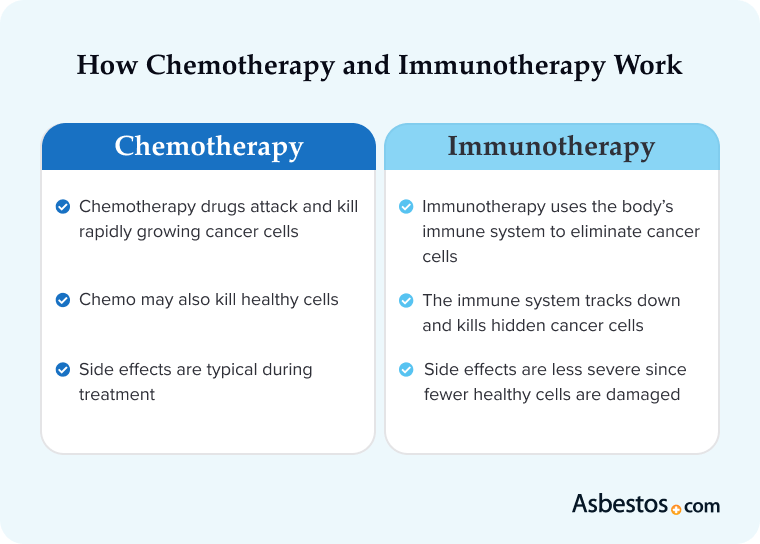
Chemotherapy and immunotherapy are both systemic treatments for cancer that work by distributing certain drugs throughout the body. When recommending immunotherapy vs. chemotherapy to treat mesothelioma, specialists consider the individual patient as well as the type and stage of the disease.
Immunotherapy is a type of cancer treatment that helps the body’s immune system recognize and kill mesothelioma cells. Normally, the immune system defends the body against harmful invaders like bacteria and viruses. But cancer cells can hide or disguise themselves to avoid detection. Immunotherapy makes it easier for the immune system to identify and target cancer cells.
CAR T-cell therapy: This approach modifies a person’s T-cells in a lab to recognize specific cancer cells. It enhances the body’s ability to see and destroy cancer cells.
Cancer vaccines: This therapy introduces specific cancer-associated proteins to stimulate the immune system. It trains immune cells to recognize and attack cancer more effectively.
Checkpoint inhibitors: These drugs block specific proteins in cancer or immune cells. They prevent cancer cells from blocking immune responses so the body can attack tumors.
Immunotherapy can be used alone or with other treatments to improve outcomes. This targeted approach can lead to longer-lasting results for some people with mesothelioma, potentially controlling cancer longer than other therapies.
Expert Take
Dr. Jacques Fontaine: Chemotherapy vs Immunotherapy for Mesothelioma
What is the difference between chemotherapy and immunotherapy? Basically chemotherapy is a medication that goes and attacks and kills all cells that are replicating, that are duplicating, that are growing quickly. So it will kill cancer cells that are growing quickly of course. But it will also kill other normal cells in our body that are also growing, such as cells in our mouth, that’s why you get ulcers, cells in our digestive system, that’s why you can get diarrhea, cells in our bone marrow, that’s why our platelets go down, that’s why we become anemic with chemotherapy.
So chemotherapy is not very specific. It goes in and it neutralizes and kills any cell, whether good or bad, that’s growing, replicating. However now, we have multiple other ways of killing cancer cells. You may know we all have a few microscopic cancer cells running around our bloodstream, but these cancer cells don’t cause any problem because our own immune system keeps them in check.
And the way it does that is that the immune system with its policeman called the T cell checks the ID on every cell. And if it shows that the cell is a cancer cell, it will attack it and our own immune system will kill that cancer cell, not allowing it to replicate or to grow in an uncontrolled fashion. However, sometimes cancer cells can develop a fake ID and it shows that fake ID to the policeman, that fake ID to the T cell from the immune system and then it evades the immune system. The immune system thinks it’s a normal good cell in our body, and that cancer cell then starts growing quickly.
So we have found a new type of medication called an immune checkpoint inhibitor, where when that cancer cell gets to the checkpoint with a policeman, the T cell from the immune system, and instead of down regulating it or showing that fake ID, we give it that medication, it’s no longer able to show the fake ID, the immune system recognizes it as a bad cell, and the immune system comes and kills those cancer cells. So that is the basis of an immune checkpoint inhibitor, which is an FDA approved type of immunotherapy that we give not just in mesothelioma, in lung cancer, in esophagus cancer, in kidney cancers, in skin cancers, in multiple types of cancers.
Immunotherapy.
What Is Chemotherapy?
Chemotherapy for mesothelioma uses strong drugs to fight cancer cells in the body. Cancer cells grow and divide much faster than normal cells.
Common chemo drugs: Common chemo drugs for mesothelioma include cisplatin, Alimta (pemetrexed), carboplatin, gemcitabine and vinorelbine.
How chemo works: Chemo drugs attack fast-growing cells and stop them from multiplying. The drugs enter the bloodstream, so they can reach almost every part of the body and target cancer cells wherever they are.
Chemotherapy doesn’t only affect cancer cells. It also impacts other fast-growing cells. Hair, skin and the lining of the stomach are affected. That’s why people on chemo might experience side effects like hair loss, nausea and fatigue. The drugs are often given in cycles, with breaks in between to help healthy cells recover.
Key Differences Between Immunotherapy and Chemotherapy
Chemo blocks a mesothelioma tumor’s ability to grow and spread. Immunotherapy boosts your body’s ability to kill cancer cells. Both therapies can affect the entire body (systemic therapy). Each treatment has a different way of attacking cancer cells.
Peritoneal mesothelioma survivor Tami Pream has been undergoing heated chemo treatments, or HIPEC, combined with an immunotherapy regimen. She tells us her treatment combinations have been successful so far. “It seems to be making somewhat of a difference in how I’m feeling,” Tami says.
Mechanism of Action
Most chemo drugs damage cancer cells as they divide and multiply. They prevent the synthesis of DNA and other molecules. These are vital for cell division and survival. Cancer cells grow and divide faster than most healthy cells. So they’re an ideal target for chemo drugs.
Immunotherapy drugs can help your immune system spot cancer cells. Cancer cells come from your own cells. So your immune system doesn’t always recognize them as a threat. Boosting the immune system helps the body kill cancer cells.
Target Specificity
Immunotherapy is more targeted than chemotherapy. Chemotherapy targets all rapidly dividing cells, impacting both cancerous and healthy cells. Immunotherapy targets only cancer cells, enhancing the immune system’s ability to recognize and attack them. Immunotherapy trains immune cells to identify cancer as a threat, leaving healthy cells largely unaffected.
Side Effects
Chemo and immunotherapy have shared and unique side effects. Chemo’s targeting of rapidly dividing cells affects healthy cells in areas like the digestive tract and hair follicles. Symptoms like nausea, vomiting and hair loss may occur.
Immunotherapy’s impact on the immune system causes immune-related side effects. Inflammation can develop in the lungs, skin, liver or intestines. Immune side effects occur less frequently than chemo side effects, but they may require immunosuppressive treatment when severe.
500+ SPECIALISTS AVAILABLE
Get to the Right Doctor, Faster
Connect with top-rated doctors specializing in mesothelioma treatment, who will personalize treatment options based on your diagnosis.
Immunotherapy and chemo offer improved survival and quality of life benefits for people with mesothelioma. Chemo helps people who need immediate symptom relief. Immunotherapy potentially offers longer-lasting effects.
Chemo is widely accessible, making it a common first-line treatment. Many forms of immunotherapy have also become widely accessible. These therapies may be used interchangeably as both first- and second-line treatments.
Benefits of Immunotherapy
Immunotherapy for mesothelioma harnesses the body’s immune system to fight cancer more effectively. It helps the immune system recognize and target mesothelioma cells. Certain types of immunotherapies may train the body to recognize cancer cells for a long time.
For some people, immunotherapy results in long-lasting responses. The effect can last months or even years after treatment. Mesothelioma survivor Andy Ashcraft lived for several years with stage 4 mesothelioma thanks to immunotherapy. The drug amatuximab, which he received through a clinical trial, was effective for 3 years.
Immunotherapy is beneficial for patients with advanced or inoperable mesothelioma when conventional treatments may be less effective. It can boost survival and quality of life, improving symptoms.
Benefits of Chemotherapy
Chemotherapy can shrink mesothelioma tumors and control their spreading. Chemo drugs target and kill cancer cells, reducing tumor size. Shrinking tumors alleviates symptoms like pain and shortness of breath. Its ability to limit cancer spread helps slow disease progression. These factors make it an effective first-line treatment for patients needing quick relief or when surgery isn’t feasible.
Chemo’s tumor-shrinking effect can enhance the effectiveness of other treatments. For example, it can reduce tumor size before surgery. This has the potential to make surgical tumor removal easier. Chemo can also be combined with immunotherapy, targeted therapy and Tumor Treating Fields. Combining chemo with these therapies enhances effectiveness.
Side Effects of Immunotherapy vs. Chemotherapy
Chemo and immunotherapy for mesothelioma patients have many of the same side effects, including fatigue and flu-like symptoms. Drug interactions can make it hard to treat side effects. Some medications can reduce how well chemo and immunotherapy work.
Both treatments for mesothelioma can have serious side effects. Chemotherapy can cause severe infections. It can cause long-term memory problems and “chemo brain” or “brain fog.” Immunotherapy can cause pneumonia, hepatitis, kidney issues and organ damage.
Immunotherapy drugs usually have milder side effects. Inflammation, for example, can cause side effects as part of the body’s immune response. This can lead to symptoms such as fever and fatigue. These side effects are usually reversible.
Chemo drugs target cells that divide rapidly. This includes cancer cells and some healthy cells, like hair cells, the lining of the gut and bone marrow. This is why some chemo drugs cause hair loss, mouth sores and nausea.
Your medical team can prescribe medication and therapies to help alleviate side effects. Talk to your doctor as soon as side effects develop. Prompt treatment can help keep side effects under control.
Chemotherapy Side Effects
Immunotherapy Side Effects
Shared Side Effects
Cognitive problems
Abnormal blood pressure
Constipation, diarrhea, nausea & vomiting
Infections
Dizziness
Difficulty breathing
Hair loss
Injection site reaction
Infection
Low blood counts
Weakness
Mouth sores and skin irritation
Fatigue, fever and chills
Fatigue, fever and chills
Fatigue, fever and chills
Pain and headaches
Pain and headaches
Pain and headaches
Weight loss
Weight loss
Weight loss
When Side Effects Begin and How Long They Last
Side effects of both therapies usually begin soon after treatment starts. Sometimes, they can last for months or years after treatment. But they usually stop soon after treatment ends.
Chemo side effects vary with different drugs. Immunotherapy side effects are often less predictable than those of chemo. Cancer treatments affect everyone differently.
Effectiveness of Immunotherapy vs. Chemotherapy
Trials have compared the effects of immunotherapy with chemotherapy for people with mesothelioma. In first-line treatment, immunotherapy shows a slight survival benefit over chemo. Immunotherapy didn’t show significant survival benefit in second-line treatment. Combining certain chemo and immunotherapy drugs can improve effectiveness as well.
Chemo and immunotherapy are first-line treatments for advanced pleural mesothelioma. This includes stage 2 or higher and inoperable stage 1. A combo of immunotherapy drugs Opdivo and Yervoy is often used. Keytruda may be used alone or in combination with chemotherapy.
When Are Immunotherapy and Chemo Most Effective?
Immunotherapy: Immunotherapy is slightly more effective in the first line of treatment in advanced cases. Doctors may choose immunotherapy or chemo as the first treatment. The decision is based on the patient’s health and tumor characteristics. For relapsed cases, doctors use a different second-line treatment. If immunotherapy was used first, then chemo would be used next.
Chemotherapy: Chemotherapy is effective for all stages and types of mesothelioma. Surgical patients may receive it before and after surgery. Chemo is an effective option for late-stage patients of all types. This makes chemo a good option for late-stage peritoneal patients who may not be offered immunotherapy.
Chemotherapy drugs are also combined. Alimta with either cisplatin or carboplatin is often given before surgery to remove pleural tumors. Dr. Jeffrey Velotta, a thoracic surgeon at Kaiser Permanente Oakland Medical Center, tells us pleural mesothelioma patients live the longest when they undergo surgery first, then chemo and then immunotherapy.
Doctors often treat peritoneal mesothelioma with surgery and heated chemo. This type of chemo is localized and performed during surgery. Immunotherapy has rarely been used in peritoneal cases, but research is ongoing.
Combining Treatments
Research published in the journal Cancers shows that for some cancers, a combo of immunotherapy and chemo is better than either alone. If cancer recurs after using only one therapy, doctors may then use a mix of the two.
DREAM trial: Chemo with cisplatin and pemetrexed plus immunotherapy with durvalumab was tested. Most patients survived progression-free after 6 months.
IND227 trial: Chemo with pemetrexed and either cisplatin or carboplatin plus immunotherapy with pembrolizumab was tested. This therapy was better than chemo alone. It significantly improved survival and response rates.
JME-001 trial: Chemo with cisplatin and pemetrexed plus immunotherapy with nivolumab was tested. Most participants had a partial response to the treatment.
KEYNOTE-483 trial: Chemo with cisplatin and pemetrexed plus immunotherapy with Keytruda was tested in pleural mesothelioma patients. It confirmed an improvement in overall survival and resulted in FDA approval of the combination in 2024.
PrE0505 trial: Chemo with cisplatin and pemetrexed plus immunotherapy with durvalumab was tested. It worked better in people with certain gene mutations related to DNA repair.
The BEAT-meso and DREAM3R trials are testing new drug combinations for mesothelioma. These combinations use immunotherapy and chemotherapy. Ongoing clinical trials offer access to the latest in cancer treatment. Discuss open trials with your mesothelioma doctor.
Who’s Eligible?
The main factors for chemo or immunotherapy eligibility are health and cancer type. Some therapies may not be suitable for those with heart problems or serious health issues.
Some patients qualify for both therapies. Mesothelioma survivor Barbara Lapalla tells us she received immunotherapy after chemo stopped working. Lapalla says, “I tell people today, I’m a walking miracle. They don’t believe in miracles. Then they see me.”
Chemo eligibility: Your cancer type must respond to chemo, and you must also be healthy enough for the therapy.
Immunotherapy eligibility: Your cancer type must respond to immunotherapy, and you must have a healthy immune system.
Underlying conditions can limit therapeutic options. For example, people with severe heart issues may not be eligible for chemo. A person with an autoimmune disease may not qualify for immunotherapy.
$30B+ IN TRUST FUNDS AVAILABLE
Navigate Mesothelioma Treatment Costs
Discover financial assistance programs, insurance guidance, and veteran benefits to help cover your mesothelioma treatment expenses.
Cost and Accessibility of Immunotherapy vs. Chemotherapy
Mesothelioma immunotherapy is generally much more expensive than chemo. Its history of use in cancer treatment often makes chemo more accessible. Immunotherapy’s high cost can limit accessibility, though some insurance plans do cover it for mesothelioma.
Health insurance, medical grants and other types of financial aid help patients afford treatment. Veterans may qualify for VA health care and disability compensation. Social Security Disability is available for anyone diagnosed with mesothelioma. Asbestos lawsuits and trust fund claims also help patients pay for medical care.
Costs of Immunotherapy
Immunotherapy for mesothelioma is generally quite expensive. The combination of Yervoy and Opdivo for mesothelioma can cost $256,000 per year. The specific price depends on factors like the type of immunotherapy drug, treatment frequency and health care facility charges.
Some therapies, like CAR T-cell therapy, can be even more costly. Some patients qualify to receive these drugs through clinical trials. Although many insurance plans offer some coverage, high out-of-pocket costs often remain. Financial aid options and pharmaceutical assistance programs can help patients afford immunotherapy.
Costs of Chemotherapy
The cost of chemo can vary a lot depending on which drugs are used and how long or often treatments last. A 2013 report put the price of first-line chemo for mesothelioma at $40,102 with Alimta and cisplatin. That was 12 years ago and the cost was already staggering.
Most insurance plans cover chemo, but the amount they cover can vary for each patient. Chemo is often easier to access than immunotherapy because it has been used for a much longer time.
Insurance Coverage and Financial Assistance
Health insurance plays a key role in covering the high costs of cancer treatments like chemo and immunotherapy. Most insurance plans offer some coverage for these treatments, including private health insurance, Medicare and Medicaid.
However co-pays, deductibles and how much of the costs are covered can vary greatly depending on the plan. Even with coverage, these treatments can still be expensive for many patients.
Talking with Patient Advocates and financial counselors can help people find financial assistance. Programs like medical grants can reduce the financial burden. Veterans with mesothelioma can also file VA claims. Seeking financial help allows patients to concentrate on recovery without worrying about treatment costs.
Common Questions About Immunotherapy vs. Chemotherapy
Is there a cost difference between immunotherapy and chemotherapy?
The cost of immunotherapy vs. chemotherapy varies. It depends on the treatment length, cancer type and its stage. Chemo is usually less expensive than immunotherapy. A 2020 study on non-small cell lung cancer found chemotherapy cost $147,801 and immunotherapy $202,202 in 2016.
Insurance doesn’t always cover all cancer treatment costs. Patient Advocates at The Mesothelioma Center can help you find financial aid.
Are there differences in the length of treatment time?
Chemotherapy and immunotherapy vary in how long they last. It depends on the cancer stage, type and side effects. Immunotherapy for advanced pleural mesothelioma usually lasts 2 years. Chemotherapy for pleural mesothelioma usually lasts for 5 months.
Is immunotherapy, chemotherapy or a combination recommended depending on mesothelioma type?
Doctors use chemo or immunotherapy for epithelioid pleural mesothelioma. Immunotherapy is recommended for biphasic or sarcomatoid pleural mesothelioma. Chemo is approved for peritoneal mesothelioma. Immunotherapy isn’t approved yet for this type.
Does the recommended therapy depend on your mesothelioma stage?
Yes, mesothelioma treatment depends on the stage. People with early-stage disease may be eligible for surgery with chemo and/or radiation. However, those with advanced disease often don’t qualify for surgery. The first-line treatment is systemic therapy.
Recommended Reading
Your web browser is no longer supported by Microsoft. Update your browser for more security, speed and compatibility.
If you are looking for mesothelioma support, please contact our Patient Advocates at (855) 404-4592
Fact Checked
Our fact-checking process begins with a thorough review of all sources to ensure they are high quality. Then we cross-check the facts with original medical or scientific reports published by those sources, or we validate the facts with reputable news organizations, medical and scientific experts and other health experts. Each page includes all sources for full transparency.
Reviewed
Asbestos.com is the nation’s most trusted mesothelioma resource
The Mesothelioma Center at Asbestos.com has provided patients and their loved ones the most updated and reliable information on mesothelioma and asbestos exposure since 2006.
Our team of Patient Advocates includes a medical doctor, a registered nurse, health services administrators, veterans, VA-accredited Claims Agents, an oncology patient navigator and hospice care expert. Their combined expertise means we help any mesothelioma patient or loved one through every step of their cancer journey.
More than 30 contributors, including mesothelioma doctors, survivors, health care professionals and other experts, have peer-reviewed our website and written unique research-driven articles to ensure you get the highest-quality medical and health information.
About The Mesothelioma Center at Asbestos.com
Assisting mesothelioma patients and their loved ones since 2006.
Helps more than 50% of mesothelioma patients diagnosed annually in the U.S.
A+ rating from the Better Business Bureau.
5-star reviewed mesothelioma and support organization.
My family has only the highest compliment for the assistance and support that we received from The Mesothelioma Center. This is a staff of compassionate and knowledgeable individuals who respect what your family is experiencing and who go the extra mile to make an unfortunate diagnosis less stressful. Information and assistance were provided by The Mesothelioma Center at no cost to our family.
Asbestos.com. (2026, February 9). Immunotherapy vs. Chemotherapy. Retrieved May 18, 2026, from https://www.asbestos.com/treatment/immunotherapy-vs-chemotherapy/
MLA
"Immunotherapy vs. Chemotherapy." Asbestos.com, 9 Feb 2026, https://www.asbestos.com/treatment/immunotherapy-vs-chemotherapy/.
Chicago
Asbestos.com. "Immunotherapy vs. Chemotherapy." Last modified February 9, 2026. https://www.asbestos.com/treatment/immunotherapy-vs-chemotherapy/.
Most helpful, steered us in the right direction for treatment. Great source of information and support, the Center followed through on every one of our requests.
Because of their guidance, I was able to navigate getting my mother into MD Anderson when her case got put aside by mistake in all the COVID-19 craziness. Vanessa was amazing and I can’t recommend enough reaching out to them. I thought it was a gimmick to get you to hire a lawyer, but I was so wrong. They truly seemed to want to help meso patients and KNOW what you need to ask and do in order to get help.
Hearing the news about my mother's diagnosis was heartbreaking. I felt lost, I didn't know how I could help or where to seek the best medical care. I started researching specialists online and shortly after, Dr. Smart reached out to me. She has been extremely helpful and encouraging throughout this entire process. Even though we aren't located in her area, she has helped us get in contact and set up appointments with the best doctors/specialists nearby. She has always been available for any questions that we have, and she even sent us a binder full of helpful resources. The patient advocates are amazing and true to their title. Dealing with this process is not easy, but knowing that we have someone like Dr. Smart in our corner is reassuring and we are so grateful for her and The Mesothelioma Center.
My son Carlos was diagnosed with this terrible and unknown disease a few months ago. Thank God we found The Mesothelioma Center along the way, and Vanessa Blanco who provided us with information on hospitals and doctors who have been of great help. I am very grateful to them.
Extremely communicative and helped my dad get an appointment with one of the top centers in Philadelphia. I'm so grateful for this center. They assisted with information on nutrition, legal help, and scheduling appointments. Special thanks to Danielle!
Danielle DiPietro was an invaluable resource for me. Her suggestions and recommendations guided us towards stellar practitioners in our area. Without her advocacy, I feel we would have been receiving less-than-optimal medical and legal care for mesothelioma. Receiving the diagnosis was a shock and I felt lost initially. I wish everyone could take advantage of this FREE assistance.
I was very grateful and appreciative of Dr. Smart from The Mesothelioma Center. She was very helpful to my husband and me. She educated and walked us through the steps, and suggested ideas and questions to ask his doctors. She also provided me with a lot of information that I can read and educate myself about this illness. We need more people like Dr. Smart, who is very educated and you can tell she enjoys the work that she does by the way she assisted my husband and me. We thank the Lord and are grateful that we met Dr. Smart from The Mesothelioma Center.
In January of 2016, my husband was diagnosed with peritoneal mesothelioma. Our first reaction was: what is this and what can we do? He was diagnosed by an oncologist and was scheduled to start chemotherapy. When we arrived home that day, I googled mesothelioma and discovered The Mesothelioma Center had a form to fill out to request additional information. I filled it out and within an hour, I received a phone call from Karen Selby from The Mesothelioma Center asking if I needed any help. Karen was and still is my lifeline. She located a doctor at the Cleveland Clinic who performed surgery and HIPEC on peritoneal mesothelioma patients. My husband was scheduled with an appointment and his surgery was performed on March 3, 2016. He continued with follow-up appointments with the oncologist until a friend of ours passed away from it in 2017. Immediately I sent Karen an email asking if she knew any mesothelioma specialists at the clinic, and of course, I got a prompt response back with a name. Everything was going well until the last CAT scan, which showed it returned. He is now doing chemo and has his next CAT scan scheduled for the end of March with a follow-up for the results with the mesothelioma doctor. Without Karen, I am not sure my husband would still be here. She provided me with so much information along with help in various ways, too numerous to even mention. Thank you to all those who are there to help us.
Dr. Landau is the Medical Director of Virtual Hematology at the Medical University of South Carolina, where he leads programs that expand access to cancer care through telehealth. With more than 18 years of experience in oncology and hematology, he specializes in hematologic and genitourinary cancers, including bladder, prostate and kidney cancers. He has held multiple leadership roles in cancer program development and previously served as section chief of hematology and oncology at Orlando Health UF Health Cancer Center, where he founded its telehealth program.
Fact-checked and verified content:
Our fact-checking process begins with a thorough review of all sources to ensure they are high quality. Then we cross-check the facts with original medical or scientific reports published by those sources, or we validate the facts with reputable news organizations, medical and scientific experts and other health experts. Each page includes all sources for full transparency.
Please read our editorial guidelines to learn more about our content creation and review process.