“This can be a very overwhelming diagnosis. The doctor tells you you have a diagnosis and you don't even know how to pronounce it. You go home, you start navigating on the internet which can be very scary and you start learning some of the statistics that you see on the internet and you feel like ‘Can I even share this with my family?’ It can be very scary. We're there for them. They are never alone.”
Karen Selby, registered nurse and Patient Advocate at The Mesothelioma Center
“The prognosis for mesothelioma patients is not as good as it is with some other cancers… but it is not nearly as bad as is often portrayed. People with early-stage disease, and certain types and certain factors that contribute to prognosis are very individual. And how any one person does is very specific to that person, not some large data set. So while it's a difficult and challenging disease, the prognosis is variable.”
Dr. Andrea Wolf, director of the Women’s Lung Cancer Program at Mount Sinai
“There have been people who survived way beyond what the statistics say. I plan on being one of those. I have a lot of people counting on me being around. I’m not going to disappoint them.”
Tina H., pleural mesothelioma survivor
The CDC reported 2,803 new mesothelioma cases in the U.S. in 2021. Doctors diagnose about 3,000 cases annually. Incidence trends reflect a 20 to 60 year latency period.
U.S. mesothelioma incidence declined roughly 55% for men since a 1992 peak, while women’s rates were relatively stable, per SEER data.
Veterans account for approximately 30% of all mesothelioma diagnoses in the United States.
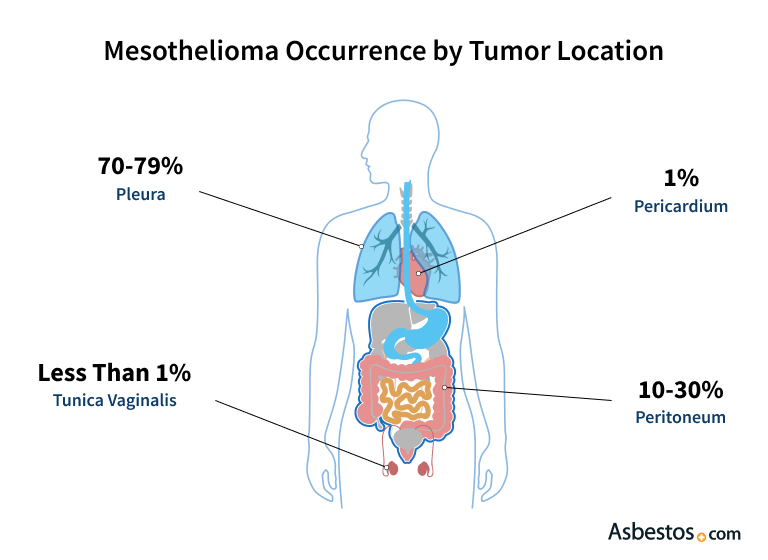
About 80% of mesothelioma cases are pleural. About 20% are peritoneal.
The 5-year survival rate for pleural mesothelioma is 12%. For peritoneal mesothelioma, it’s 65%.
“This can be a very overwhelming diagnosis. The doctor tells you you have a diagnosis and you don't even know how to pronounce it. You go home, you start navigating on the internet which can be very scary and you start learning some of the statistics that you see on the internet and you feel like ‘Can I even share this with my family?’ It can be very scary. We're there for them. They are never alone.”
Karen Selby, registered nurse and Patient Advocate at The Mesothelioma Center
“The prognosis for mesothelioma patients is not as good as it is with some other cancers… but it is not nearly as bad as is often portrayed. People with early-stage disease, and certain types and certain factors that contribute to prognosis are very individual. And how any one person does is very specific to that person, not some large data set. So while it's a difficult and challenging disease, the prognosis is variable.”
Dr. Andrea Wolf, director of the Women’s Lung Cancer Program at Mount Sinai
“There have been people who survived way beyond what the statistics say. I plan on being one of those. I have a lot of people counting on me being around. I’m not going to disappoint them.”
Tina H., pleural mesothelioma survivor
The CDC reported 2,803 new mesothelioma cases in the U.S. in 2021. Doctors diagnose about 3,000 cases annually. Incidence trends reflect a 20 to 60 year latency period.
U.S. mesothelioma incidence declined roughly 55% for men since a 1992 peak, while women’s rates were relatively stable, per SEER data.
Veterans account for approximately 30% of all mesothelioma diagnoses in the United States.
About 80% of mesothelioma cases are pleural. About 20% are peritoneal.
The 5-year survival rate for pleural mesothelioma is 12%. For peritoneal mesothelioma, it’s 65%.
How Common Is Mesothelioma?
Mesothelioma is a rare cancer. For every 100,000 people in the United States, fewer than 1 new mesothelioma case was reported in 2021. Doctors diagnosed 72,779 new cases of mesothelioma in the U.S. from 1999 to 2021. Since 1999, the highest number of new mesothelioma cases in the U.S. occurred in 2011, with 3,376 diagnoses. While cases were trending down in 2020 and 2021, the COVID-19 pandemic may have delayed diagnoses during this time period.
These figures reflect the latest available data from the Centers for Disease Control and Prevention, the National Program of Cancer Registries and the National Cancer Institute’s U.S. Cancer Statistics Working Group and the Surveillance, Epidemiology and End Results Program. The most recent federal mesothelioma data is from 2021 because gathering and reporting accurate information from these federal agencies takes time.
Peritoneal mesothelioma survivor and advocate Tamron Little understands just how rare this cancer is. She tells us, “Mesothelioma is a very rare cancer. The first oncologist I saw was honest and said he didn’t know anything about peritoneal mesothelioma. After that visit, I was determined to find a mesothelioma specialist.”
Learn about your diagnosis, top doctors and how to pay for treatment in our free mesothelioma guide.
Mesothelioma incidence rates vary across the United States. Data from the United States Cancer Statistics (USCS) Working Group, a collaboration between the CDC and the National Cancer Institute’s (NCI) SEER Program, shows significant geographic differences.
California, Pennsylvania, Washington and other states with long histories of shipbuilding, oil refining and asbestos manufacturing report high mesothelioma rates. In 2021, California had 284 new cases, Florida 237 and Texas 206. USCS Working Group data from 2021 shows the mesothelioma incidence rate in Washington state was 0.9 per 100,000 people. The mesothelioma incidence rate in Pennsylvania was 0.8 per 100,000 people in 2021.
Highest Rates Per 100K People
Idaho: The total new case count was 21 and the state population in 2021 was 1,904,314. The age-adjusted rate of new mesothelioma cases in 2021 in these states was 0.9 in 100,000 people.
Minnesota: The total new case count was 69 and the population of the state in 2021 was 5,711,471. The age-adjusted rate of new mesothelioma cases in 2021 in these states was 1.0 in 100,000 people.
New Hampshire: The total new case count was 21 and the state population in 2021 was 1,387,505. The age-adjusted rate of new mesothelioma cases in 2021 in these states was 1.0 in 100,000 people.
New Jersey: The total new case count was 114 and the state population in 2021 was 9,267,961. The age-adjusted rate of new mesothelioma cases in 2021 in these states was 1.0 in 100,000 people.
California, Pennsylvania, Texas, New York and Ohio had the highest mesothelioma-related mortalities between 2016 and 2021. Delaware’s mortality rate from 2018-2021 was 1 per 100,000 people. Maine’s was 1 per 100,000. Alaska’s was 1.2 per 100,000. Puerto Rico had a mortality rate of 0.1 per 100,000. Georgia had a mortality rate of 0.4 per 100,000.
Source:
U.S. Cancer Statistics Working Group
Surviving Mesothelioma Book
A Survivor’s Guide to Living With Mesothelioma
Learn about Judy Glezinski’s inspiring journey as a mesothelioma survivor, and get tips on how to improve your prognosis.
The No. 1 cause of mesothelioma is occupational asbestos exposure. Asbestos is a naturally occurring mineral that saw wide use in construction, manufacturing and military applications from the 1940s through the 1970s. When people inhale or ingest asbestos fibers, they embed in the body’s protective linings, causing cellular damage that can lead to mesothelioma decades later. People working in construction, shipyards, manufacturing and the U.S. military have the highest mesothelioma incidence, according to research from the National Institute for Occupational Safety and Health.
Researchers from the Respiratory Health Division, National Institute for Occupational Safety and Health, the University of Pittsburgh and Indiana University published a study in Environmental Research in 2023. It maps occupations, industries and mesothelioma incidence from 2006–2022 and confirms industrial and military exposure causes most U.S. mesothelioma cases.
Mesothelioma Cases by Occupation From 2006-2022
Manufacturing 30.1%: Includes foundry workers, welders, auto plant workers, shipbuilders and chemical plant workers.
Construction 18.5%: Includes insulation workers, carpenters, pipefitters, roofers and brick masons.
Educational services 8.8%: Includes teachers, custodians, maintenance staff and administrators.
Health care and social assistance 8.7%: Includes nurses, doctors, health technicians, hospital staff, janitors and maintenance staff.
Professional, scientific and technical 8.6%: Includes engineers, architects, consultants and lab technicians.
Military 7.9%: Includes shipyard workers, boiler technicians, mechanics, Naval ship and submarine personnel.
Public administration 7.9%: Includes police officers, emergency responders and corrections officers.
Other services 7.9%: Includes auto mechanics, HVAC technicians and small engine repair technicians.
Transportation and warehousing 7.1%: Includes truck drivers, shipyard and dock workers, train operators and vehicle maintenance crews.
Retail trade 6.4%: Includes auto parts dealers and clerks, as well as store workers.
Family members of workers who encountered asbestos can develop mesothelioma through secondary exposure. It’s the most common way women encounter asbestos, affecting about 44% of women compared to 3% of men.
Veterans account for approximately 30 to 33% of all mesothelioma diagnoses in the U.S., according to the Department of Veterans Affairs. Navy veterans face the highest risk because shipbuilders and naval crews relied heavily on asbestos aboard vessels.
Mesothelioma Statistics by Tumor Location
Where tumors first develop affects survival rates significantly. About 73% of people with pleural mesothelioma survive 1 year. The 5-year survival rate is 12%. For peritoneal mesothelioma, 92% survive 1 year. The 5-year survival rate is 65%. For pericardial mesothelioma, 26% survive 1 year. The 5-year survival rate is 9%.
Type
% of Cases
1-Year Survival
5-Year Survival
Pleural
80%
73%
12%
Peritoneal
~20%
92%
65%
Pericardial
~1%
26%
9%
Testicular
<1%
Data limited
Data limited
Source:
SEER
Survival rates also vary by cell type. Epithelioid mesothelioma is the most common cell type, accounting for approximately 60% to 70% of diagnoses. Patients with epithelioid mesothelioma typically survive roughly twice as long as those with sarcomatoid mesothelioma.
The incidence rate of pleural mesothelioma is significantly higher than for any other mesothelioma type. About 80% of cases occur in the pleura, the smooth tissue surrounding the lungs. About 20% of cases are peritoneal mesothelioma, which develops in the peritoneum, the smooth lining of the abdomen. About 1% are pericardial cases, forming in the heart’s lining, the pericardium. Fewer than 1% of mesothelioma cases are testicular, developing in the tunica vaginalis, the tissue that covers the testes.
Pleural is the most common type of mesothelioma.
Source:
SEER
Mesothelioma Treatment Statistics
Treatment significantly extends survival for mesothelioma patients. Peritoneal patients who receive HIPEC surgery have a 50% or greater chance of surviving 5 years, and immunotherapy combinations have extended median survival beyond 18 months for some pleural patients.
A recent study presented at the European Lung Cancer Congress looked at combining 2 or more mesothelioma treatment options, known as a multimodal approach. Patients receive sequential treatments such as surgery, followed by chemotherapy and radiation. The study showed a 1-year survival rate of 79.6% for pleural mesothelioma patients who underwent a combination of surgery, chemo and radiation.
Treatment’s Effect on Mesothelioma Survival
Of peritoneal patients who receive HIPEC, 50% live more than 5 years. An International Journal of Hyperthermia study also found a median disease-free survival of almost 5 years and median overall survival of more than 8 years.
Chemo may triple the survival rate of mesothelioma patients, according to a study of SEER data.
Immunotherapy combining Opdivo (nivolumab) and Yervoy (ipilimumab) showed a median overall survival of 18.1 months versus 14.1 months for standard chemo in the CheckMate-743 trial. The FDA approved this combination as a first-line option for some people with pleural mesothelioma that surgeons can’t remove.
More than 60% of patients receive chemo, the most common treatment for mesothelioma.
More than 65% of those who receive chemo live 3 years or more.
Clinical trials are research studies testing new drugs, surgical techniques and treatment combinations. These trials give patients access to breakthrough therapies that could extend survival. Another key to successful outcomes is beginning treatment as early as possible. Mesothelioma symptoms often don’t appear until people are already in later stages. Regular screenings for people with asbestos exposure can help catch the disease early.
FREE MESOTHELIOMA TREATMENT GUIDE
Expert Guidance for Your Mesothelioma Journey
Get answers about treatment, top doctors, and clinical trials from the nation’s most trusted mesothelioma resource.
Government agencies break down and study mesothelioma statistics among different demographics to help understand risk and prognosis. Different ages, genders, races or ethnicities have different incident rates.
This information also helps agencies identify and address disparities in access to screenings, diagnosis and treatment. As the Utah Department of Health and Human Services explains, “Analysis of public health data by demographic characteristics is essential to the reduction and elimination of health disparities.”
Mesothelioma Incidence by Age
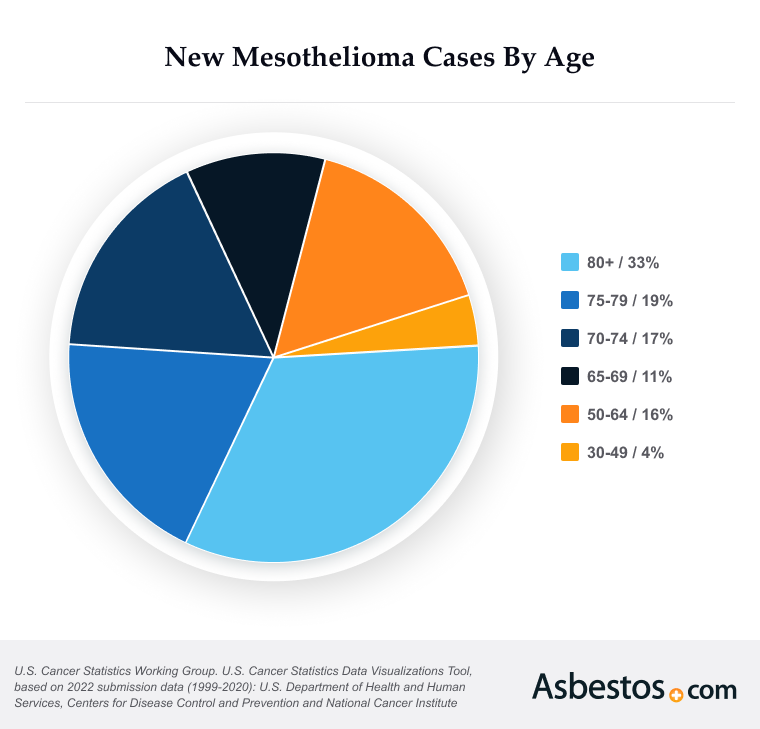
CDC data from 2021 showed 33% of people diagnosed with mesothelioma were 80 or older. People between the ages of 75-79 comprised 19% of new cases in 2021. About 4% of cases were among people between the ages of 35-49.
The latency period is generally shorter for peritoneal mesothelioma than for pleural mesothelioma. Most people diagnosed with peritoneal and pleural mesothelioma are about 51 and 67 years old, respectively.
Mesothelioma survivor Tamron tells us she wasn’t in the usual age demographic when diagnosed. She shares, “I was just 21 years old. My case was as rare as you can get.”
The highest mesothelioma incidence is among people 75 and older.
Source:
Data from the U.S. Cancer Statistics Working Group
Mesothelioma Survival Rates by Age
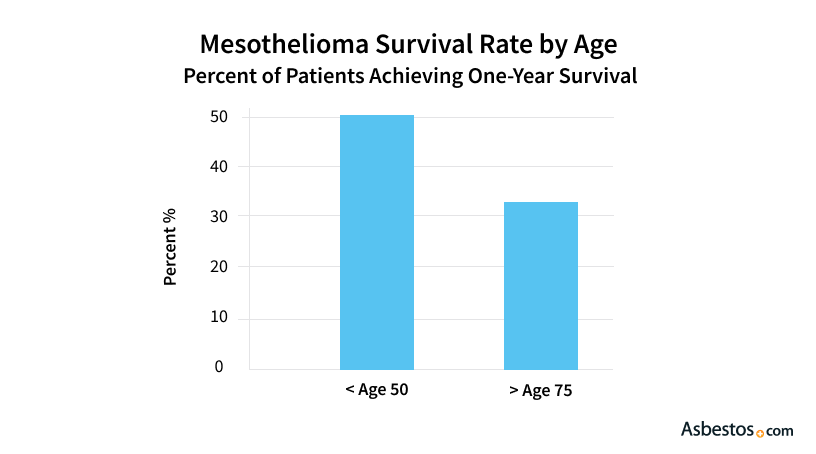
Younger patients have significantly higher mesothelioma survival rates than older patients. More than 50% of patients diagnosed before the age of 50 survive 1 year, while fewer than 33% of those 75 or older survive the same length of time.
There were 502 mesothelioma deaths among patients ages 85 and older in 2022, the latest year for which data on mortality by age is available. That same year, 21 people between the ages of 45 and 49 died of mesothelioma.
Younger people tend to survive longer with mesothelioma.
Source:
SEER
Mesothelioma Incidence by Gender
Historically, mesothelioma has been primarily diagnosed in men. According to the CDC’s United States Cancer Statistics, men made up 70% and women 30% of new mesothelioma cases in the U.S. in 2021. There were 1,973 new mesothelioma cases among men and 830 in women.
Women at the highest risk of developing mesothelioma from asbestos exposure are registered nurses, homemakers and teachers in elementary and middle school. A recent study found among people older than 44 years, mesothelioma incidence rates were higher among men. Among those younger than 45 years, women had higher incidence rates.
Source:
U.S. Cancer Statistics Working Group.
Mesothelioma Latency Period by Gender
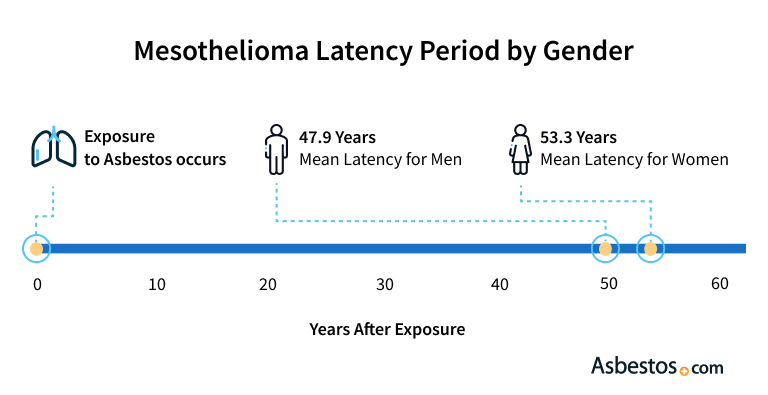
The time from the initial asbestos exposure to when symptoms appear, or latency period, tends to be longer for women than for men. It’s believed this is because a significant percentage of women experienced secondhand exposure over time rather than primary exposure.
Men’s higher rates of heavy occupational asbestos exposure likely result in a shorter latency period. The latency period for men is about 48 years. The latency period for women is about 53 years.
The mesothelioma latency period is about 5 years shorter in men than women.
Source:
Industrial Health
Mesothelioma Survival Rates by Gender
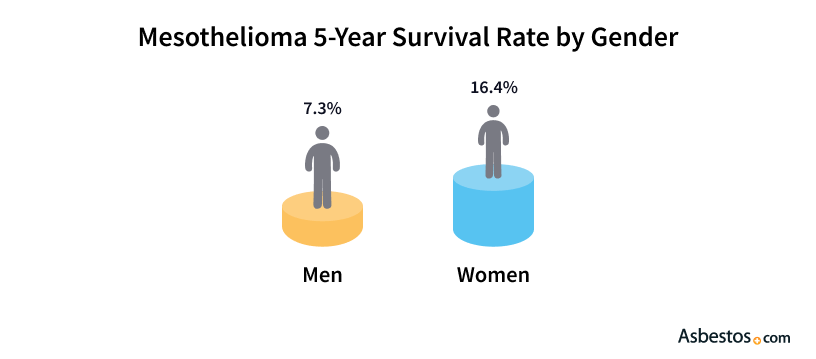
Women tend to have better survival rates than men. For example, the 5-year survival rate for women with pleural mesothelioma is about 16%. For men, it’s around 7%.
However, according to the CDC, mesothelioma deaths among women increased significantly. Mesothelioma cancer deaths for women increased 25% from 1999 to 2020. Combining statistics for both men and women, there were 2,376 mesothelioma deaths in 2020.
The 5-year survival rate for women with pleural mesothelioma is about 50% higher than the rate for men. While men account for the majority of diagnoses, the number of mesothelioma deaths among women rose 25% from 1999 to 2020. Women are also more likely to develop peritoneal mesothelioma than men, which generally carries a more favorable prognosis.
The 5-year survival rate for women with pleural mesothelioma is about 50% higher than the rate for men.
Source:
Annals of Thoracic Surgery
Mesothelioma Statistics by Race or Ethnicity
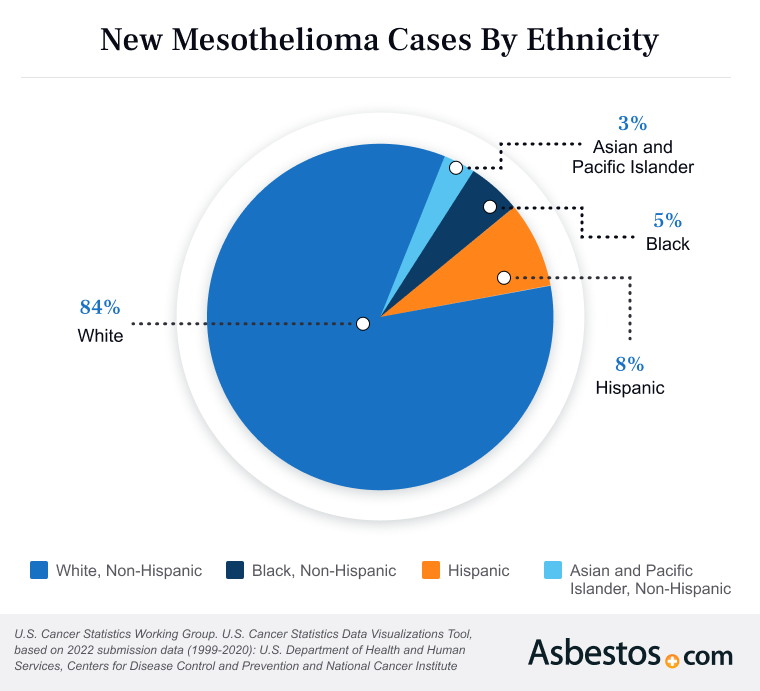
Most people with mesothelioma are non-Hispanic white. In 2021, they made up 81% of all cases. Between 2017 and 2021, the CDC reported 12,174 new cases among whites. In comparison, there were 1,275 cases among Hispanics and 741 cases among non-Hispanic Blacks.
Data from SEER shows that mesothelioma cases in non-Hispanic whites have gone down from 1.3 per 100,000 people in 2000 to 0.8 in 2021. For Hispanic, non-Hispanic Black, and non-Hispanic Asian/Pacific Islander groups, the rates have stayed about the same.
Survival rates also differ by race. In 2015, the 5-year survival rate was about 19% for Black patients, compared to about 9% for white patients.
The mesothelioma incidence rate is highest among white men and women.
Women and Mesothelioma
Although mesothelioma is more common in men, women account for approximately 30% of U.S. diagnoses. Secondary asbestos exposure is the most common exposure pathway for women, accounting for approximately 44% of female cases.
Women most at risk for occupational exposure include registered nurses, elementary and middle school teachers and homemakers, according to CDC data. Among people younger than 45, women have higher mesothelioma incidence rates than men in the same age group.
Women with mesothelioma may also have been exposed through talcum powder products, which have tested positive for asbestos contamination. Women are also more likely to develop peritoneal mesothelioma, which generally produces better survival outcomes than pleural mesothelioma.
Mesothelioma Statistics Worldwide
WHO estimates that globally more than 200,000 people die annually from asbestos-related diseases. A study in Occupational and Environmental Medicine used WHO data to estimate that mesothelioma specifically accounts for roughly 38,000 of those deaths each year. Many experts believe the true toll is likely higher because of underreporting in countries without robust cancer registry infrastructure.
Australia, the United Kingdom and the Netherlands have the highest per-capita mesothelioma rates, reflecting early and heavy industrial asbestos use. India, China, Russia and other nations that continued heavy asbestos use into the 1990s and beyond haven’t yet reached their incidence peak, and many lack the infrastructure to accurately report cases.
The disease’s 20 to 60-year latency period means countries with more recent asbestos use will see cases rise in the decades ahead. The global picture underscores that asbestos-containing materials in older U.S. buildings and imported products remain a source of exposure risk, even as domestic industrial use has significantly declined.
Mesothelioma Costs and Financial Statistics
The National Cancer Institute estimates that the first year of lung cancer treatment costs more than $60,000. Mesothelioma treatment costs are similar. These expenses can include hospital bills, lost income, and travel for care.
Some patients may qualify for financial help, like VA benefits or Social Security Disability Insurance. Others may file legal claims, such as asbestos trust fund claims and mesothelioma lawsuits, to help pay for costs.
Mesothelioma Claims and Financial Compensation
Of the 4,244 asbestos lawsuits filed in 2025, 48% (2,035) were mesothelioma lawsuits, according to KCIC’s Asbestos Litigation: 2025 Year in Review.
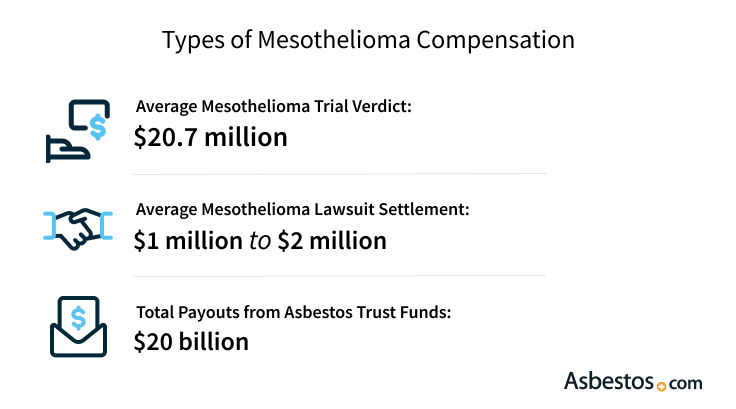
The average settlement is between $1 million and $2 million. Most mesothelioma cases are resolved through settlement rather than trial. Settlement amounts vary based on exposure history, diagnosis details, age and the number of defendants named.
The average trial verdict is $20.7 million, according to Mealey’s Litigation Report 2024.
There are more than 60 asbestos trust funds still available for future claims. Companies that filed for bankruptcy created asbestos trust funds, which operate independently of the legal system.
Between 2004 and 2016, asbestos trust funds paid nearly $24 billion to claimants. Payout amounts vary significantly across funds.
Patient Advocate and VA-accredited claims agent Danielle DiPietro explains: “It’s important for patients and families to seek out financial assistance. You really can’t expect what a diagnosis is going to cost for treatment or at-home care, or what your family’s needs are. So it’s always important to plan for the future.”
The average payouts from mesothelioma trials, settlements and trust funds.
Source:
Mealey’s Litigation Report
Frequently Asked Questions About Mesothelioma Statistics
How many people are diagnosed with mesothelioma each year?
Approximately 3,000 people receive a mesothelioma diagnosis in the United States each year. The CDC reported 2,803 new cases in 2021, the most recent year of available federal data. For every 100,000 people in the U.S., doctors diagnose fewer than 1 new case annually, making mesothelioma a rare cancer.
What is the survival rate for mesothelioma?
Survival rates for mesothelioma vary significantly by type. About 12% of people with pleural mesothelioma survive 5 years, while about 65% of people with peritoneal mesothelioma survive 5 years. Peritoneal survival rates reflect the availability of HIPEC surgery, and published SEER figures typically lag real-world outcomes by 5 to 10 years. Immunotherapy combinations have also improved outcomes for some pleural patients.
Is mesothelioma increasing or decreasing in the United States?
Mesothelioma diagnoses in the United States have declined roughly 40% since peaking in the early 1990s, though doctors still diagnose approximately 3,000 new cases annually. Cases continue today because the disease carries a 20 to 60-year latency period, meaning doctors are still diagnosing people who encountered asbestos decades ago. The COVID-19 pandemic may have affected 2020–2021 counts, as delays likely pushed some diagnoses into later years. Mesothelioma death rates among women haven’t declined at the same pace as those among men.
Who is most at risk for mesothelioma?
People with occupational asbestos exposure face the highest risk of mesothelioma. Manufacturing workers account for 22% of U.S. cases and construction workers account for 13.5%. Veterans account for approximately 30 to 33% of all mesothelioma diagnoses in the U.S., and secondary household exposure is the most common pathway for women. The disease’s 20 to 60-year latency period means many people who encountered asbestos decades ago are still being diagnosed today.
What is the life expectancy for mesothelioma patients?
The typical life expectancy after a pleural mesothelioma diagnosis is 12 to 21 months. A 2018 study of highly selected patients reported median survival of more than 8 years, though most peritoneal mesothelioma patients who receive HIPEC surgery have a median overall survival of 53 months. Cell type also plays a role. People with epithelioid mesothelioma typically survive approximately twice as long as those with sarcomatoid mesothelioma. Younger patients generally have better outcomes than older patients. Individual outcomes vary substantially depending on diagnosis stage, overall health and treatment options.
Your web browser is no longer supported by Microsoft. Update your browser for more security, speed and compatibility.
If you are looking for mesothelioma support, please contact our Patient Advocates at (855) 404-4592
Fact Checked
Our fact-checking process begins with a thorough review of all sources to ensure they are high quality. Then we cross-check the facts with original medical or scientific reports published by those sources, or we validate the facts with reputable news organizations, medical and scientific experts and other health experts. Each page includes all sources for full transparency.
Reviewed
Asbestos.com is the nation’s most trusted mesothelioma resource
The Mesothelioma Center at Asbestos.com has provided patients and their loved ones the most updated and reliable information on mesothelioma and asbestos exposure since 2006.
Our team of Patient Advocates includes a medical doctor, a registered nurse, health services administrators, veterans, VA-accredited Claims Agents, an oncology patient navigator and hospice care expert. Their combined expertise means we help any mesothelioma patient or loved one through every step of their cancer journey.
More than 30 contributors, including mesothelioma doctors, survivors, health care professionals and other experts, have peer-reviewed our website and written unique research-driven articles to ensure you get the highest-quality medical and health information.
About The Mesothelioma Center at Asbestos.com
Assisting mesothelioma patients and their loved ones since 2006.
Helps more than 50% of mesothelioma patients diagnosed annually in the U.S.
A+ rating from the Better Business Bureau.
5-star reviewed mesothelioma and support organization.
My family has only the highest compliment for the assistance and support that we received from The Mesothelioma Center. This is a staff of compassionate and knowledgeable individuals who respect what your family is experiencing and who go the extra mile to make an unfortunate diagnosis less stressful. Information and assistance were provided by The Mesothelioma Center at no cost to our family.
Registered Nurse and Board Certified Patient Advocate
Karen Selby is a registered nurse and Board Certified Patient Advocate at The Mesothelioma Center with more than 30 years of experience in oncology and thoracic surgery. She worked as an operating room nurse in thoracic surgery at the University of Maryland for 6 years, assisting with surgeries such as lung transplants, pneumonectomies and pleurectomies. She later served as regional director of the tissue procurement program at the University of Florida. Karen joined The Mesothelioma Center in 2009, providing patients with personalized support and resources.
Fact-checked and verified content:
Our fact-checking process begins with a thorough review of all sources to ensure they are high quality. Then we cross-check the facts with original medical or scientific reports published by those sources, or we validate the facts with reputable news organizations, medical and scientific experts and other health experts. Each page includes all sources for full transparency.
Please read our editorial guidelines to learn more about our content creation and review process.