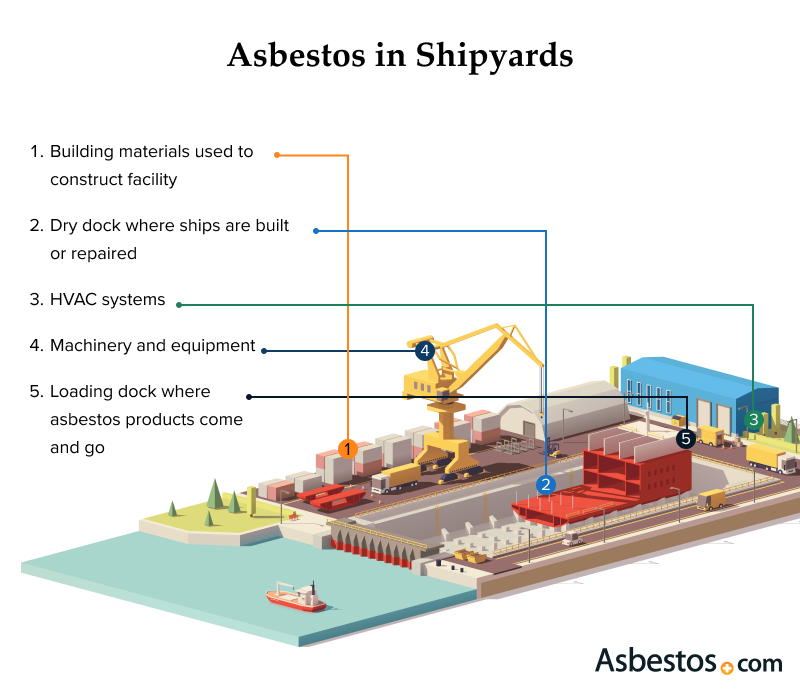
Shipyard workers suffer higher rates of mesothelioma, lung cancer and asbestosis because asbestos products were used in nearly every part of shipbuilding. U.S. veterans were exposed in Navy shipyards and civilians were exposed in commercial shipyards to asbestos insulation, gaskets, pumps and pipes.
Virginia, Massachusetts, Florida, District of Columbia, Washington
How Do Shipyard Workers Face Asbestos Exposure?
Cutting, drilling, handling and sanding asbestos materials exposed shipyard workers. Such activities release dust with asbestos fibers into the air. Inhalation of these fibers occurred through both direct and indirect means. The fibers traveled beyond their origin to expose workers in other areas.
Repeated exposure increases the risk of workers developing mesothelioma. Historically, many shipbuilding components used asbestos. The mineral resists corrosion by ocean water. Engine gaskets, seals and pipe insulation used asbestos for its strength and fire resistance.
Shipyard building materials also contributed to occupational exposure. Asbestos panels were common in yard equipment and in buildings.
The NGO Shipbreaking Platform reports that commercial ships may contain up to 10 tons of asbestos, and U.S. Navy vessels may have up to 900 tons. A 2021 Maritec survey found that more than 55% of in-service ships and 50% of new builds contain asbestos. Regulations to reduce asbestos use in ships have failed to protect workers.
Common places asbestos was found in shipyards, including engine rooms, insulation, gaskets and boiler rooms.
Asbestos Products Associated with Shipyard Workers
Shipyards used asbestos products for most of the 20th century. Insulation, gaskets, seals, brakes and cement had asbestos. Before 1975, the U.S. Navy relied heavily on asbestos materials throughout its vessels. Shipbuilders used asbestos in engine rooms, sleeping quarters and boiler rooms.
A 1975 regulation limited its use when alternatives were available. In 1979, an amendment urged the removal of some asbestos insulation. Workers exposed prior to these regulations are still developing diseases now. Mesothelioma has a long latency period, the time between asbestos exposure and diagnosis, of up to 60 years.
Most U.S. manufacturers have now phased out asbestos from their products. But workers may still find it in older materials in shipyards today. Widespread use meant many shipyard workers faced a risk. They remain at risk of developing asbestos-related illnesses.
Product
How shipyard workers encountered it
Adhesives
Workers used various asbestos adhesives to seal and repair ships.
Bedding
The filler used to stuff mattresses contained asbestos as a fireproofing material. Shipyard workers who built sleeping quarters got exposed to this material.
Cables
Asbestos in cables, including wire cables, made them stronger and salt-resistant.
Cement
Asbestos cement was a popular material in the construction of shipyards. Workers used corrugated asbestos sheets to build the shipyard’s walls and roofs.
Hydraulic assemblies
Asbestos insulation and packing were in the hydraulic assemblies and pumps.
Insulation
On ships, the most common asbestos insulations were spray-on insulation and pipe wrap. It was also found in the form of block insulation and packing material used on pumps, valves and boilers.
Gaskets and valves
Amosite asbestos, a brown form of the mineral, was the best fiber for marine gaskets and valves. It withstood salt corrosion.
Paint and coatings
Asbestos paint and coatings covered ships. They provided fireproofing. Deck covering material had asbestos for its strength and fire resistance.
Panels
Workers used asbestos heat paneling in ships to make fireproof walls and barriers.
Pumps
Asbestos insulation was common in and around pumps. Frequent repairs were necessary because of wear and tear.
Textiles
Sails and fireproof blankets on ships contained asbestos textiles. Workers used the blankets in shipyards to put out fires and prevent burns.
Shipyard Jobs With the Highest Asbestos Exposure
Asbestos exposure in a shipyard depended heavily on the trade. The U.S. Navy graded likely exposure according to job specialty, and workers in engine rooms, boiler rooms and insulation trades often had the most direct contact. Dockyard workers who never handled asbestos directly could still breathe toxic fibers that traveled through the yard.
The Navy contracted GAF to insulate ships with various asbestos products like heat panels, pipe coverings, boiler jackets and asbestos cement.
Johns Manville
JM made products to repair ships for the Navy and private industries. These included transite asbestos cement, a rigid asbestos board, plus block insulation, heat panels and weatherproofing coatings and adhesives.
Keasbey & Mattison
K&M made corrugated asbestos cement used to build shipyards. It also sold asbestos textiles to manufacture fireproof sails.
Pryor Giggey Co.
This company made asbestos insulation for marine-grade boilers.
FREE MESOTHELIOMA GUIDE FOR VETERANS
Expert Guidance for Veterans with Mesothelioma
Find out if you qualify to file a VA claim with help from the nation’s most trusted mesothelioma resource.
Shipbuilders used asbestos insulation, gaskets and pipe wrap throughout most of the 20th century. As a result, shipyard workers develop mesothelioma, asbestosis, pleural plaques and lung cancer at higher rates than the general working population.
Shipyard workers are at increased risk of developing mesothelioma and other asbestos-related diseases. A 2024 study in the Annals of Work Exposures and Health analyzed asbestos fibers in the lung tissue of individuals who died from mesothelioma. It uncovered a direct correlation between the amount of asbestos and the risk of mesothelioma in shipyard workers. Research from the National Institute for Occupational Safety and Health and the Centers for Disease Control and Prevention also documents elevated cancer risk among shipyard workers exposed to asbestos.
A 2024 study of asbestos-related disease in Palermo, Italy, found that 92.2% of cases occurred in workers from the shipbuilding sector. Mesothelioma accounted for more than 15% of the cases in the Palermo group. Other diseases included asbestosis, pleural plaques and lung cancer.
There is a well-established link between asbestos exposure and mesothelioma. Several studies from decades ago prove a link. Researchers believe asbestos causes DNA damage that leads to cancer.
How Shipyard Work Exposed Families
Shipyard workers could carry asbestos fibers home on their coveralls, skin and hair. Spouses who shook out or washed work clothes and children who greeted a parent after a shift could inhale those hazardous fibers without ever entering a shipyard. Among The Mesothelioma Center’s documented survivor cases, 26 of 215 (12.1%) involved secondary asbestos exposure. Family members who develop mesothelioma after this type of exposure may also be able to file a secondary asbestos exposure lawsuit.
Shaun B.
Verified Asbestos.com Survivor
Mesothelioma Survivor Recounts Family Exposure in Shipyards
Shaun B.’s father worked at the Ford Motor Company in Norfolk, Virginia. He had also worked at the Norfolk Naval Shipyard in Portsmouth, Virginia. Both are known for a high risk of asbestos exposure. Shaun tells us that he also worked at both locations where his father had worked. This could mean that he and his father have shared occupational asbestos exposure or primary exposure histories.
The Occupational Safety and Health Administration standards regulate asbestos in shipyards. It puts responsibility for worker safety on employers. OSHA requires notifying employees about asbestos at a worksite. It also sets limits on the environment and requires personal protective equipment.
Shipyard Safety Regulations
EPA 40 CFR Part 751: Asbestos Part 1; Chrysotile Asbestos; Regulation of Certain Conditions of Use Under the Toxic Substances Control Act
OSHA 29 CFR part 1915: Occupational Safety and Health Standards for Shipyard Employment
OSHA CPL 03-00-020: OSHA’s National Emphasis Program on Shipbreaking
The standard sets long-term practices in addition to prevention. Employers must screen employees who exceed exposure limits. They must also keep detailed records of exposure monitoring for at least 30 years. These records can still exist decades later, and a former shipyard worker’s exposure history may help support a claim.
Navigate Treatment Costs
See If You Qualify for Lung Cancer Compensation
If you developed lung cancer after being exposed to asbestos at work, you may qualify for compensation.
Compensation for Shipyard Workers Exposed to Asbestos
Many shipyard workers have won claims for asbestos-related illnesses. Former shipyard workers with mesothelioma may file lawsuits or asbestos trust fund claims. Family members who lost a loved one may be able to file awrongful death claim.
Many asbestos lawsuits have involved Navy veterans. The Federal Tort Claims Act allows the U.S. government to escape liability for its role. It passes liability to private contractors. However, in May 2024, a judge ruled against a U.S. government request to dismiss a wrongful death case. The family of a Navy veteran’s wife filed after she died from mesothelioma.
Aaron Munz, veteran and director of the Veterans Department at The Mesothelioma Center, says the Navy grades a veteran’s likely asbestos exposure according to job specialty: “The Navy recognizes that every veteran had exposure to asbestos, but they categorize the amount of likely exposure based on the job specialty.”
If you are thinking of filing, work with a mesothelioma attorney. They should have a record of winning compensation for veterans and shipyard workers. This area of asbestos litigation is complex, so make sure to find an expert to handle your claim.
Notable Verdicts and Settlements
Amount
Year
Worker
Shipyard and Trade
$25 million
2011
Bert Minton
Newport News Shipbuilding, shipfitter and repair supervisor
$5.2 million
2007
Family of Richard Walmach
Puget Sound Naval Shipyard, machinist’s mate
$4.25 million
2019
Douglas Everson and his wife
Lockheed Shipyard, marine electrician
Common Questions About Shipyard Workers and Asbestos
Which shipyard jobs had the highest asbestos exposure?
Exposure varied heavily by trade in a shipyard. Insulators, boilermakers, pipefitters and other workers who handled asbestos-insulated equipment directly, especially in enclosed engine and boiler rooms, experienced the heaviest exposure.
What is shipyard lung disease?
Shipyard lung disease refers to the group of illnesses asbestos exposure causes in the lungs, including mesothelioma, asbestosis, pleural plaques and lung cancer. Shipbuilders used asbestos throughout most of the 20th century, which is why shipyard workers developed these diseases at high rates. Lung cancer is one of the most common diagnoses in former shipyard workers.
How does asbestos exposure in ship engine rooms compare with exposure elsewhere in a shipyard?
Ship engine rooms could create especially heavy asbestos exposure because workers handled insulated pipes, boilers, pumps and gaskets in enclosed spaces with limited ventilation. Disturbing these materials could release fibers that remained concentrated in the work area.
Can shipyard work cause lung cancer as well as mesothelioma?
Yes, asbestos exposure in a shipyard can cause lung cancer, not only mesothelioma. Many doctors never told former shipyard workers with lung cancer that their diagnosis could trace back to asbestos on the job.
Can the family of a shipyard worker develop mesothelioma?
Yes, family members can develop mesothelioma after breathing in asbestos fibers a shipyard worker carried home on clothes, skin or hair. This is called secondary asbestos exposure, also known as take-home exposure.
Can you sue the U.S. Navy for asbestos exposure?
The Federal Tort Claims Act generally shields the U.S. government, including the Navy, from asbestos lawsuits. Shipyard workers instead hold private asbestos manufacturers and shipyard operators liable for their diseases. A mesothelioma lawsuit can identify the companies responsible for a worker’s asbestos exposure.
How do mesothelioma law firms handle Navy shipyard asbestos cases?
Mesothelioma law firms investigate where and how a Navy shipyard worker encountered asbestos. Attorneys can use military service records, job specialties, shipyard records and known asbestos product histories to reconstruct a worker’s exposure.
Recommended Reading
Your web browser is no longer supported by Microsoft. Update your browser for more security, speed and compatibility.
If you are looking for mesothelioma support, please contact our Patient Advocates at (855) 404-4592
Fact Checked
Our fact-checking process begins with a thorough review of all sources to ensure they are high quality. Then we cross-check the facts with original medical or scientific reports published by those sources, or we validate the facts with reputable news organizations, medical and scientific experts and other health experts. Each page includes all sources for full transparency.
Reviewed
Asbestos.com is the nation’s most trusted mesothelioma resource
The Mesothelioma Center at Asbestos.com has provided patients and their loved ones the most updated and reliable information on mesothelioma and asbestos exposure since 2006.
Our team of Patient Advocates includes a medical doctor, a registered nurse, health services administrators, veterans, VA-accredited Claims Agents, an oncology patient navigator and hospice care expert. Their combined expertise means we help any mesothelioma patient or loved one through every step of their cancer journey.
More than 30 contributors, including mesothelioma doctors, survivors, health care professionals and other experts, have peer-reviewed our website and written unique research-driven articles to ensure you get the highest-quality medical and health information.
About The Mesothelioma Center at Asbestos.com
Assisting mesothelioma patients and their loved ones since 2006.
Helps more than 50% of mesothelioma patients diagnosed annually in the U.S.
A+ rating from the Better Business Bureau.
5-star reviewed mesothelioma and support organization.
My family has only the highest compliment for the assistance and support that we received from The Mesothelioma Center. This is a staff of compassionate and knowledgeable individuals who respect what your family is experiencing and who go the extra mile to make an unfortunate diagnosis less stressful. Information and assistance were provided by The Mesothelioma Center at no cost to our family.
Munz, A. (2026, October 8). Shipyard Workers and Asbestos. Asbestos.com. Retrieved October 15, 2026, from https://www.asbestos.com/occupations/shipyard-workers/
MLA
Munz, Aaron. "Shipyard Workers and Asbestos." Asbestos.com, 8 Oct 2026, https://www.asbestos.com/occupations/shipyard-workers/.
Chicago
Munz, Aaron. "Shipyard Workers and Asbestos." Asbestos.com. Last modified October 8, 2026. https://www.asbestos.com/occupations/shipyard-workers/.
My primary support since being diagnosed with Mesothelioma, over 2 years ago, has been this company. Their monthly nationwide support group has been a tremendous help for me. I have learned about others' treatments and have been able to freely discuss mine, knowing others walk the same walk as I do and fully understand. Karen Selby, the nurse and patient advocate, has helped me so much. I call her and she delivers. She's experienced in Thoracic surgeries, is supportive, kind, knowledgeable, and makes a patient feel very cared for! The whole staff are polite, caring, and will help with Mesothelioma victims' many needs. I feel very blessed to have this Organization by my side as I live with this cancer.
I found out about The Mesothelioma Center while researching Peritoneal Mesothelioma days after being diagnosed with malignant cancer. While a lot of the 'Mesothelioma' websites are actually law firms just trying to get your business, theirs is a user-friendly, comprehensive website set up to aid patients, their loved ones, and/or caregivers with all things related to a cancer diagnosis from asbestos exposure. I was soon put in touch with one of their doctors, Snehal Smart, M.D., who immediately sent me a packet of general information, a book on surviving Mesothelioma, and offered me assistance in finding doctors, reputable law firms, financial help, support groups, and so much more! The Mesothelioma Center's website is, in my opinion, the best resource for anyone suffering from cancer due to asbestos. Dr. Smart is amazing! She is very knowledgeable and helpful, but she is also a very kind, caring doctor who appears to go the distance whether she is researching a pertinent topic, making suggestions, providing contacts, or just being a good listener on the other end of the phone. In addition, Dr. Smart referred me to a law firm who is now fighting to get me compensation for the negligence of those defendants whose products exposed me to asbestos and caused my subsequent cancer. Thank you, TMC and Dr. Smart, for helping me determine the best treatment plan for my cancer and being part of my miracle. I am currently cancer-free and back to being a mom to my precious daughter. The Mesothelioma Center, their website, and their staff rock!!
I just want to take this time to thank Mesothelioma Center for all the information you provide. The survival stories are inspiring and give hope where hope is needed! Thanks to you, I have met many others on the site and continue to converse with them. Keep up the good work. I am always looking forward to your posts! Thank you, Richard Delisle.
My brother was recently diagnosed with mesothelioma. I began researching it online. The information I received from The Mesothelioma Center is all-inclusive. No need to look anywhere else! The first phone call was with Karen, and she answered all my questions with ease. She also had a calming effect by presenting all the options available for my brother and his family. Thank you!
My father was recently diagnosed with mesothelioma. We, as a family, were devastated. We were uncertain where to even start, so we reached out to The Mesothelioma Center. They were absolutely amazing. They provided physicians in our area who specialize in this type of cancer because it is so rare. They also set us up with a firm who specializes in getting funds that are set aside to help with our medical bills. I’m so glad we made the phone call. They were very knowledgeable, supportive, sincere, and true patient advocates.
Yvonne Waterman, Ph.D., is the founder of the European Asbestos Forum and a specialist in asbestos litigation. Waterman has worked to build a global network of professionals fighting for a future without asbestos exposure and disease.
Fact-checked and verified content:
Our fact-checking process begins with a thorough review of all sources to ensure they are high quality. Then we cross-check the facts with original medical or scientific reports published by those sources, or we validate the facts with reputable news organizations, medical and scientific experts and other health experts. Each page includes all sources for full transparency.
Please read our editorial guidelines to learn more about our content creation and review process.