

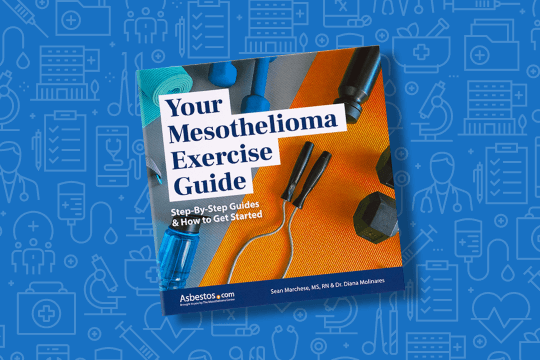
FREE EXERCISE GUIDE
Boost Your Energy During Treatment
Doctor-approved exercises to help mesothelioma patients maintain strength and manage treatment side effects.
Get Your Free GuideWhen you or someone you love is diagnosed with mesothelioma, coping with the related stress may feel overwhelming. Finding coping strategies and developing a support system is important for everyone involved in the cancer journey.

Written by Michelle Whitmer | Edited by Walter Pacheco | Last Update:

Exclusive Content
Brunilda Villareal: What have you learned from your husband’s mesothelioma diagnosis?
Exclusive Content
Brunilda Villareal: What have you learned from your husband’s mesothelioma diagnosis?

Being diagnosed with a rare cancer can feel like too much to handle, but all of your feelings of worry for yourself and your family are normal. There are ways to cope with the effects of mesothelioma on mental health and empower yourself to navigate the challenges of your survivor journey.
As the U.S. Centers for Disease Control and Prevention notes, as many as 75% of cancer survivors experience symptoms of psychological distress. The CDC also reports that 33% or fewer cancer survivors speak with their doctors about their needs.
Talking to your doctor is a good way to start to address your stress. Connecting with other mesothelioma survivors and hearing personal stories of hope and strength can also be a helpful place to start. Support groups, such as The Mesothelioma Center’s Mesothelioma Support Group can create a safe space for survivors to ask questions, discuss coping strategies and share perspectives.
Self-care looks different for everyone. What one person may find relaxing and recharging may not work for others. The key to making time for it is to spend it doing what makes you happy.
This can also be a time to explore new approaches and try new things. You may discover a new interest or technique that benefits you.
As registered and licensed dietitian Tejal Parekh explains, mesothelioma patients can experience a loss of appetite as a result of the cancer or its treatments. This can make mealtime less enjoyable and have a negative impact on overall wellbeing with reduced intake of key nutrients. Parekh suggests food journaling to practice self-care.
“A nutrition journal is an extremely useful tool because it allows you to see which foods work well for you during treatment and which foods are best avoided,” Parekh explains. “Often, it’s the little things that make a big difference. Finding a new drink or a new food that sits well can be a great feat and it can be really helpful to document that in your nutrition journal.”
Eating the right foods for you before, during and after treatment can help boost your overall well-being. Nutrition and treatment can support one another, helping you recover and feel stronger after treatment and prepare yourself for your next treatment.
Oncologists recommend gentle exercise to cancer patients because it improves quality of life. It lessens the side effects of treatment and reduces the risk of cancer recurrence. Research shows exercise lessens fatigue, enhances physical function and improves mood.
Complementary therapies such as mind-body therapies including yoga, tai chi, qigong provide gentle exercise and a relaxation effect. These therapies help patients process stress and lessen fatigue. They may reduce anxiety and improve sleep.
Meditation is a practice that aims to focus or clear the mind. Some types of meditation may have a spiritual focus, while others stress the importance of mindfulness.
Research on meditation for cancer patients shows it may reduce anxiety, lessen fatigue and improve quality of life. It may also improve fatigue, mood and sleep quality.
Enjoying hobbies, walks in nature and time with family may feel centering to those who do not wish to practice meditation. Meditation is safe for mesothelioma patients to practice, but patients should avoid meditations that call for fasting from food or water.
Doctor-approved exercises to help mesothelioma patients maintain strength and manage treatment side effects.
Get Your Free GuideDealing with the mental and emotional effects of a mesothelioma diagnosis is tough. Cancer centers often offer counseling and support groups to help patients and families cope.
Paying attention to mental health during a crisis helps everyone overcome challenges in healthier ways. Counseling and support groups are among the most effective options to improve mental health.
Counseling helps cancer patients cope with the challenges of treatment and recovery. Counselors now use many different types of therapies to help the unique needs of every patient. Many cancer centers offer free counseling services to patients.
Cancer support groups offer support from people who truly understand the struggle. They provide a safe space to talk about emotions and hard topics that few people understand. The support found in these groups is worth the effort of finding the right group.
Depression following a mesothelioma diagnosis is completely normal. Depression in mesothelioma patients may contribute to fatigue and appetite loss.
Patients with ongoing physical and mental symptoms of depression should get help from a professional. Helpful treatments include counseling, medication, support groups and therapeutic techniques.
Research shows that cancer patients can recover from depression when they get cancer-focused counseling.
Mesothelioma caregivers sometimes cope with different types of grief including anticipatory or complicated grief. All forms of grief are normal, and professionals agree that there is no right way to grieve.
Anticipatory grief occurs before the loss of a loved one with a terminal illness. Complicated grief is a period of mourning that endures for a long time without progress.
Getting support helps caregivers through the grieving process. Counseling, support groups, hobbies and time spent with family and friends can help.
Support for mental health is available for mesothelioma patients, caregivers and their families. It’s available online and in-person.
It’s important to get the help you need to support your mental and emotional health whether you’re a patient or caregiver. It takes effort and time, but the return is worth the investment.

People with mesothelioma should lean on their circle of support. If you serve as a caregiver, family member and co-worker, a strong support system will help you juggle all your responsibilities.
Ask for help. You can build a solid support network to help your family during this difficult time.
Neighbors may be able to help around the house or with food shopping. Churches may offer varying forms of support from meals to respite care. Community organizations may provide services such as transportation to medical appointments. Getting support will help you avoid burnout.
Recommended ReadingYour web browser is no longer supported by Microsoft. Update your browser for more security, speed and compatibility.
If you are looking for mesothelioma support, please contact our Patient Advocates at (855) 404-4592
The Mesothelioma Center at Asbestos.com has provided patients and their loved ones the most updated and reliable information on mesothelioma and asbestos exposure since 2006.
Our team of Patient Advocates includes a medical doctor, a registered nurse, health services administrators, veterans, VA-accredited Claims Agents, an oncology patient navigator and hospice care expert. Their combined expertise means we help any mesothelioma patient or loved one through every step of their cancer journey.
More than 30 contributors, including mesothelioma doctors, survivors, health care professionals and other experts, have peer-reviewed our website and written unique research-driven articles to ensure you get the highest-quality medical and health information.
My family has only the highest compliment for the assistance and support that we received from The Mesothelioma Center. This is a staff of compassionate and knowledgeable individuals who respect what your family is experiencing and who go the extra mile to make an unfortunate diagnosis less stressful. Information and assistance were provided by The Mesothelioma Center at no cost to our family.LashawnMesothelioma patient’s daughter


Whitmer, M. (2026, June 29). Coping With the Stress of a Mesothelioma Diagnosis. Asbestos.com. Retrieved September 3, 2026, from https://www.asbestos.com/support/mental-health/coping-strategies/
Whitmer, Michelle. "Coping With the Stress of a Mesothelioma Diagnosis." Asbestos.com, 29 Jun 2026, https://www.asbestos.com/support/mental-health/coping-strategies/.
Whitmer, Michelle. "Coping With the Stress of a Mesothelioma Diagnosis." Asbestos.com. Last modified June 29, 2026. https://www.asbestos.com/support/mental-health/coping-strategies/.

Michelle Whitmer has covered science and medicine for Asbestos.com for more than 15 years. She has been featured in multiplatform media, including The New York Times and KYW Newsradio. Whitmer is pursuing American Medical Writers Association certification, has completed OSHA Asbestos Standard for the Construction Industry training and is CDC certified in Health Literacy.
Our fact-checking process begins with a thorough review of all sources to ensure they are high quality. Then we cross-check the facts with original medical or scientific reports published by those sources, or we validate the facts with reputable news organizations, medical and scientific experts and other health experts. Each page includes all sources for full transparency.
Please read our editorial guidelines to learn more about our content creation and review process.

