


Expert Take
Dr. Andrea Wolf: What is the life expectancy of a mesothelioma patient
“Mesothelioma life expectancy varies widely based on numerous factors, including stage at diagnosis, overall health, and treatment approach. However, we now have more treatment options than ever, ranging from surgery and chemotherapy to immunotherapy, that not only extend survival but also significantly improve patients’ quality of life.”

Dr. Catherine Perrault, medical officer and board-certified family physician with our Medical Outreach Team
“When we talk about the life expectancy for a mesothelioma patient, or any cancer patient, we tend to talk about numbers. Any one person is largely affected by so many things. And… staying positive is one of the keys to long-term survival. Even people who have recurrent disease or progressive disease, as long as they're feeling well and doing well, can keep living with that disease the way many other people live with other chronic conditions.”

Dr. Andrea Wolf, director of the Women’s Lung Cancer Program at Mount Sinai
“[My father] did survive longer than what we had expected. His attitude, I think, once he got feeling better, after the chemo was done… he realized, ‘I’m doing better. I’ve got all these people who care about me.’ And my dad’s a worker. I mean, he’s like a workaholic. And as long as he had projects to do, it kept him moving. And it kept him moving for 14 years. So, yeah, he kept going with it. I think he just had the attitude of ‘I’m not done. I’m not done. I’m here. So now my time’s not over.”
Kim S., daughter of a mesothelioma patient
- 5-year survival rate: 12% for people with pleural mesothelioma
- Cell type impact: Epithelioid tumors have the longest life expectancy at 14.4 months for pleural and 51.5 months for peritoneal
- Gender difference: More than 75% of women with peritoneal mesothelioma live at least 5 years
- Life expectancy without treatment: 6 to 8 months
- Life expectancy with treatment: 12 to 21 months (pleural); 3 to 5 years (peritoneal)
- Longest known survivor: Jerry Lampe has lived more than 40 years with peritoneal mesothelioma
- Longest-living factors: Early stage, epithelioid cell type, peritoneal location, surgery-eligible
“Mesothelioma life expectancy varies widely based on numerous factors, including stage at diagnosis, overall health, and treatment approach. However, we now have more treatment options than ever, ranging from surgery and chemotherapy to immunotherapy, that not only extend survival but also significantly improve patients’ quality of life.”
Dr. Catherine Perrault, medical officer and board-certified family physician with our Medical Outreach Team
“When we talk about the life expectancy for a mesothelioma patient, or any cancer patient, we tend to talk about numbers. Any one person is largely affected by so many things. And… staying positive is one of the keys to long-term survival. Even people who have recurrent disease or progressive disease, as long as they're feeling well and doing well, can keep living with that disease the way many other people live with other chronic conditions.”
Dr. Andrea Wolf, director of the Women’s Lung Cancer Program at Mount Sinai
“[My father] did survive longer than what we had expected. His attitude, I think, once he got feeling better, after the chemo was done… he realized, ‘I’m doing better. I’ve got all these people who care about me.’ And my dad’s a worker. I mean, he’s like a workaholic. And as long as he had projects to do, it kept him moving. And it kept him moving for 14 years. So, yeah, he kept going with it. I think he just had the attitude of ‘I’m not done. I’m not done. I’m here. So now my time’s not over.”
Kim S., daughter of a mesothelioma patient
- 5-year survival rate: 12% for people with pleural mesothelioma
- Cell type impact: Epithelioid tumors have the longest life expectancy at 14.4 months for pleural and 51.5 months for peritoneal
- Gender difference: More than 75% of women with peritoneal mesothelioma live at least 5 years
- Life expectancy without treatment: 6 to 8 months
- Life expectancy with treatment: 12 to 21 months (pleural); 3 to 5 years (peritoneal)
- Longest known survivor: Jerry Lampe has lived more than 40 years with peritoneal mesothelioma
- Longest-living factors: Early stage, epithelioid cell type, peritoneal location, surgery-eligible
What Is the Life Expectancy for Mesothelioma Patients?
Mesothelioma life expectancy is how long a patient is expected to live after a diagnosis. It can vary greatly based on the patient’s treatment. On average, people live longer with treatment than without it.
- Life Expectancy With Treatment: 12 to 21 months
- Life Expectancy Without Treatment: 6 to 8 months
We spoke with Tamron Little, an advocate and a survivor of peritoneal mesothelioma. She discussed her own life expectancy and survival. She said, “The average mesothelioma life expectancy is about 1 to 2 years. Here I am, 14 years later. It’s very rare for a peritoneal mesothelioma patient to live this long.”
Life expectancy is the average time a patient lives after diagnosis. A prognosis is a doctor’s overall outlook for how a disease is likely to progress. The survival rate is the percentage of patients who are still alive at a given time, such as 5 years after diagnosis. These terms are not interchangeable, and each one refers to something different.
Oncologists often find it hard to give patients a precise life expectancy. Many factors can affect how long you live with mesothelioma. An early diagnosis, for example, can improve your mesothelioma life expectancy.
Answer a few questions, and download a free, personalized list of questions to ask your doctor.
What Factors Affect Mesothelioma Life Expectancy?
Several factors affect mesothelioma life expectancy. These include the stage at diagnosis, tumor location, cell type and the patient’s health. Coexisting conditions play an important role.
You may be able to improve your mesothelioma life expectancy and prognosis in many ways. For example, research shows 12% of treated pleural patients live for 5 years or more. Without treatment, living longer than 6 months is rare.
- Age
- Cancer Types
- Cell Type
- Coexisting Conditions
- Gender
- Genetics
- Health
- Lifestyle
- Overall Health
If you’ve had asbestos exposure, tell your doctor. Report any new or worsening symptoms. People who were exposed to asbestos should be watched closely. It can help lead to an earlier diagnoses. An early diagnosis may mean people can qualify to try more therapies.
Dr. Marcelo DaSilva, a thoracic surgeon, shares, “The life expectancy of patients with mesothelioma can be determined by three factors. One is the patient’s physiologic reserve. Is the patient well for his condition and age? The second is the type, the histologic type. Is that epithelioid, sarcomatoid, biphasic tumor? And the third is the staging, or the stage. In what stage is the patient at the time of diagnosis?”
Learn about Judy Glezinski’s inspiring journey as a mesothelioma survivor, and get tips on how to improve your prognosis.
Get Your Free BookType of Mesothelioma & Tumor Location
Life expectancy depends greatly on where tumors first form in the body. Those whose tumors begin in the chest typically have a shorter life expectancy. Mesothelioma that starts in the abdomen often means a longer life expectancy. People diagnosed with mesothelioma in the lining around the testes tend to live longer. Tumors on the heart’s lining often lead to shorter survival.
| Mesothelioma Type | Avg Life Expectancy (With Treatment) |
|---|---|
| Pleural Mesothelioma | 12 -21 months |
| Peritoneal Mesothelioma | 3 – 5 years |
| Pericardial Mesothelioma | 3 – 10 months |
| Testicular Mesothelioma | 20 months to 2 years |
Pleural Mesothelioma Life Expectancy
The average life expectancy for pleural mesothelioma is approximately 12 to 21 months with standard treatment. However, patients who qualify for surgery may survive approximately 3 years or longer, according to the CDC. Of those who have surgery, 75% live for 3 years or more. We also work with pleural mesothelioma survivors here at The Mesothelioma Center who have lived beyond the 10-year milestone.
Pleural mesothelioma is the most common type, accounting for approximately 75–80% of all mesothelioma cases, but it can be challenging to treat. Early diagnosis can help improve life expectancy. Stage 1 mesothelioma patients have a life expectancy of about 21 months or more. Those with stage 2 can expect to live between 19 and 67 months. In stage 3, life expectancy ranges from 16 to 56 months. By stage 4, patients typically live between 12 and 26 months.
Peritoneal Mesothelioma Life Expectancy
Peritoneal mesothelioma patients have a life expectancy of about 31 months on average across all cases. Patients who qualify for surgery and HIPEC often live 3 to 5 years. Aggressive treatments such as surgery help about 50% of patients live 5 years or more. People tend to live longer with prompt treatment.
Tamron tells us she’s thriving years after her diagnosis. She says surgery and heated chemo was the right treatment for her. And she credits HIPEC with her extended survival.
Among women with peritoneal mesothelioma, more than 75% live at least 5 years, making gender one of the strongest survival predictors for this type, according to SEER data. For patients who don’t qualify for surgery, systemic chemo can still extend life expectancy to approximately 12 months or more, significantly longer than the approximately 6 months typically seen without treatment.
Pericardial Mesothelioma Life Expectancy
Pericardial mesothelioma has a life expectancy of 3 to 10 months. Its location and the difficulty of early diagnosis affect its life expectancy. Early detection is rare, but it can greatly affect a patient’s prognosis.
This type of mesothelioma is rare and aggressive. It develops in the pericardium, the sac around the heart. Because it’s near the heart, treatment options are limited. Surgery, chemo and radiation may help in some cases. They can manage symptoms and extend survival.
Testicular Mesothelioma Life Expectancy
Testicular mesothelioma has a life expectancy of 20 months to 2 years. It has a relatively better prognosis than other types of mesothelioma. It’s extremely rare. It’s so rare that it’s often misdiagnosed. It’s vital to find a specialist for an accurate diagnosis and treatment plan.
It affects the tunica vaginalis, which lines the testes. Some may live longer with prompt and effective treatment. Surgery to remove the affected tissue, plus chemo and radiation, can boost survival rates.
These life expectancy statistics are based on clinical research and apply only to people diagnosed with different types of mesothelioma. The statistics are not indicative of the life expectancy of the population at large.
-
 Trial Tests Limited Surgery for Unresectable Pleural Mesotheliomanews
A new clinical trial at the University of Chicago is testing whether a smaller, symptom-focused surgery can help pleural mesothelioma patients maintain quality of…
 Sean Marchese 04/16/2026

Stage at Diagnosis
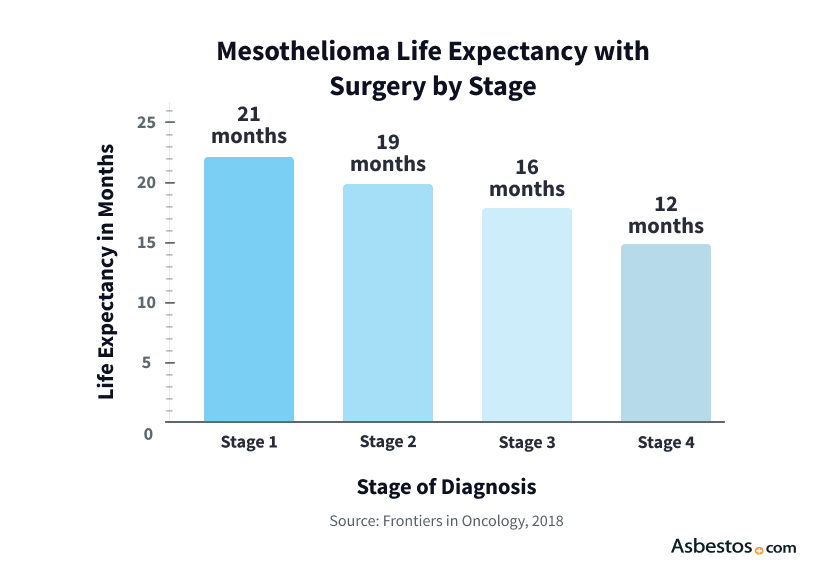
The stage of mesothelioma affects life expectancy. Diagnosis in earlier stages can extend survival. Doctors measure mesothelioma stages from 1 to 4. Each stage describes the extent of the spread of tumors or metastases. Stages 1 and 2 are early stages.
People with early-stage mesothelioma tend to live for 19 to 21 months. Mesothelioma life expectancy is 21 months at stage 1, 19 at stage 2, 16 at stage 3 and 12 at stage 4.
Sean Marchese, a nurse and contributing writer for The Mesothelioma Center, says an early diagnosis gives patients their best shot at treatment and survival. “Early-stage mesothelioma patients have the best treatment options, including surgery. And they have the longest survivability, usually one to two years or beyond.”
Late-stage mesothelioma involves stages 3 and 4. These patients have a life expectancy of 12 to 16 months. If the cancer spread isn’t significant, you may be able to consider surgery. Stage 4 is the most advanced and final phase. With treatment, life expectancy for stage 4 mesothelioma is 12 months.
Many patients with an early diagnosis are asymptomatic. They show no signs or symptoms of mesothelioma. Doctors should closely monitor those with pleural fluid and a history of asbestos exposure. This is the case even if the effusion is minor or resolves spontaneously.
Cell Type
Tumor cell type affects mesothelioma life expectancy. This is because your cell type impacts which treatment is best for you. Epithelial (epithelioid) mesothelioma tumors are linked to a higher life expectancy. Epithelial tumors in the peritoneum raise life expectancy to 51.5 months.
Sarcomatoid mesothelioma cells are more aggressive. They’re also more resistant to treatment. The life expectancy for pleural patients with these cells is 5.3 months. It’s 10.5 months for peritoneal patients. The biphasic type is a mix of epithelial and sarcomatoid cells. It has a life expectancy of 9.5 months for pleural and 10.5 months for peritoneal.
| Cell Type | Pleural Life Expectancy | Peritoneal Life Expectancy |
|---|---|---|
| Epithelial | 14.4 months | 51.5 months |
| Sarcomatoid | 5.3 months | 10.5 months |
| Biphasic | 9.5 months | 10.5 months |
Age, Gender and Overall Health
Age, gender and overall health can all affect mesothelioma life expectancy. Older patients, men, and those with co-existing conditions live shorter lives. In contrast, women and healthier people tend to live longer.
A 2022 review looked at 10 years of study and experience with pleural mesothelioma. The authors note age and gender are “key determinants of survival.”
- Age: Pleural patients at age 40 may live 4 to 9 years. At age 80, life expectancy is between 1 to 3 years. The longer you live with mesothelioma, the better your life expectancy.
- Gender: Mesothelioma stats show about 50% of men survive 5+ years. More than 75% of women with peritoneal mesothelioma live for at least 5 years.
- Health: Chronic illnesses can decrease life expectancy. These include heart disease, COPD, obesity and diabetes
Dr. Andrea Wolf, a thoracic surgeon, has studied this gender gap directly. “I published a study several years ago looking at thousands of mesothelioma patients, and women had a three-fold better survival than men… It’s important for women to know that this is not a death sentence particularly for them.”
Asbestos exposure, not smoking, causes mesothelioma. But, smoking can cut life expectancy for those with asbestos-related cancer. Studies show asbestos exposure plus smoking raises the lung cancer death rate 28 times.

Doug J.
Pleural Mesothelioma Survivor Defies His Life Expectancy
In December 2016, Doug J. was diagnosed with pleural mesothelioma, and given a life expectancy of just one year. By May 2017, he courageously underwent pleurectomy and decortication surgery at the MD Anderson Cancer Center. Doug’s surgery and follow-up treatments were successful, and he now passionately cares for his family ranch in Wyoming.
Doug J.
Mesothelioma Life Expectancy With Treatment
Mesothelioma treatment can extend life expectancy several years for most patients. With treatment, mesothelioma life expectancy averages approximately 12 to 21 months for pleural mesothelioma and approximately 3 to 5 years for peritoneal mesothelioma, roughly 2 to 4 times longer than the 6 to 8 months typically seen in untreated patients. Chemo, radiation and immunotherapy may help late-stage patients live longer.
Jerry L. is a survivor of peritoneal mesothelioma. He has lived for more than 40 years since his diagnosis. Initially told he had 6 to 12 months to live, Jerry tells us he found immunotherapy worked for him.
“I say my prayer of thanks for the privilege of another day,” Jerry shares. “It’s my way of not forgetting reality, but I often ask myself why I’m still alive.”
| Treatment | Survival Benefit | Best For |
|---|---|---|
| Chemotherapy (Alimta + cisplatin) | Roughly doubles survival for some patients | Most mesothelioma patients; primary treatment |
| Surgery (P/D or EPP) | About 45% longer survival vs. no surgery | Eligible pleural patients (early stage, good health) |
| HIPEC (cytoreductive surgery) | About 37% longer survival; ~50% reach 5 years | Eligible peritoneal mesothelioma patients |
| Immunotherapy | About 30% longer survival for some patients | Advanced/inoperable cases; epithelioid cell type |
| Radiation + chemotherapy combined | About 40% longer survival vs. chemo alone | Pleural patients not eligible for surgery |
| TTFields + chemotherapy | Almost 50% longer survival vs. chemo alone | Pleural mesothelioma patients |
Mesothelioma Life Expectancy Without Treatment
Pleural mesothelioma life expectancy without treatment is about 6 to 8 months. Peritoneal mesothelioma, untreated, has a life expectancy of about 6 months. With any diagnosis, cancer can progress fast without therapy. Some patients feel uncomfortable with cancer treatment. It’s a personal choice if the treatment’s benefits outweigh the risks.
Palliative care, if started with standard treatment, may help. It can increase life expectancy and ease pain and discomfort. Most palliative options are less invasive forms of therapies such as chemo or radiation.
“When I talk to mesothelioma patients about life expectancy, I don’t just share numbers…I help them understand what those numbers really mean. I remind them they’re not statistics. They’re individuals, each with their own journey. My job is to treat the person, not the data.,” Dr. Andrea Wolf, thoracic surgeon and director of the New York Mesothelioma Program at Mount Sinai, tells us.

Access expert diet and exercise guidance designed specifically for mesothelioma patients to support treatment and overall wellness.
Get Your Free GuideHow to Improve Mesothelioma Life Expectancy
Treatment with a mesothelioma specialist is one of the most important steps to take after a mesothelioma diagnosis. Lifestyle changes can also lead to better overall health. Staying fit can extend your life expectancy. Experts in exercise for cancer patients can help you with a safe fitness plan. A nutritionist can help create a healthy diet for you as well. Consult your doctor before starting any new diet, exercise or therapy.
Be sure to discuss any supplements you’re thinking of taking. Some can cause harmful effects with cancer drugs. The National Cancer Institute says even common vitamins can affect treatment. For example, Vitamin E can have a bad interaction with radiotherapy. It can increase the risk of tumor relapse.
- Consider Integrative Medicine. Complementary therapy includes acupuncture or yoga. Along with proven cancer therapy, it may help reduce your stress and pain.
- Eat Right. Cancer patients need to eat enough protein and calories to recover from treatment. A mesothelioma diet can prevent weight loss. It can also help your immune function.
- Find a Mesothelioma Specialist. Mesothelioma doctors include oncologists, surgeons and others. They can offer you the latest and best therapies at top research and treatment centers.
- Increase Activity Level. “Performance status” refers to how active and fit someone is. It affects how you recover from harsh cancer treatments and how long you may live.
- Stop Smoking. Smoking and asbestos exposure greatly raise the risk of lung cancer. They also reduce mesothelioma life expectancy.
Life expectancy information can be very personal. Remember that support is available. You and your family have access to many resources.
Cancer treatment can be overwhelming. It causes strong emotions and stress. Reaching out for mental health support can help you cope with a mesothelioma diagnosis.

Mesothelioma Caregiver
Kim S: How My Dads Attitude Helped Him Outlive His Mesothelioma Diagnosis
And I’m the oldest, so I had to go in and kinda kick him into shape like, let’s go dad. You know, don’t we’ve done all this now. You’re getting better. You know, the the tumor’s shrinking.
We’re doing good. Let’s just get in there and go for it. You know? And once I think just all of us going in and and just really, like, encouraging him, all the grandkids coming around him and stuff.
He realized, you know, I’m doing better. I’ve got all these people who care about me, and my dad’s a worker. I mean, he’s like a workaholic. And as long as he had projects to do, it kept him moving.
And it kept him moving for fourteen years. So, yeah, he he kept going with it. It. I think he just had the attitude of I’m not done.
I’m not done with what, you know, I’ve been saved. I’ve been, you know, here. I’m here. So now my time’s not over.
So now I still gotta keep doing because I was blessed to be saved by this disease. Now I just gotta keep moving forward for my family, and that’s what he did.
Common Questions About Mesothelioma Life Expectancy
- What is the longest someone has lived with mesothelioma?
-
Some mesothelioma patients live more than 10 years after their diagnosis. Jerry Lampe has lived more than 40 years with peritoneal mesothelioma. That’s longer than any known survivor. Tamron Little has survived 15 years with peritoneal mesothelioma.
Tim C. was diagnosed with pleural mesothelioma in 2002. He underwent an extrapleural pneumonectomy at Brigham and Women’s Hospital. He’s lived more than 20 years since then and attributes his success to the support of his family.
- Which type of mesothelioma has the longest life expectancy?
-
Peritoneal mesothelioma has the longest life expectancy. Heated intraperitoneal chemo has played a key role. A 2018 study found HIPEC gave a median, disease-free life expectancy of almost 5 years. The median overall life expectancy was more than 8 years.
- Does mesothelioma have the shortest life expectancy compared to other cancers?
-
Mesothelioma has one of the shortest life expectancies compared to other cancers. The 5-year life expectancies for mesothelioma (7.2%), pancreatic (7.3%) and brain cancers (12.8%) are the lowest. Testicular cancer (97%), skin melanoma (92.3%) and prostate cancer (88%) have the highest 5-year life expectancies.
- Will remission extend the lifespan of a mesothelioma patient?
-
Remission doesn’t necessarily increase mesothelioma lifespan. A patient in remission has limited symptoms with no noticeable signs of cancer. Tumor cells may still be present and recurrence is possible. Mesothelioma can progress quickly. A long remission often means successful treatment.
- How long do you live after being diagnosed with mesothelioma?
-
Most mesothelioma patients live approximately 12 to 21 months after diagnosis with treatment, though survival varies widely by type, stage and cell type. Peritoneal mesothelioma patients who receive tumor-removing or cytoreductive surgery with HIPEC have significantly better outcomes. Approximately 50% survive 5 or more years. Patients who choose not to pursue treatment average approximately 6 to 8 months.
- Can you survive mesothelioma?
-
Mesothelioma survival is possible. While rare, remission is possible for some patients. Average life expectancy is approximately 12 to 21 months. But some patients have lived 20 or more years after diagnosis with successful treatment. For peritoneal patients, for example, aggressive treatment raises the 5-year survival rate to approximately 52%. New and improved treatments continue to improve outcomes for people with mesothelioma.
The patients most likely to achieve long-term survival typically share key characteristics: early-stage diagnosis, specifically the epithelioid cell type, peritoneal tumor location and qualifying for aggressive multimodal treatment including surgery. Long-term survivors like Jerry Lampe (30+ years) and Tamron Little (15+ years) illustrate how significantly individual outcomes can differ from the average statistics about mesothelioma survival rate. - What is the life expectancy for stage 4 mesothelioma?
-
With treatment, the life expectancy for stage 4 mesothelioma is about 12 months. Without treatment, life expectancy is 6 to 8 months. Stage 4 is the most advanced stage, when cancer has spread beyond the original tumor site.
- Is mesothelioma always fatal?
-
Mesothelioma isn’t always fatal. Long-term survivors like Jerry Lampe and Tamron Little have lived 15 to more than 40 years after diagnosis. Early detection, treatment and overall health all play a role in how long a patient lives.