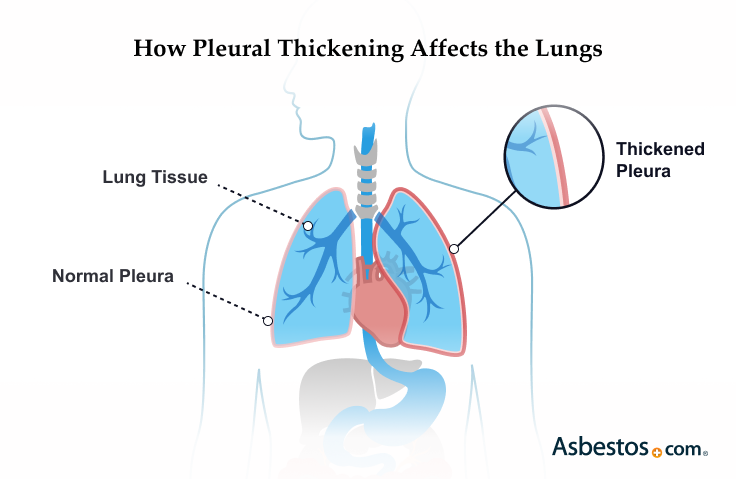
Pleural thickening is scarring of the pleura, the thin membrane that lines the lungs and chest wall. This can happen after asbestos exposure, injury or infection. It isn't cancer, but may be an early sign of mesothelioma. Treatment can't cure it, but can ease symptoms and help you feel better.
Learn more about pleural mesothelioma and the steps you can take to fight this disease.
Pleural thickening isn’t cancer, but it can appear alongside conditions like pleural mesothelioma or, in some cases, before it, so doctors monitor it closely. Asbestos can cause both pleural thickening and mesothelioma. If you have pleural thickening, see your doctor often. In some people, it gets worse and leads to more serious illness.
Key Facts About Pleural Thickening
About 50% of asbestos-exposed workers develop pleural thickening.
More than 90% of mesothelioma patients experience pleural thickening.
Pleural thickening can significantly increase the risk of pleural mesothelioma.
Recent studies show finding pleural thickening early can lead to better care. Registered Nurse Sean Marchese says, “It can help find mesothelioma sooner. This means more ways to treat it and feel better.”
Types of Pleural Thickening
In pleural mesothelioma, pleural thickening is usually diffuse or focal. These terms describe how much of the lining is affected. The thickening can be noncancerous, cancerous or another type.
Each type affects the lungs differently. That changes how doctors treat it and what to expect.
Main Types of Pleural Thickening
Diffuse pleural thickening: Scarring spreads across a large part of the lung lining. It often happens after heavy asbestos exposure.
Focal pleural thickening: Scarring stays in one area. It’s usually milder than diffuse thickening.
Knowing what caused the thickening helps doctors plan care. They keep a close eye on both types to protect your lungs and catch signs of cancer early.
Diffuse Pleural Thickening
Diffuse pleural thickening means a large area of the lungs’ lining has scarring. This can make it harder to breathe. This type is strongly linked to heavy asbestos exposure.
Diffuse Pleural Thickening Types
Benign pleural thickening: This type isn’t cancer. It happens when thick, fibrous tissue builds up in the lung lining.
Malignant pleural thickening: This kind covers 50% or more of one pleura or 25% of both pleurae. It can be a sign of pleural mesothelioma.
Doctors recommend people with diffuse thickening regularly track their lung health. Without care, this condition could lead to pleural mesothelioma.
Focal Pleural Thickening
Focal pleural thickening means scarring in one small area of the lungs’ lining. It can happen after minor asbestos exposure or past infections. While it’s usually less serious, doctors still need to watch it closely.
Focal Pleural Thickening Types
Apical pleural thickening: Scarring at the top of one lung.
Biapical pleural thickening: Also called bilateral apical. Scarring at the top of the pleura and both lungs.
Nodular pleural thickening: Scarring that forms small lumps or nodules.
Imaging scans can help find this condition early. Early care may lower the risk of more serious lung problems like mesothelioma.
500+ SPECIALISTS AVAILABLE
Get to the Right Mesothelioma Specialist, Faster
Connect with top-rated doctors specializing in mesothelioma treatment, who will personalize treatment options based on your diagnosis.
The main cause of pleural thickening is breathing in asbestos. Other causes include infections or chest injuries. Asbestos dust has tiny fibers that can get stuck in the lining of the lungs. Over time, these fibers cause irritation and scarring. This scar tissue can build up and lead to pleural thickening.
Use of medications such as cyclophosphamide or ergotamine
Discuss your risk for pleural thickening with your doctor. If you have a history of asbestos exposure, ask about regular screenings.
A classic study in the Journal of Occupational Medicine and Toxicology looked at asbestos. Some workers were found to have pleural thickening after exposure to the mineral. It developed in 5% to 13.5% of workers, often 3 to 34 years after their first exposure.
What Are the Symptoms of Pleural Thickening?
The most common symptoms of pleural thickening are breathlessness, chest pain and coughing. Symptoms usually develop slowly and can be hard to notice at first. Catching these signs early can lead to better care and outcomes.
Common Pleural Thickening Symptoms
Breathlessness
Chest pain
Coughing
Fatigue
Fever
Pain when inhaling or exhaling
Shortness of breath (dyspnea)
Anyone with lasting breathing problems or chest discomfort should talk to a doctor. Regular screenings are crucial for preventing asbestos-related diseases. This is especially critical for those with known asbestos exposure.
How pleural thickening changes the smooth lining of the lungs.
How Doctors Diagnose Pleural Thickening
Imaging scans can show signs of pleural effusion.
Doctors use X-rays, CT scans and MRIs to look for pleural thickening. Finding it early can help guide better treatment and improve outcomes.
They may also run tests to rule out other conditions like pleural plaques and pleural effusion. A pleural effusion is fluid buildup in the pleural space, and it can worsen shortness of breath. Pleural plaques are small, flat spots on the outside of the lungs, while pleural thickening is more widespread scarring that can make the lungs stiff. Doctors also check for signs of asbestos cancers, like pleural mesothelioma.
Telling your doctor about any asbestos exposure helps with a clear diagnosis. If you’re unsure about your diagnosis, getting a second opinion is always an option.
Biopsy
A biopsy removes a small piece of tissue from the lining of the lungs. Doctors look at it under a microscope to find out what’s causing the thickening.
Your doctor may use a needle or a small camera (thoracoscopy) depending on where the thickening is. The results help confirm a diagnosis and guide the best treatment plan for you. Recent research suggests CT-guided biopsies are also a safe and effective option for collecting pleural tissue.
Imaging Scans
Doctors use the same imaging scans for pleural thickening and mesothelioma. A CT scan of the chest is the most useful imaging test for showing the location and extent of pleural thickening. On chest X-rays, pleural thickening shows as a thick white line along the lung’s edge. PET scans and MRIs help tell pleural thickening apart from mesothelioma.
CT scans provide detailed images that help doctors map the thickening and plan next steps. These scans help catch problems early so treatment can start sooner.
Pam McWhorter shares with us how imaging scans that found pleural thickening eventually led to her husband’s pleural mesothelioma diagnosis. She tells us that after an X-ray, “They noted on his medical records that there was thickening on the outside of the left lung.” Then he had a CT scan. Pam tells us the CT scan report said, “‘Nodular thickening, suspect for mesothelioma, doctors should take immediate action.’”
Jim McWhorter
Verified Asbestos.com Survivor
Pleural Thickening Was a Sign of Survivor’s Mesothelioma Journey to Come
Jim McWhorter was told an injury-prompted X-ray was clear, but pleural thickening was noted in his record. A later surgery found tumors. It turns out that the pleural thickening led to his pleural mesothelioma diagnosis.
There is no cure for pleural thickening. But supportive treatment can help manage it. The best options are to quit smoking, stay active and do rehab.
Treatments That Ease Pleural Thickening
Complementary therapies: Relaxation techniques and meditation may ease symptoms such as pain.
Exercise: Respiratory exercises can improve cardiorespiratory functions.
Medications: Doctors may use steroids to ease breathlessness.
Oxygen therapy: Using inhalers may help less severe cases.
Pulmonary rehabilitation: People perform breathing techniques and exercises over 2-3 weeks.
Smoking cessation: Lung function may improve when patients stop smoking.
In severe cases, surgery such as P/D may remove scar tissue to help the lung expand more easily. People with severe breathing issues may use portable oxygen tanks.
Doctors Who Treat Pleural Thickening
Pulmonologists and pleural specialists have the expertise to diagnose and treat pleural thickening. They can recommend follow-up care and watch your condition for signs of progression.
Our Patient Advocates can match you with a top specialist near you. Our team has been helping people find doctors since 2006.
Wickii Thambiah Vigneswaran
Pleural Specialist | Thoracic Surgery
Expertise:
Thoracic Surgery
Mesothelioma
Lung and Lung/Heart Transplantations
Pleurectomy and Decortication
Robotic Surgery
Dr. Wickii Vigneswaran is an internationally renowned thoracic surgeon who specializes in pleural mesothelioma and other diseases of the chest. He is double board certified in thoracic and cardiac surgery, an expert in robotic surgery and has more than 30 years of experience treating mesothelioma.
Dr. Jeffrey Velotta is a thoracic surgeon at Kaiser Permanente Oakland Medical Center, serving pleural mesothelioma patients on the West Coast. He is board certified in general, thoracic and cardiac surgery, and he trained under renowned mesothelioma specialist Dr. David Sugarbaker.
Dr. Raja Michael Flores is a professor and chairman of the Department of Thoracic Surgery at Mount Sinai Medical Center in New York City. Flores is a widely respected expert in pleural mesothelioma and is a recognized leader in the field of thoracic surgery for pioneering video-assisted surgical techniques for lung cancer and mesothelioma.
Dr. Jacques Fontaine is the Director of the Mesothelioma Research and Treatment Center at Moffitt Cancer Center in Tampa, Florida. He specializes in minimally invasive thoracic surgery including robotic surgery. Fontaine became a pleural mesothelioma specialist while studying under Dr. Sugarbaker at the International Mesothelioma Program at Brigham & Women’s Hospital.
If you need assistance finding a pleural specialist, our Patient Advocates at The Mesothelioma Center can match you with a top doctor near you. Our team of Patient Advocates has been helping patients find doctors since 2006.
Common Questions About Pleural Thickening
Can smoking cause pleural thickening?
Asbestos is the primary cause of pleural thickening. Some data indicates a correlation between smoking and the progression of pleural thickening. Smoking limits lung function. It’s also proven to be a cause of other respiratory diseases, such as lung cancer.
Can pleural thickening affect your lifespan?
In most cases, pleural thickening won’t affect lifespan. But this condition may be a sign of more serious underlying conditions. These include malignant pleural mesothelioma or other cancer. Your doctor will determine how serious your pleural thickening is with diagnostic tests.
Have there been any asbestos lawsuits related to pleural thickening?
Yes, Miller v. Armstrong World Industries, Inc. in 1991 was a precedent-setting court case. Raymond Miller was an insulator who worked with asbestos products. He eventually developed pleural thickening. There is now an asbestos trust fund, the Armstrong World Industries Asbestos Trust. It accepts claims from people who were exposed to the company’s asbestos products. and became ill.
Is pleural thickening serious?
Pleural thickening is not always a serious condition. But if it’s left untreated, it can advance into other, more dangerous stages such as encasement of the lung. This condition causes restrictive lung disease. Pleural thickening is also a sign of significant asbestos exposure. Pleural mesothelioma’s main cause is asbestos exposure.
What is the difference between benign and malignant pleural thickening?
Benign pleural thickening means cancer tumors did not lead to the thickened tissue. Fibrous tissue that builds on top of itself is the cause. Pleural mesothelioma or cancer that spreads from another location causes malignant pleural thickening
Recommended Reading
Your web browser is no longer supported by Microsoft. Update your browser for more security, speed and compatibility.
If you are looking for mesothelioma support, please contact our Patient Advocates at (855) 404-4592
Fact Checked
Our fact-checking process begins with a thorough review of all sources to ensure they are high quality. Then we cross-check the facts with original medical or scientific reports published by those sources, or we validate the facts with reputable news organizations, medical and scientific experts and other health experts. Each page includes all sources for full transparency.
Reviewed
Asbestos.com is the nation’s most trusted mesothelioma resource
The Mesothelioma Center at Asbestos.com has provided patients and their loved ones the most updated and reliable information on mesothelioma and asbestos exposure since 2006.
Our team of Patient Advocates includes a medical doctor, a registered nurse, health services administrators, veterans, VA-accredited Claims Agents, an oncology patient navigator and hospice care expert. Their combined expertise means we help any mesothelioma patient or loved one through every step of their cancer journey.
More than 30 contributors, including mesothelioma doctors, survivors, health care professionals and other experts, have peer-reviewed our website and written unique research-driven articles to ensure you get the highest-quality medical and health information.
About The Mesothelioma Center at Asbestos.com
Assisting mesothelioma patients and their loved ones since 2006.
Helps more than 50% of mesothelioma patients diagnosed annually in the U.S.
A+ rating from the Better Business Bureau.
5-star reviewed mesothelioma and support organization.
My family has only the highest compliment for the assistance and support that we received from The Mesothelioma Center. This is a staff of compassionate and knowledgeable individuals who respect what your family is experiencing and who go the extra mile to make an unfortunate diagnosis less stressful. Information and assistance were provided by The Mesothelioma Center at no cost to our family.
Selby, K. (2026, February 13). Pleural Thickening and Asbestos. Asbestos.com. Retrieved May 7, 2026, from https://www.asbestos.com/mesothelioma/pleural-thickening/
MLA
Selby, Karen. "Pleural Thickening and Asbestos." Asbestos.com, 13 Feb 2026, https://www.asbestos.com/mesothelioma/pleural-thickening/.
Chicago
Selby, Karen. "Pleural Thickening and Asbestos." Asbestos.com. Last modified February 13, 2026. https://www.asbestos.com/mesothelioma/pleural-thickening/.
The Patient Advocates are absolutely amazing and helpful! I am so very pleased with the information and the emotional support that I have received from everyone! When I felt all hope was lost, Amy gave me great information and was so compassionate. I do not feel alone, and I know there is strong support for anyone dealing with this tragic disease. I received a FREE information package, including a recipe book, information on the disease, a toll-free number to contact for assistance, and a book with the answers to 100 questions that are commonly asked. This information alone was worth my time! I read for hours and hours, and just that alone—knowledge—can be a great comfort. To fully understand this disease, to just have the knowledge!!! Thank you all!! Thank you so, so much.
I found out about The Mesothelioma Center while researching peritoneal mesothelioma days after being diagnosed with the malignant cancer. While a lot of the 'Mesothelioma' websites are actually law firms just trying to get your business, theirs is a user-friendly, comprehensive website set up to aid patients, their loved ones, and/or caregivers with all things related to a cancer diagnosis from asbestos exposure. I was soon put in touch with one of their doctors, Snehal Smart, M.D., who immediately sent me a packet of general information, a book on surviving mesothelioma, and offered me assistance in finding doctors, reputable law firms, financial help, support groups, and so much more! The Mesothelioma Center's website is, in my opinion, the best resource for anyone suffering from cancer due to asbestos. Dr. Smart is amazing! She is very knowledgeable and helpful, but she is also a very kind, caring doctor who goes the distance whether she is researching a pertinent topic, making suggestions, providing contacts, or just being a good listener on the other end of the phone. In addition, Dr. Smart referred me to a law firm who is now fighting to get me compensation for the negligence of those defendants whose products exposed me to asbestos and caused my subsequent cancer. Thank you, TMC and Dr. Smart, for helping me determine the best treatment plan for my cancer and being part of my miracle. I am currently cancer-free and back to being a mom to my precious daughter. The Mesothelioma Center, their website, and their staff rock!!
I reached out and talked to Aaron a couple of weeks before my diagnosis of malignant mesothelioma. He was very helpful and gave me a lot of information at that time. I have talked to him several times since and always gotten my questions answered. Aaron is very knowledgeable and has been very helpful and supportive. He also sent me a comprehensive packet of information, including info on nutrition, legal help, and medical resources.
My brother was recently diagnosed with mesothelioma. I began researching it online. The information I received from The Mesothelioma Center is all-inclusive. No need to look anywhere else! The first phone call was with Karen, and she answered all my questions with ease. She also had a calming effect by presenting all the options available for my brother and his family. Thank you!
My Dad was diagnosed with mesothelioma, and thankfully The Mesothelioma Center was the first place I called. Snehal Smart answered the phone immediately and was very helpful. She immediately sent us an information packet and answered questions. She followed up each week to see how things were going and if we had any questions. She also connected us with a lawyer. I highly recommend this Center.
Dr. Wickii Vigneswaran is a thoracic surgeon at James A. Haley Veterans' Hospital in Tampa, Florida. He is also a professor at the University of South Florida Morsani College of Medicine. Vigneswaran is an internationally recognized expert in the surgical management of diseases affecting the lungs, mediastinum and pleura. He is the former director of the Lung and Lung-Heart Transplantation team at the University of Chicago Medical Center.
Fact-checked and verified content:
Our fact-checking process begins with a thorough review of all sources to ensure they are high quality. Then we cross-check the facts with original medical or scientific reports published by those sources, or we validate the facts with reputable news organizations, medical and scientific experts and other health experts. Each page includes all sources for full transparency.
Please read our editorial guidelines to learn more about our content creation and review process.