Mesothelioma symptoms vary depending on the type, location and stage of the cancer. Symptoms often resemble common illnesses, delaying diagnosis. Discussing your symptoms, how long they've lasted and any history of asbestos exposure can help your doctor decide whether further testing is needed.
Dr. Marcelo DaSilva: What are the symptoms of mesothelioma?
So the symptoms of mesothelioma vary greatly from the time of the initial presentation until we see the patients. Most commonly, the patients present with cough, shortness of breath, difficulty in walking, loss of stamina.
A few patients who were running five or 10 miles, all the sudden, they can't do that, or simple activities at home, such as cooking or care for yourself becomes challenging. Usually presents with a pleural effusion with fluid compressing the lung, causing all those symptoms. But it also can cause chest pain, which indicates to us that the tumor has somehow invaded the chest wall.
Dr. Marcelo DaSilva: What are the symptoms of mesothelioma?
So the symptoms of mesothelioma vary greatly from the time of the initial presentation until we see the patients. Most commonly, the patients present with cough, shortness of breath, difficulty in walking, loss of stamina.
A few patients who were running five or 10 miles, all the sudden, they can't do that, or simple activities at home, such as cooking or care for yourself becomes challenging. Usually presents with a pleural effusion with fluid compressing the lung, causing all those symptoms. But it also can cause chest pain, which indicates to us that the tumor has somehow invaded the chest wall.
“The most common symptoms are: difficulty breathing, labored breathing when exercising and a dry cough. The first thing you're likely going to feel is ‘I can't breathe.’ Or for a peritoneal patient, it can be an accumulation of fluid in the tummy. That is the number one symptom for a patient with peritoneal mesothelioma.”
Karen Selby, registered nurse and Patient Advocate at The Mesothelioma Center
“A number of treatments can help ease symptoms and improve quality of life. Discuss all your symptoms with your medical team. Together, you can find the best treatment for you.”
Dr. Daniel Landau, medical director of virtual hematology at the Medical University of South Carolina
“I started feeling pain on my left back like right in the middle. I actually thought I had a kidney stone. I saw the pulmonologist, and he said, ‘I don’t know Kim. The only thing I can think is let’s biopsy it. You keep having pain.’ I didn’t have any problems with shortness of breath. I didn’t have, coughing, excessive coughing. It was mainly the pain.”
Kim Madril, pleural mesothelioma survivor
Diagnosis challenge: Symptoms often mimic pneumonia, bronchitis and other common illnesses
First symptoms: Chest or abdominal pain, fatigue and shortness of breath are the most common early signs
Latency period: Symptoms typically appear 20 to 60 years after asbestos exposure
Most common symptom: Pleural effusion (fluid buildup around the lungs) affects most pleural mesothelioma patients
Most reported symptom: Fatigue affects 70% of pleural and 86% of peritoneal mesothelioma patients
Palliative care gap: Only 50% of patients receive palliative care to manage symptoms
Stage at symptom onset: Most patients don’t notice symptoms until stage 3 or 4
“The most common symptoms are: difficulty breathing, labored breathing when exercising and a dry cough. The first thing you're likely going to feel is ‘I can't breathe.’ Or for a peritoneal patient, it can be an accumulation of fluid in the tummy. That is the number one symptom for a patient with peritoneal mesothelioma.”
Karen Selby, registered nurse and Patient Advocate at The Mesothelioma Center
“A number of treatments can help ease symptoms and improve quality of life. Discuss all your symptoms with your medical team. Together, you can find the best treatment for you.”
Dr. Daniel Landau, medical director of virtual hematology at the Medical University of South Carolina
“I started feeling pain on my left back like right in the middle. I actually thought I had a kidney stone. I saw the pulmonologist, and he said, ‘I don’t know Kim. The only thing I can think is let’s biopsy it. You keep having pain.’ I didn’t have any problems with shortness of breath. I didn’t have, coughing, excessive coughing. It was mainly the pain.”
Kim Madril, pleural mesothelioma survivor
Diagnosis challenge: Symptoms often mimic pneumonia, bronchitis and other common illnesses
First symptoms: Chest or abdominal pain, fatigue and shortness of breath are the most common early signs
Latency period: Symptoms typically appear 20 to 60 years after asbestos exposure
Most common symptom: Pleural effusion (fluid buildup around the lungs) affects most pleural mesothelioma patients
Most reported symptom: Fatigue affects 70% of pleural and 86% of peritoneal mesothelioma patients
Palliative care gap: Only 50% of patients receive palliative care to manage symptoms
Stage at symptom onset: Most patients don’t notice symptoms until stage 3 or 4
Most Common Mesothelioma Symptoms
Mesothelioma symptoms vary depending on where the cancer develops, but some symptoms occur across multiple types. Fatigue, pain, unexplained weight loss and fluid buildup are common regardless of the type. Our 2025 Patient Survey found fatigue was the most commonly reported symptom among people with pleural and peritoneal mesothelioma.
Common Mesothelioma Symptoms
Chest or abdominal pain
Fatigue or weakness
Fever or night sweats
Loss of appetite
Persistent cough or wheezing
Shortness of breath
Swelling in the chest or abdomen
Unexplained weight loss
Many mesothelioma symptoms also occur with more common illnesses, including pneumonia, the flu and digestive conditions. Because symptoms often don’t appear until 20 to 50 years after asbestos exposure, doctors may not suspect mesothelioma right away. Tell your doctor if you’ve worked with or around asbestos, even if that exposure happened decades ago.
Our interactive guide covers common mesothelioma symptoms. Answer a few questions about your health and symptoms to learn more about common signs and possible next steps.
Mesothelioma Symptom Checker
Understand Your Symptoms & Learn What to Do Next
Answer a few quick questions about what you’re feeling, and we’ll help you make sense of your symptoms and recommend the right next step. No email or sign-up required.
Want to speak to us directly?Our Patient Advocates are available 24/7.
Based on your mesothelioma and the symptoms you shared — — here are some steps that may help.
Based on the symptoms you shared — — here are some steps that may help.
Here are some steps that many patients find helpful as they manage mesothelioma.
Here are some steps that many patients find helpful.
Keep a log of the symptoms you’re feeling and when, and bring it to your mesothelioma care team. It helps them adjust treatment and manage side effects.
“I started feeling pain on my left back like right in the middle. I actually thought I had a kidney stone. I woke up one early morning at 3 AM. And I had this sharp shooting pain on the left side.”
Mesothelioma is caused by asbestos exposure, and symptoms can appear 20 to 50 years afterward. If you’ve ever worked around asbestos or lived with someone who did, it’s worth mentioning that to a doctor.
We can help you get seen by a specialist quickly.A Patient Advocate can help arrange an expedited appointment at no cost.
This tool provides general information only and does not diagnose any condition or replace medical advice. If you’re having a medical emergency, call 911.
Early Warning Signs of Mesothelioma
Shortness of breath, chest discomfort, abdominal bloating and fatigue are common early signs of mesothelioma. Because these initial symptoms are so similar to infections or less serious chronic conditions, they can go unrecognized. They also develop decades after the asbestos exposure that causes them, making it less likely this rare cancer is initially considered unless doctors are aware of an exposure history.
Speak with your doctor about your history with asbestos and ask about regular mesothelioma screenings, which can catch early signs of disease. Regular monitoring can help identify changes that may need further evaluation. This awareness can help doctors consider mesothelioma sooner when symptoms appear.
Survivor Story
Kim Madril: What symptoms did you experience prior to your mesothelioma diagnosis?
I started feeling pain on my left back like right in the middle. I actually thought I I had a kidney stone. I woke up one early morning at 3 AM.
And I had this sharp shooting pain on the left side.
My husband jumped out of bed. He’s like, “what’s wrong?” I said, I think I’m having a kidney stone. And he’s like, alright. Let’s go to the emergency department.
I’m not one to go see doctors, and and I think really I hadn’t been to emergency department in probably 15 years or so. So we ended up there, and they said, “well, you must have passed it because we don’t we don’t see we don’t that we don’t see anything.” I was okay for probably three or four months, and then it came again.
Not to the same degree. And I was kinda like, “Oh, oh, ow, ow!” and it kept happening. And the intervals were coming closer, than than before. They weren’t as spread out.
And so my PCP finally said, “Kim, let’s let’s just, let’s just get a a cat scan. Okay?”
And I said, “oh, okay.” And the CAT scan came back. And he said, there’s something see some sort of nodule, that’s what he called it, a nodule at the base of your left lung. It’s not your kidney. It’s the bottom of your left lung. Which is right about where your kidneys are. And I thought, oh my gosh, I never never thought it would be like a lung thing.
So, I said, oh, okay. And he said, let’s watch it. Because it’s so small right now.
And I said, alright. I’m good with that. But then the pain kept happening. And he said, I’m gonna refer you to a pulmonologist.
And I saw the pulmonologist, And he said, he said, I don’t know Kim. The only thing I can think is you let’s biopsy it. It’s it’s something there. It’s some sort of mask. You keep having pain.
I didn’t have the I didn’t have any problems with shortness of breath. I didn’t have, coughing, excessive coughing.
It was mainly the pain. He said, we just need to biopsy it. So I said, alright. That sounds great.
Respiratory Warning Signs
Because pleural mesothelioma develops in the lining around the lungs, its initial symptoms are generally respiratory. Dr. Snehal Smart, a board-certified Patient Advocate, explains: “Most patients who may have pleural mesothelioma may experience chest pain, trouble breathing, coughing and shortness of breath.”
Tumors growing in the pleura cause fluid to accumulate between the lung and chest wall known as a pleural effusion. This fluid buildup makes it harder for the lungs to expand fully. This fluid buildup is often the first symptom that leads to a mesothelioma diagnosis. As pleural mesothelioma progresses, this fluid buildup and tumor growth combine to cause more noticeable breathing problems.
Respiratory difficulties are the most reported mesothelioma symptoms.
Abdominal Warning Signs
Peritoneal mesothelioma develops in the lining of the abdomen, so its early signs usually center on digestion and abdominal discomfort. As tumors grow, they trigger fluid buildup called ascites, which puts pressure on the stomach and intestines.
Abdominal Warning Signs
Abdominal pain
Abdominal swelling
Fluid buildup (ascites)
Nausea
Weight loss
This fluid buildup and pressure on digestive organs can lead to nausea, constipation and visible swelling as the disease progresses. Peritoneal mesothelioma’s abdominal symptoms often get mistaken for digestive conditions.
What Patient Advocates say
“Patients with peritoneal mesothelioma may experience abdominal pain and weight loss.”
Dr. Snehal Smart, patient advocate at The Mesothelioma Center
What survivors say
“It started with my stomach growing. …and it didn’t stop getting bigger. It was always liquid that was being accumulated. It’s not in the stomach. It’s in between the stomach and the skin. And that is actually caused by mesothelioma, but we didn’t know that at the time.”
Epifanio F., peritoneal mesothelioma survivor
Intermediate-Stage Symptoms
Patients often tell us that symptoms during the intermediate stages of mesothelioma begin to affect daily activities in noticeable ways. Breathing problems may worsen, abdominal pressure can increase and fatigue may make everyday tasks like walking, working or holding a conversation more difficult. Simple activities like climbing stairs, eating a full meal or sleeping through the night can become challenging.
Mesothelioma can progress differently depending on where it develops. Pleural and peritoneal mesothelioma also use different staging systems, so symptoms and treatment approaches can vary. As symptoms change, doctors may adjust treatment plans or add supportive measures to help manage them.
500+ SPECIALISTS AVAILABLE
Get to the Right Doctor, Faster
Connect with top-rated doctors specializing in mesothelioma treatment, who will personalize treatment options based on your diagnosis.
As pleural mesothelioma advances into stages 2 and 3, breathing problems become more frequent and severe. Tumor growth and ongoing pleural effusions put more pressure on the lungs, making it harder for people to catch their breath during ordinary daily activities.
Intermediate-Stage Respiratory Symptoms
Chest pain that becomes more pronounced
Fatigue with daily activities
Persistent cough
Shortness of breath with activity
Trouble breathing that worsens
Pleural mesothelioma survivor Michael Cole described the change this way: after surgery, a breathing test that once let him blow out 98 of 100 candles dropped to just 3. Pacing activities and practicing deep breathing exercises helped him manage his reduced lung capacity over time.
What doctors say
“Many oncologists, primary care providers and even pulmonologists don’t realize that a pleural effusion or shortness of breath and pain could be mesothelioma because it is so rare.”
Dr. Jeffrey Velotta, thoracic surgeon and mesothelioma specialist with Kaiser Permanente Oakland Medical Center in Oakland, California.
What survivors say
“Before my illness I was very active and got quite a lot of exercise. The illness and treatments can change that experience. It’s important to do what you can do without overdoing it, and to always check with your doctor first. You know your own body better than anyone else…Push without hurting yourself.”
Michael Cole, long-term pleural mesothelioma survivor
Abdominal Symptoms
Abdominal pressure and fluid buildup intensify as this cancer progresses. Growing tumors and increasing ascites push against the stomach and intestines, making pain, bloating and appetite loss more constant than they were in earlier stages.
Intermediate-Stage Abdominal Symptoms
Abdominal pain becomes more pronounced
Bowel changes and worsening nausea
Increasing fluid buildup (ascites)
More noticeable weight loss
A study in Oncology in Clinical Practice found 30% to 80% of peritoneal mesothelioma patients experience abdominal distension as the disease progresses. Peritoneal mesothelioma patients at this stage often need more frequent fluid drainage procedures to manage the growing pressure.
Isabel C.
Verified Asbestos.com Survivor
How a Peritoneal Mesothelioma Survivor Keeps a Positive Attitude
Isabel C. was diagnosed with peritoneal mesothelioma in 2008. She believes the disease traces back 3 decades ago when she worked at a factory in Puerto Rico. Despite her diagnosis, Isabel is determined to remain joyful and live life to the fullest.
Late-stage mesothelioma symptoms become severe and widespread as the cancer spreads to distant sites. Breathing difficulty worsens, abdominal distension becomes more pronounced and extreme fatigue and weight loss set in.
At this stage, the focus of care often shifts away from aggressive treatment to ensuring comfort and quality of life. This doesn’t mean curative treatment always automatically stops for every patient. You and your doctor will discuss your treatment goals and personalized plan.
Respiratory Symptoms
In late-stage pleural mesothelioma, tumor growth and fluid buildup put significant pressure on the lungs. Breathing becomes noticeably harder and even brief activities like talking or walking a short distance can trigger shortness of breath.
Late-Stage Respiratory Symptoms
Difficulty swallowing (dysphagia)
Hoarseness
Severe shortness of breath
Swelling of the face and arms
Managing symptoms at this stage often means combining several approaches, from fluid drainage procedures to breathing exercises and supplemental oxygen. Pleural mesothelioma patients at stage 4 typically need more frequent monitoring to manage this fluid buildup as it becomes harder to control.
Expert Insight
“Late stage means that there’s a lot more things involved. It’s gone beyond that primary location. It doesn’t mean that there’s not treatment options, it just means it’ll be a different course, perhaps surgery won’t be the first thing that is offered to the patient.”
Karen Selby, registered nurse and board-certified Patient Advocate
Abdominal Symptoms
In late-stage peritoneal mesothelioma, tumors can spread to the liver, intestines and other nearby organs. This spread causes more severe abdominal distension and can lead to complications like bowel obstruction, making digestion increasingly difficult.
Late-Stage Abdominal Symptoms
Bowel obstruction
Extreme weight loss
Nausea and vomiting
Severe abdominal swelling
Distant spread occurs in 10% to 50% of stage 4 mesothelioma cases and can reach organs beyond the abdomen, including the chest and brain. Peritoneal mesothelioma patients at this stage often need closer monitoring for complications tied to organ involvement, not just symptom relief.
Expert Insight
“Some mesothelioma patients present with stage 4 disease or metastatic disease. When we discuss treatment for metastatic or stage 4 mesothelioma, we have to look not only at the quantity of life but, more importantly, at the quality of life. It is important to provide these patients the best supportive care, make them comfortable and have dignity.“
Dr. Jacques Fontaine, thoracic surgeon and director of the Mesothelioma Research and Treatment Center at Moffitt Cancer Center.
Symptoms of Rare Mesothelioma Types
People with pericardial or testicular mesothelioma often receive a diagnosis while doctors evaluate other health concerns because the symptoms may not immediately suggest mesothelioma. Their symptoms differ from pleural and peritoneal mesothelioma because they affect different areas of the body. These rare forms of the disease account for a small fraction of all mesothelioma cases.
Pericardial mesothelioma affects the lining around the heart and can cause symptoms like chest pain and heart palpitations. Testicular mesothelioma affects the lining of the testes and typically causes a lump or swelling in the scrotum. Because these types are so rare, diagnosing them often requires a careful evaluation of symptoms, medical history and test results.
Pericardial Mesothelioma Symptoms
Pericardial mesothelioma affects the lining around the heart and is extremely rare, accounting for less than 1% of all cases. Symptoms of the disease often involve heart-related and general systemic issues. The disease’s rarity and nonspecific symptoms make it difficult to diagnose with only 150 cases existing in medical literature.
Signs and Symptoms of Pericardial Mesothelioma
Cough
Difficulty breathing
Fatigue
Heart murmurs or palpitations
Low blood pressure
Shortness of breath lying down
Early symptoms may include fever, night sweats and weakness. Later stages can cause fluid buildup around the heart, leading to pressure and heart complications.
Expert Insight
“[Pericardial mesothelioma] patients can present with heart failure initially. It’s not unusual to diagnose pericardial mesothelioma as an incidental finding. You’re not suspecting pericardial mesothelioma.”
Dr. Wickii Vigneswaran, thoracic surgeon
Testicular Mesothelioma Symptoms
Testicular mesothelioma occurs in the lining of the testes and is the rarest form of mesothelioma. The main signs are a lump or swollen testes.
Signs and Symptoms of Testicular Mesothelioma
Fluid buildup in the scrotum (hydrocele)
Inguinal hernia
Lump in the scrotum
Spermatocele (cyst in the epididymis)
Swollen testes
Testicular pain
Other early symptoms of testicular mesothelioma include pain similar to a groin injury. Sometimes, these symptoms are mistaken for an infection of the testes.
FREE MESOTHELIOMA GUIDE
Expert Guidance for Your Mesothelioma Journey
Get answers about treatment, top doctors, and financial support from the nation’s most trusted mesothelioma resource.
Palliative care and supportive care are approaches to symptom management that can begin at diagnosis and support you throughout curative treatments like surgery, chemotherapy or radiation. The goal is to maintain your quality of life while you pursue treatment. A comprehensive symptom management plan addresses physical discomfort and supports overall health, including nutrition, exercise and mental well-being.
Common Treatments to Manage Mesothelioma Symptoms
Complementary therapies: Massage, acupuncture, meditation, gentle yoga and cognitive behavioral techniques can reduce pain, anxiety and stress.
Fluid drainage procedures: Techniques like thoracentesis and paracentesis remove fluid buildup in the lungs or abdomen to relieve pressure and improve breathing.
Pain medication: Mild pain may be managed with over-the-counter drugs like acetaminophen. More severe pain often requires prescription opioids such as morphine or oxycodone.
Physical and occupational therapy: These therapies enhance strength, mobility and help patients manage daily activities.
Radiation therapy: Radiation can reduce tumor size and alleviate pain, particularly for nerve-related or chest wall discomfort.
Respiratory therapy: Breathing exercises and supplemental oxygen ease shortness of breath and improve lung function.
Counseling and support groups tailored for mesothelioma patients address anxiety, depression and social challenges linked to this rare and aggressive cancer. Taking an active role in symptom management can enhance comfort, help patients maintain independence longer and improve overall outlook.
Managing Symptoms as Mesothelioma Progresses
As mesothelioma progresses, symptom intensity increases. In intermediate and advanced stages, your care team may include pain specialists, nutritionists or respiratory therapists. Palliative care can continue throughout treatment, including multimodal therapy.
Treatments like tumor-removing surgery, chemo and immunotherapy can reduce tumors and relieve symptoms. Surgery may ease pressure-related pain, while chemo and immunotherapy can help slow cancer growth and control symptoms.
When curative treatment becomes less effective or a decision is made to stop more aggressive treatments, the focus shifts to staying as comfortable and independent as possible. Hospice care may become part of the conversation in late-stage mesothelioma. Palliative care, supportive care and hospice care often work together, each addressing a different part of comfort and quality of life as symptoms become more severe.
Expert Insight
“Palliative care is becoming a bigger topic these days, especially in a terminal diagnosis, especially cancer. It is comfort care, but it’s pain management, and it’s something that a patient can do and start from the beginning. I recommended it because I just don’t see a need for a patient to suffer or be in pain when they don’t have to be.”
Amy Pelegrin, hospice care director at The Mesothelioma Center
Managing Symptoms of Pericardial and Testicular Mesothelioma
Symptom management for pericardial and testicular mesothelioma can differ from pleural and peritoneal mesothelioma because these types are much rarer. Fewer cases exist to guide standard treatment approaches.
Palliative care and supportive care can be tailored to your specific symptoms. A specialist familiar with these rare types can help guide treatment decisions and symptom management, including care for heart-related discomfort from pericardial mesothelioma or recovery after testicular mesothelioma surgery.
Common Questions About Mesothelioma Symptoms
When do mesothelioma symptoms appear?
Mesothelioma symptoms tend to present between 20 and 60 years after asbestos exposure. This delay is known as the latency period. Asbestos exposure, age, and health can affect the latency period.
Can you have mesothelioma without symptoms?
Yes, you may have mesothelioma without any symptoms. Many mesothelioma symptoms are mild and resemble the flu or a stomach virus. Most only appear decades after asbestos exposure. Doctors may misdiagnose this rare cancer as other illnesses. This can delay your mesothelioma diagnosis.
Can mesothelioma symptoms come on suddenly?
Yes, some mesothelioma symptoms may occur suddenly. Some patients have no symptoms until the cancer spreads to other organs. The cancer’s location determines the type and severity of symptoms you may have.
Do mesothelioma symptoms progress quickly?
It varies. Mesothelioma symptoms usually develop slowly over many years following asbestos exposure. Early signs can be mild or nonexistent, making them difficult to detect. However, as the cancer advances into later stages, symptoms tend to worsen more quickly and become more severe.
What is the most common symptom of mesothelioma?
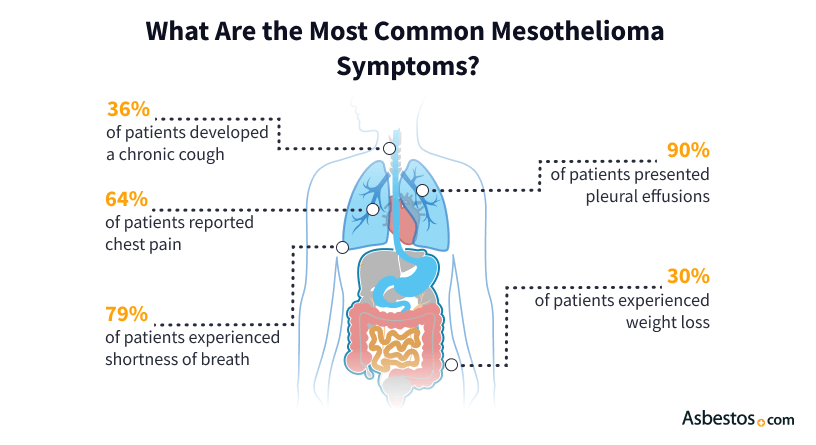
Pleural effusion, or fluid buildup around the lungs, is the most frequently reported symptom of pleural mesothelioma, the most common form of the disease. According to the National Institutes of Health, up to 90% of mesothelioma patients experience pleural effusion. It can cause shortness of breath, chest pressure and persistent coughing.
When should I see a mesothelioma specialist?
See a mesothelioma specialist if you have a history of asbestos exposure and notice chest or abdominal pain, unexplained weight loss, persistent cough or shortness of breath. These symptoms don’t always mean you have mesothelioma, but a specialist can recommend the appropriate tests to determine the cause. Bring details about when your symptoms started and how they’ve changed. That information can help your doctor determine the next steps.
Recommended Reading
Your web browser is no longer supported by Microsoft. Update your browser for more security, speed and compatibility.
If you are looking for mesothelioma support, please contact our Patient Advocates at (855) 404-4592
I spoke with Danielle regarding how best to search for a doctor that specializes in Mesothelioma regarding causes symptoms and questions. Almost fell off my chair when she answered my questions in an outstanding calm manner including offering me a couple of avenues to consider. I cannot imagine how frightened some callers must be and fear hearing a uninterested person when they call about a health problem - not the case with Danielle. Unusual and appreciated. Thank you.
I was overwhelmed and frightened when first confronted with the shortness of breath and the implications of a continuing pleural effusion of unknown etiology. In my youth I had served in the merchant marine and the navy. I worked around and with asbestos without any asbestos specific training or protection. It seemed that Mesothelioma had just caught up with me. While I was getting excellent care and attention from my pulmonologist and cardiothoracic surgeon I wanted to find a center of excellence to ensure that I was using the most up-to-date technology to fight my disease. I wasn't making progress finding this on my own and I didn't want to insult my local doctors by implying that they weren't the best. But, I was also leery about contacting an organization funded by class-action-suit lawyers. However, one morning after a sleepless night I decided to give it a shot and I called the Mesothelioma Center. Boy, was I happily surprised! I was assigned a patient advocate (Amy) and sent current literature on the subject. In sharp contrast with making a call to a typical doctor's office I was not confronted with five minutes of recorded BS and forced to leave a message for someone to call me back. I actually got to speak to a human being, straight away. Between Amy and Missy (the medical specialist) was able to ask questions and discuss my concerns with sympathetic, knowledgeable, helpful, and very supportive people. I no longer feel alone in this battle. My sincere thanks to the staff of the Mesothelioma Center and the people who fund it. You provide a rare and valuable service.
Asbestos.com. (2026, October 12). Mesothelioma Symptoms and Symptom Management. Retrieved October 20, 2026, from https://www.asbestos.com/mesothelioma/symptoms/
MLA
"Mesothelioma Symptoms and Symptom Management." Asbestos.com, 12 Oct 2026, https://www.asbestos.com/mesothelioma/symptoms/.
Chicago
Asbestos.com. "Mesothelioma Symptoms and Symptom Management." Last modified October 12, 2026. https://www.asbestos.com/mesothelioma/symptoms/.
Asbestos.com is the nation’s most trusted mesothelioma resource
The Mesothelioma Center at Asbestos.com has provided patients and their loved ones the most updated and reliable information on mesothelioma and asbestos exposure since 2006.
Our team of Patient Advocates includes a medical doctor, a registered nurse, health services administrators, veterans, VA-accredited Claims Agents, an oncology patient navigator and hospice care expert. Their combined expertise means we help any mesothelioma patient or loved one through every step of their cancer journey.
More than 30 contributors, including mesothelioma doctors, survivors, health care professionals and other experts, have peer-reviewed our website and written unique research-driven articles to ensure you get the highest-quality medical and health information.
About The Mesothelioma Center at Asbestos.com
Assisting mesothelioma patients and their loved ones since 2006.
Helps more than 50% of mesothelioma patients diagnosed annually in the U.S.
A+ rating from the Better Business Bureau.
5-star reviewed mesothelioma and support organization.
My family has only the highest compliment for the assistance and support that we received from The Mesothelioma Center. This is a staff of compassionate and knowledgeable individuals who respect what your family is experiencing and who go the extra mile to make an unfortunate diagnosis less stressful. Information and assistance were provided by The Mesothelioma Center at no cost to our family.
Professional Contributors Featured In This Article
We Thoroughly vet individuals who are experts in their field to contribute to articles on Asbestos.com. We believe in the integrity and quality of our educational materials, and only publish information that is relevant, factual, and backed by experts.
Dr. Landau is the Medical Director of Virtual Hematology at the Medical University of South Carolina, where he leads programs that expand access to cancer care through telehealth. With more than 18 years of experience in oncology and hematology, he specializes in hematologic and genitourinary cancers, including bladder, prostate and kidney cancers. He has held multiple leadership roles in cancer program development and previously served as section chief of hematology and oncology at Orlando Health UF Health Cancer Center, where he founded its telehealth program.
Fact-checked and verified content:
Our fact-checking process begins with a thorough review of all sources to ensure they are high quality. Then we cross-check the facts with original medical or scientific reports published by those sources, or we validate the facts with reputable news organizations, medical and scientific experts and other health experts. Each page includes all sources for full transparency.
Please read our editorial guidelines to learn more about our content creation and review process.








 Karen Selby , registered nurse and board-certified Patient Advocate
 Dr. Jacques Fontaine , thoracic surgeon and director of the Mesothelioma Research and Treatment Center at Moffitt Cancer Center.
 Dr. Wickii Vigneswaran , thoracic surgeon

 Amy Pelegrin , hospice care director at The Mesothelioma Center


