Mesothelioma immunotherapy helps the immune system locate and combat cancer cells. This treatment enhances the body's ability to fight mesothelioma. Immunotherapy for mesothelioma benefits include a longer life, improved quality of life and reduced symptoms.
Immunotherapy for mesothelioma is a treatment that uses your own immune system to fight this asbestos-related cancer. Unlike chemotherapy or radiation, which directly attack cancer cells, immunotherapy boosts the body’s natural defenses to recognize and destroy mesothelioma cells.
Key Facts About Mesothelioma Immunotherapy
Combining immunotherapy with chemo often works better than chemotherapy alone, improving response rates and survival for many patients.
Clinical trials have shown it can extend survival. For example, some patients lived more than 1 year longer with immunotherapy than those who received only chemo.
More patients are accessing immunotherapy every year. In a recent patient survey, 40% of people with mesothelioma said they had tried immunotherapy as part of their treatment plan.
Immunotherapy is now one of the top treatments for malignant mesothelioma.
Mesothelioma immunotherapy has become a standard part of care for many patients in recent years, offering new hope for those with difficult-to-treat tumors. Doctors often use immunotherapy alongside other mesothelioma treatments, such as chemo or surgery, to improve outcomes.
Expert Insight
“I’ve treated mesothelioma patients who had exhausted older chemotherapy regimens. But improved surgical management and additional immunotherapy options have helped extend their lives in ways we never thought possible just a decade ago.”
Dr. Andrea Wolf, thoracic surgeon and director of the New York Mesothelioma Program at Mount Sinai
How Does Immunotherapy Work to Treat Mesothelioma?
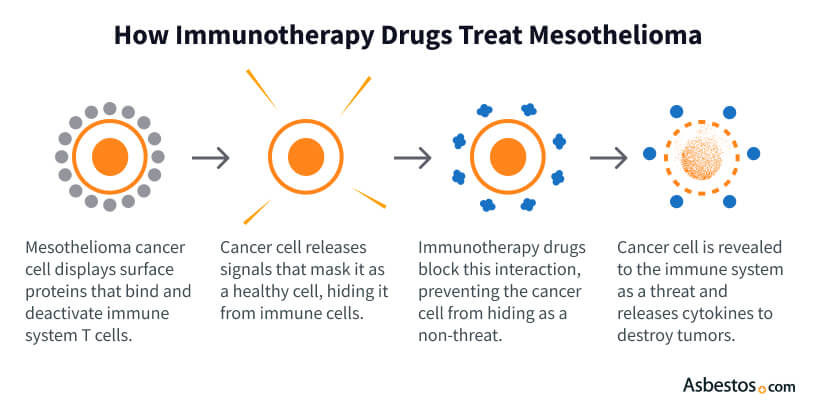
Immunotherapy works by helping your immune system recognize and attack mesothelioma cells it would otherwise miss. Your immune system naturally fights infections using T-cells that seek out and destroy harmful invaders (in this case, tumor cells). However, mesothelioma tumors use deceptive tactics to hide from these immune cells, while immunotherapy removes their disguise.
The Role of Checkpoint Inhibitors
Checkpoint inhibitors are a class of immunotherapy drugs that block proteins cancer cells use to hide from the immune system. These drugs target specific immune “checkpoints”, molecular signals that normally prevent T-cells from attacking healthy tissue. Mesothelioma tumors exploit these checkpoints to avoid detection.
Specifically, PD-1 is a checkpoint protein found on T-cells, while PD-L1 is its binding partner often expressed on mesothelioma tumor cells. When PD-L1 on a tumor binds to PD-1 on a T-cell, it sends a “stop” signal that prevents the immune cell from attacking. Drugs like Opdivo (nivolumab) and Keytruda (pembrolizumab) block PD-1 pathway that tumors use to evade detection. Breaking this connection allows T-cells to recognize and destroy cancer cells.
CTLA-4 is another checkpoint protein that acts as a “brake” on T-cell activation, limiting how aggressively the immune system responds. Yervoy (ipilimumab) blocks CTLA-4, releasing this brake and allowing T-cells to multiply and attack mesothelioma tumors more aggressively. When combined with a PD-1 inhibitor like Opdivo, this dual-checkpoint approach attacks mesothelioma from two angles.
Immune cells locate and destroy mesothelioma cancer cells.
FDA-Approved Mesothelioma Immunotherapy Drugs
Immunotherapy has become a standard treatment for inoperable pleural mesothelioma thanks to several recent FDA approvals. These immunotherapy drugs use the body’s natural immune response to recognize and fight mesothelioma cancer cells, improving survival outcomes for many patients. FDA-approved drugs such as Opdivo, Yervoy and Keytruda have significantly changed the standard of care for mesothelioma.
Immunotherapy Drugs Approved to Treat Mesothelioma
Keytruda (pembrolizumab): Approved in September 2024 for treating unresectable pleural mesothelioma with standard chemo (pemetrexed and platinum), Keytruda shows better tumor response rates and survival than chemo alone.
Opdivo (nivolumab): FDA-approved in October 2020 with Yervoy (ipilimumab) for first-line treatment of adults with unresectable pleural mesothelioma. This was the first immunotherapy combination approved specifically for mesothelioma. The approval was based on results from the CheckMate 743 clinical trial, which showed significant survival benefits over chemotherapy.
Yervoy (ipilimumab): Approved with Opdivo for first-line treatment of unresectable malignant pleural mesothelioma, Yervoy targets the CTLA-4 immune checkpoint, enhancing the immune system’s ability to destroy cancer cells.
These immunotherapy treatments represent the current gold standard for mesothelioma patients who can’t undergo surgery. While Keytruda combined with chemo offers strong results for many patients, the Opdivo and Yervoy combination has shown particular effectiveness for non-epithelioid mesothelioma.
Free Mesothelioma Treatment Guide
Receive our updated guide with the latest information on treatments and clinical trials.
Immunotherapy offers fewer side effects, targeted action and several other key benefits for mesothelioma patients that set it apart from conventional treatments. JAMA Network Open in 2024 published a study on the success of immunotherapy and noted that while results can vary, many patients experience longer survival and a better quality of life with immunotherapy.
Mesothelioma immunotherapy greatly improves outcomes, providing longer survival and better cancer control. Many people live 2 to 5 years beyond their prognosis. Compared to chemo, immunotherapy for mesothelioma typically has fewer side effects, enabling patients to maintain their daily activities.
Mesothelioma Immunotherapy Success Rates
Keytruda + chemotherapy: Median survival of approximately 18 months, with improved progression-free survival compared to chemotherapy alone.
2-year survival rate: 41% of mesothelioma patients treated with immunotherapy were alive at 2 years, compared to 27% with chemotherapy alone.
Opdivo + Yervoy: Median overall survival of 18.1 months, compared to 12-14 months with chemotherapy.
These therapies specifically target cancer cells, protecting healthy tissues. Treatment is personalized based on each patient’s cancer markers, increasing the chances of success. Plus, immunotherapy complements chemotherapy or surgery to improve patient outcomes.
The most significant benefit of immunotherapy for mesothelioma is hope for a cure. Mesothelioma patients and families now have more options to try, even after standard treatments. Seeing tumors shrink from immunotherapy or hearing that a therapy keeps the cancer stable can be highly encouraging. Survivor accounts offer firsthand perspectives of how clinical progress in immunotherapy becomes real and life-changing.
Research on immunotherapy for mesothelioma is advancing, with promising therapies in clinical trials, including CAR T-cell therapy, cancer vaccines and oncolytic viruses. In May 2024, the FDA fast-tracked Keytruda’s review with chemo for pleural mesothelioma.
Experimental Methods to Treat Mesothelioma
CAR T-cell and protein therapies: Doctors extract immune cells from your blood, modify them in a lab to fight cancer more effectively, then return them to your body. This helps your immune system better target mesothelioma tumors. Several U.S. clinical trials are recruiting participants.
Mesothelioma cancer vaccines: These vaccines train your immune system to recognize and attack existing mesothelioma cells through exposure to cancer-specific proteins. Unlike preventive vaccines, these fight cancer already present in your body. Multiple vaccine trials are ongoing in the U.S.
Monoclonal antibodies: These laboratory-made antibodies target mesothelin, a protein on mesothelioma cells. Amatuximab and Tremelimumab are two under study. Multiple trials involving monoclonal antibodies for mesothelioma are actively recruiting patients.
Virotherapy: Also called oncolytic virus therapy, this uses engineered viruses to infect and destroy mesothelioma cells while sparing healthy tissue. When cancer cells burst, they release substances that activate your immune response. Researchers are exploring adenoviruses, measles, herpesviruses and reoviruses.
Noteworthy Clinical Trials
CheckMate 743 is the landmark clinical trial that led to FDA approval of Opdivo plus Yervoy for mesothelioma. Published in The Lancet in 2021, the trial enrolled 605 patients with unresectable malignant pleural mesothelioma. Patients receiving the immunotherapy combination lived a median of 18.1 months compared to 14.1 months with standard platinum-based chemotherapy, a 4-month improvement in overall survival. The combination showed particular effectiveness for patients with non-epithelioid (sarcomatoid or biphasic) mesothelioma, where median survival nearly doubled compared to chemotherapy.
KEYNOTE-483 is the clinical trial that supported Keytruda’s September 2024 FDA approval for mesothelioma. The Phase 3 trial combined Keytruda with pemetrexed and platinum-based chemotherapy as a first-line treatment. Results showed that adding Keytruda to chemotherapy improved both progression-free survival and overall survival compared to chemotherapy alone, leading the FDA to approve this combination for unresectable pleural mesothelioma.
Trials like DREAM3R and CheckMate 743 compare immunotherapy to chemo to identify the most effective treatment. Participation in clinical trials allows patients to access innovative therapies early. Researchers want to make these methods available to all to help people with mesothelioma live longer and better lives.
Jim McWhorter
Verified Asbestos.com Survivor
Navy Veteran Experiences Positive Results After Mesothelioma Immunotherapy Trial
Mesothelioma patient Jim McWhorter was able to get into a clinical trial at Dana-Farber Cancer Institute in Boston, testing a combination of the immunotherapy drugs durvalumab and tremelimumab. For the first few months, he experienced extremely positive results. The cancer had stabilized.
Who Is a Candidate for Mesothelioma Immunotherapy?
Eligibility for immunotherapy can depend on several factors, including previous mesothelioma treatments, overall health and specific tumor characteristics. Each patient is unique, and specialists evaluate these factors individually. Even those who haven’t responded well to earlier treatments may benefit from immunotherapy.
Factors Influencing Candidacy for Mesothelioma Immunotherapy
Cell type: Patients with nonepithelioid mesothelioma (sarcomatoid or biphasic) often respond better to immunotherapy than chemotherapy.
Overall health and performance status: Doctors use the Eastern Cooperative Oncology Group status to assess whether a patient is healthy enough for immunotherapy.
PD-L1 biomarker status: High PD-L1 levels may predict better response, but patients with low or negative PD-L1 can still benefit from immunotherapy.
Previous treatment response: Patients whose mesothelioma progressed or returned after chemotherapy may qualify for immunotherapy as a second-line treatment.
Stage and operability: Patients with advanced, metastatic, or unresectable mesothelioma are typically prime candidates for immunotherapy.
Dr. Catherine Perrault, a medical officer with The Mesothelioma Center’s Medical Outreach Program, discussed the role mesothelioma cell types play in eligibility in a our recent webinar on Keytruda. She noted people with different mesothelioma cell types may respond differently to immunotherapy. But having a specific type doesn’t necessarily disqualify a patient from receiving immunotherapy.
Mesothelioma clinical trials may also provide immunotherapy options when standard therapies aren’t suitable or available. They can offer new hope for improved quality of life and extended survival.
MATCHED TO YOUR DIAGNOSIS
Find an Immunotherapy Clinical Trial
Discover new treatments with immunotherapy clinical trials near you. Get help with eligibility and enrollment.
Immunotherapy can greatly improve mesothelioma outcomes, but it may also cause side effects. These often happen because the immune system becomes overactive, leading to flu-like symptoms or mild autoimmune reactions.
Side effects such as coughing and shortness of breath can be confusing since they’re similar to symptoms of pleural mesothelioma. Because of this overlap, clear communication between patients and doctors about any new or worsening symptoms during treatment is critical.
Common Immunotherapy Side Effects
Appetite changes: loss of appetite or mild digestive troubles
Coughing: may be mistaken for mesothelioma symptoms, so requires close monitoring
Diarrhea or constipation: usually mild and treated with medication
Fatigue: common but usually manageable with rest
Feverorchills: flu-like signs indicating immune system activity
Headaches: typically mild and short-lived
Jointormusclepain: arthritis-like aches, often eased with mild pain relievers
Nausea: often less severe than with chemo.
Since mesothelioma affects lung function, respiratory side effects like coughing or shortness of breath need close monitoring to distinguish disease progression from treatment effects. Report these symptoms quickly, allowing your medical team to provide the best care and symptom relief. Regular check-ups and open communication help maintain comfort and quality of life during immunotherapy. Your medical team will check on you frequently and address any issues early to maintain your comfort.
Expert Insight
Dr. Jeffrey Velotta: Is Immunotherapy the Future of Mesothelioma Treatment?
Immunotherapy has really come up. And I think the clinical trials will show of benefit with immunotherapy. I think the future is going to be looking at get the surgery, get the cancer out so they can get well enough. They can start gaining weight again. They don’t feel the shortness of breath. They don’t feel the pain. And then, ultimately, just provide them with just protection, preventative so like things not coming back.
So just give them the immunotherapy and the chemotherapy afterwards. And preliminary, when we look at our patients that we’ve kind of been doing that for, it looked with doing surgery followed by chemotherapy followed by immunotherapy. They actually live the longest compared to even surgery and chemotherapy just alone. So I think it’s really that addition of adding immunotherapy.
Serious Side Effects
Although rare, some people with mesothelioma can experience serious immune-related side effects. These happen when the immune system becomes too aggressive and starts attacking healthy tissues instead of just cancer cells. This can cause severe inflammation in organs. Doctors need to act quickly to manage these side effects to prevent lasting damage or treatment interruptions.
Severe Immunotherapy Side Effects
Colitis: severe inflammation of the colon that causes ongoing diarrhea, abdominal pain or blood in the stool
Endocrine gland disorders: problems with glands that lead to hormone imbalances, fatigue, mood changes or a fast heartbeat
Hepatitis: inflammation of the liver causing yellowing of the skin (jaundice), dark urine or belly pain
Kidney inflammation (nephritis): swelling, less urine output or lower back pain from kidney inflammation
Pneumonitis: lung inflammation that causes chest pain, severe cough and trouble breathing
Doctors usually treat these serious side effects with steroids or other medicines that reduce immune system activity. Patients are carefully watched with blood tests and regular exams to catch problems early.
If serious side effects occur, your mesothelioma doctor may pause or stop immunotherapy to keep you safe. Report any new or worsening symptoms promptly and discuss them with your doctor.
Some types of immunotherapy for mesothelioma have already been approved for advanced, malignant and inoperable cases, according to a 2025 study published in the medical journal Cancers. Clinical trials are exploring more immunotherapy and chemotherapy combinations as first-line treatments.
Our exclusive 2025 survey found 22% of mesothelioma patients used immunotherapy as part of their personalized treatment plan.
This has really helped improve treatment outcomes in mesothelioma, whether in unresectable or even respectable mesothelioma; thus, more research in immunotherapy is crucial to improving outcomes.
Dr. Jeffrey Velotta,
thoracic surgeon at Kaiser Permanente Oakland Medical Center
Common Questions About Immunotherapy for Mesothelioma
Does insurance cover immunotherapy?
Yes, insurance usually covers immunotherapy for mesothelioma if the treatments are FDA-approved. Medicare, private insurance and VA health care typically pay for drugs like Keytruda, Opdivo and Yervoy, which lowers out-of-pocket costs. Although immunotherapy can be expensive, as much as $100,000 or more annually for some checkpoint inhibitors, financial aid programs and clinical trials can help pay for it for those who qualify.
How long do patients stay on immunotherapy?
Mesothelioma patients usually stay on immunotherapy until their cancer worsens or side effects become hard to handle, often lasting from a few months to about 2 years. In clinical trials, immunotherapy is often given for 2 years. However, how long treatment lasts can differ based on each patient’s response and health situation.
Is immunotherapy equally effective for men and women?
Studies show that men and women benefit from immunotherapy for mesothelioma, but the response rates may be a bit different. Men may have a slightly better survival rate, but both genders can benefit from these treatments. Doctors recommend all eligible mesothelioma patients to consider immunotherapy options.
Is immunotherapy better than chemotherapy?
Immunotherapy isn’t always better than chemo, but it usually has fewer side effects and helps people live longer. It works well for people with nonepithelioid mesothelioma, who often don’t respond well to chemo. A mix of immunotherapy and chemo often gives the best results, combining the benefits of both types of treatment.
How can I access mesothelioma immunotherapy treatment?
To begin immunotherapy, talk to a mesothelioma specialist or oncologist to see if FDA-approved or experimental options are right for you. Our Patient Advocates can help you find treatment centers, set up appointments and handle insurance or VA claims. If FDA-approved therapies aren’t available, they can also help you look for clinical trials to access new treatments early.
Recommended Reading
Your web browser is no longer supported by Microsoft. Update your browser for more security, speed and compatibility.
If you are looking for mesothelioma support, please contact our Patient Advocates at (855) 404-4592
Fact Checked
Our fact-checking process begins with a thorough review of all sources to ensure they are high quality. Then we cross-check the facts with original medical or scientific reports published by those sources, or we validate the facts with reputable news organizations, medical and scientific experts and other health experts. Each page includes all sources for full transparency.
Reviewed
Asbestos.com is the nation’s most trusted mesothelioma resource
The Mesothelioma Center at Asbestos.com has provided patients and their loved ones the most updated and reliable information on mesothelioma and asbestos exposure since 2006.
Our team of Patient Advocates includes a medical doctor, a registered nurse, health services administrators, veterans, VA-accredited Claims Agents, an oncology patient navigator and hospice care expert. Their combined expertise means we help any mesothelioma patient or loved one through every step of their cancer journey.
More than 30 contributors, including mesothelioma doctors, survivors, health care professionals and other experts, have peer-reviewed our website and written unique research-driven articles to ensure you get the highest-quality medical and health information.
About The Mesothelioma Center at Asbestos.com
Assisting mesothelioma patients and their loved ones since 2006.
Helps more than 50% of mesothelioma patients diagnosed annually in the U.S.
A+ rating from the Better Business Bureau.
5-star reviewed mesothelioma and support organization.
My family has only the highest compliment for the assistance and support that we received from The Mesothelioma Center. This is a staff of compassionate and knowledgeable individuals who respect what your family is experiencing and who go the extra mile to make an unfortunate diagnosis less stressful. Information and assistance were provided by The Mesothelioma Center at no cost to our family.
Asbestos.com. (2026, February 10). Mesothelioma Immunotherapy. Retrieved June 25, 2026, from https://www.asbestos.com/treatment/immunotherapy/
MLA
"Mesothelioma Immunotherapy." Asbestos.com, 10 Feb 2026, https://www.asbestos.com/treatment/immunotherapy/.
Chicago
Asbestos.com. "Mesothelioma Immunotherapy." Last modified February 10, 2026. https://www.asbestos.com/treatment/immunotherapy/.
Most helpful, steered us in the right direction for treatment. Great source of information and support, the Center followed through on every one of our requests.
Because of their guidance, I was able to navigate getting my mother into MD Anderson when her case got put aside by mistake in all the COVID-19 craziness. Vanessa was amazing and I can’t recommend enough reaching out to them. I thought it was a gimmick to get you to hire a lawyer, but I was so wrong. They truly seemed to want to help meso patients and KNOW what you need to ask and do in order to get help.
Hearing the news about my mother's diagnosis was heartbreaking. I felt lost, I didn't know how I could help or where to seek the best medical care. I started researching specialists online and shortly after, Dr. Smart reached out to me. She has been extremely helpful and encouraging throughout this entire process. Even though we aren't located in her area, she has helped us get in contact and set up appointments with the best doctors/specialists nearby. She has always been available for any questions that we have, and she even sent us a binder full of helpful resources. The patient advocates are amazing and true to their title. Dealing with this process is not easy, but knowing that we have someone like Dr. Smart in our corner is reassuring and we are so grateful for her and The Mesothelioma Center.
My son Carlos was diagnosed with this terrible and unknown disease a few months ago. Thank God we found The Mesothelioma Center along the way, and Vanessa Blanco who provided us with information on hospitals and doctors who have been of great help. I am very grateful to them.
Extremely communicative and helped my dad get an appointment with one of the top centers in Philadelphia. I'm so grateful for this center. They assisted with information on nutrition, legal help, and scheduling appointments. Special thanks to Danielle!
Danielle DiPietro was an invaluable resource for me. Her suggestions and recommendations guided us towards stellar practitioners in our area. Without her advocacy, I feel we would have been receiving less-than-optimal medical and legal care for mesothelioma. Receiving the diagnosis was a shock and I felt lost initially. I wish everyone could take advantage of this FREE assistance.
I was very grateful and appreciative of Dr. Smart from The Mesothelioma Center. She was very helpful to my husband and me. She educated and walked us through the steps, and suggested ideas and questions to ask his doctors. She also provided me with a lot of information that I can read and educate myself about this illness. We need more people like Dr. Smart, who is very educated and you can tell she enjoys the work that she does by the way she assisted my husband and me. We thank the Lord and are grateful that we met Dr. Smart from The Mesothelioma Center.
In January of 2016, my husband was diagnosed with peritoneal mesothelioma. Our first reaction was: what is this and what can we do? He was diagnosed by an oncologist and was scheduled to start chemotherapy. When we arrived home that day, I googled mesothelioma and discovered The Mesothelioma Center had a form to fill out to request additional information. I filled it out and within an hour, I received a phone call from Karen Selby from The Mesothelioma Center asking if I needed any help. Karen was and still is my lifeline. She located a doctor at the Cleveland Clinic who performed surgery and HIPEC on peritoneal mesothelioma patients. My husband was scheduled with an appointment and his surgery was performed on March 3, 2016. He continued with follow-up appointments with the oncologist until a friend of ours passed away from it in 2017. Immediately I sent Karen an email asking if she knew any mesothelioma specialists at the clinic, and of course, I got a prompt response back with a name. Everything was going well until the last CAT scan, which showed it returned. He is now doing chemo and has his next CAT scan scheduled for the end of March with a follow-up for the results with the mesothelioma doctor. Without Karen, I am not sure my husband would still be here. She provided me with so much information along with help in various ways, too numerous to even mention. Thank you to all those who are there to help us.
Professional Contributors Featured In This Article
We Thoroughly vet individuals who are experts in their field to contribute to articles on Asbestos.com. We believe in the integrity and quality of our educational materials, and only publish information that is relevant, factual, and backed by experts.
Dr. Estelamari Rodriguez is an oncologist and hematologist specializing in mesothelioma at the Sylvester Comprehensive Cancer Center in Miami, Florida.
Fact-checked and verified content:
Our fact-checking process begins with a thorough review of all sources to ensure they are high quality. Then we cross-check the facts with original medical or scientific reports published by those sources, or we validate the facts with reputable news organizations, medical and scientific experts and other health experts. Each page includes all sources for full transparency.
Please read our editorial guidelines to learn more about our content creation and review process.