Sarcomatoid mesothelioma accounts for 10% to 20% of all mesothelioma cases and is the most aggressive cell type. Asbestos causes the spindle-shaped sarcomatoid mesothelioma tumors to primarily develop in the lining of the lungs, and they are resistant to treatment.
Learn more about mesothelioma, asbestos and the steps you can take to fight this disease.
“In pleural mesothelioma, the latest studies show epithelioid versus sarcomatoid and biphasic, or nonepithelioid mesothelioma, should be treated differently. Immunotherapy is the go to now for our nonepithelioid variants, and they are getting a huge response from that combination of Opdivo and Yervoy.”
Karen Selby, registered nurse and Patient Advocate at The Mesothelioma Center
“Sarcomatoid mesothelioma tends to be a little more locally progressive. Sometimes it will go through the chest wall or the diaphragm, which is the muscle that separates the chest and the abdomen, or through the pericardium, the sac around the heart. It is less common for that type to go to other organs or even the lymph nodes. That said, it's a little less responsive to chemotherapy. But from what we see from more recent data, it may be more responsive to immunotherapy.”
Andrea Wolf, Thoracic Surgeon, Director of the New York Mesothelioma Program at Mount Sinai
“It’s a real mystery at this point why I’ve done so well. After listening to the medical people, it’s almost shocking. I’m not superhuman by any means. I’m a simple man. Maybe I can let people know, there is hope out there.”
Wally R., sarcomatoid mesothelioma patient
Research shows immunotherapy doubles the survival rate for some patients with sarcomatoid mesothelioma
The median is 15 months with immunotherapy and 10.7 months with chemotherapy
Sarcomatoid is the least common of the mesothelioma cell subtypes. About 60% of patients have the epithelial type and 20% have the biphasic type
The 2-year survival rate for sarcomatoid mesothelioma is about 15%, and the 5-year rate is close to 4%, the least favorable outcome of any mesothelioma cell type
The fibrous nature of sarcomatoid mesothelioma cells makes them resistant to treatment, leading to a generally poor prognosis.
“In pleural mesothelioma, the latest studies show epithelioid versus sarcomatoid and biphasic, or nonepithelioid mesothelioma, should be treated differently. Immunotherapy is the go to now for our nonepithelioid variants, and they are getting a huge response from that combination of Opdivo and Yervoy.”
Karen Selby, registered nurse and Patient Advocate at The Mesothelioma Center
“Sarcomatoid mesothelioma tends to be a little more locally progressive. Sometimes it will go through the chest wall or the diaphragm, which is the muscle that separates the chest and the abdomen, or through the pericardium, the sac around the heart. It is less common for that type to go to other organs or even the lymph nodes. That said, it's a little less responsive to chemotherapy. But from what we see from more recent data, it may be more responsive to immunotherapy.”
Andrea Wolf, Thoracic Surgeon, Director of the New York Mesothelioma Program at Mount Sinai
“It’s a real mystery at this point why I’ve done so well. After listening to the medical people, it’s almost shocking. I’m not superhuman by any means. I’m a simple man. Maybe I can let people know, there is hope out there.”
Wally R., sarcomatoid mesothelioma patient
Research shows immunotherapy doubles the survival rate for some patients with sarcomatoid mesothelioma
The median is 15 months with immunotherapy and 10.7 months with chemotherapy
Sarcomatoid is the least common of the mesothelioma cell subtypes. About 60% of patients have the epithelial type and 20% have the biphasic type
The 2-year survival rate for sarcomatoid mesothelioma is about 15%, and the 5-year rate is close to 4%, the least favorable outcome of any mesothelioma cell type
The fibrous nature of sarcomatoid mesothelioma cells makes them resistant to treatment, leading to a generally poor prognosis.
What Is Sarcomatoid Mesothelioma?
Sarcomatoid mesothelioma is a rare and aggressive asbestos-related cancer. The cancer forms when sarcomatoid cells grow into tumors. These cells are long and shaped like spindles. Tumors can develop in the lining of the lungs, abdomen, heart or testes.
Sarcomatoid cells grow in connective tissues, such as bones, nerves and tendons. The sarcomatoid type is the rarest of the 3 primary cell types of mesothelioma. For comparison, about 60% of patients have the epithelial type, and 20% have the biphasic type.
Sarcomatoid tumors spread easily and are tough to treat. This leads to a worse outlook for this type of mesothelioma. However, new immunotherapy treatments have helped some patients beat the odds.
What Causes Sarcomatoid Mesothelioma?
Asbestos is the main cause of sarcomatoid mesothelioma. When people breathe in asbestos fibers, these fibers build up in the body. This buildup causes irritation and inflammation. Over time, this can cause mutations that turn mesothelial cells into cancer cells.
Mesothelioma risk factors include asbestos exposure at work, in the military and from the environment. Mainly, industrial workers faced exposure. Veterans were at risk in shipyards and military bases. People were also unknowingly exposed when someone in their home took home asbestos fibers on their work clothes or body. Recently, exposure to asbestos-contaminated talc, such as in talcum powder, has led to some mesothelioma diagnoses.
Sarcomatoid mesothelioma survivor Gene H. worked as a sheet metal contractor, where he believes he was exposed to asbestos. He tells us, “The diagnosis was tough, especially when they said 4-6 months to live. But now, with this immunotherapy, I’m not going downhill anymore. I’m on the climb back up. And that feels good.”
What Are the Symptoms of Sarcomatoid Mesothelioma?
Common symptoms of sarcomatoid pleural mesothelioma include shortness of breath, chest pain and persistent coughing. Severe cases can lead to breathing difficulties and a lasting cough. In sarcomatoid peritoneal mesothelioma, people may experience bowel issues, pain and swelling in the abdomen.
Symptoms depend on tumor location. Sarcomatoid cells are mainly in the lung lining. Pleural makes up 98% of sarcomatoid mesothelioma cases while peritoneal makes up 2% of cases. Symptoms may take 20 to 60 years to develop after asbestos exposure.
Sarcomatoid Mesothelioma Symptoms
Abdominal pain or swelling (peritoneal)
Bowel changes (peritoneal)
Chest pain or tightness (pleural)
Fatigue and weakness (pleural)
Loss of appetite (peritoneal)
Nausea or vomiting (peritoneal)
Persistent dry cough (pleural)
Shortness of breath (pleural)
Unexplained weight loss (pleural)
A 2023 review published in the journal Thoracic Cancer found sarcomatoid mesothelioma symptoms are often vague. This makes early diagnosis tough, as patients might not mention key symptoms. These symptoms are often like those of common illnesses, such as bronchitis.
If you have any mesothelioma signs or a history of asbestos exposure, speak with a specialist as soon as possible. If you have a history of asbestos exposure, speak with your doctor about early screening. An early diagnosis may mean more treatment options.
FREE MESOTHELIOMA GUIDE
Expert Guidance for Your Mesothelioma Journey
Get answers about treatment, top doctors, and financial support from the nation’s most trusted mesothelioma resource.
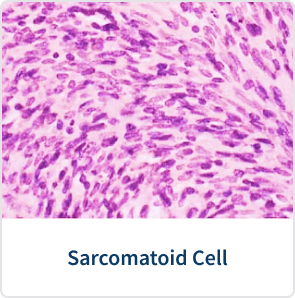
A pathology stain showing sarcomatoid mesothelioma cells under a microscope.
Sarcomatoid mesothelioma is diagnosed through imaging tests, biopsy and pathology analysis. Diagnosis often begins with X-rays or CT scans. If imaging reveals abnormalities, doctors collect a tissue sample for a biopsy, which is the only test that confirms cell type.
Another doctor reviews stained samples under a microscope and creates a pathology report. Pathology stains are tests that make cell features visible under a microscope. Sarcomatoid cells are long, narrow and shaped like spindles.
We actually have this amazing brochure that we can send to a patient that thinks they might have mesothelioma, never been to a doctor before, never been diagnosed. We offer a brochure they literally can take to the doctor’s office with them and literally hand it to the doctor and say, I think I have this. Can I have these tests?
The first test for a patient with, symptoms related to mesothelioma will be going to their primary doctor, getting an x-ray or a CAT scan done. Based on the results from that, they may go through further testing such as a thoracentesis or paracentesis, which is where they drain fluid, whether it’s from the lining of the lungs or the peritoneal area, which is the abdominal area. The next step would be for a biopsy. The biopsy is a step where they confirm the diagnosis. This sample is sent to a pathologist who ultimately tests the sample taken out from the tumor and identifies it as mesothelioma.
And not just look at under microscope by any pathologist, but pathologist who has an expertise in making that diagnosis. Because even with a good sample of tumor, looking at it under a microscope, it can sometimes be difficult to make that diagnosis. And it’s important not only to know that it’s mesothelioma, it’s important to know what is the histological subtype. Is it epithelial or is it sarcomatoid or is it a mixture of both called mixed or biphasic, because that changes the type of treatment.
We handhold them through the diagnostic part early on. So we actually prepare them before they go of what their doctor is likely going to do or what may not need to do based on their previous studies they’ve had.
Understanding Your Pathology Report
Your pathology report describes your tumor cell type, biomarkers and cancer stage. Your doctor uses the findings to complete your diagnosis. Ask your doctor about your report and how it affects your treatment options.
“Most patients don’t know their cell type when I initially speak with them,” says Dr. Snehal Smart, a medical doctor and Patient Advocate at The Mesothelioma Center. “I help them review their pathology report and explain what sarcomatoid cell types are and what this means for them.”
Patient Advocates can walk you through each section of the report to make sure you have a good understanding of what it explains. They can answer questions about how a diagnosis may impact treatment and prognosis.
Immunohistochemical markers, or biomarkers, can not only help diagnose you, but they can also help your doctor pick the best medication for you. For example, if sarcomatoid cells in your tumor show high PD-L1 levels (seen after staining), your doctor will likely recommend checkpoint inhibitors like Opdivo and Yervoy.
Expert Insight
Sarcomatoid mesothelioma is a rare subtype in contrast to epithelial. Sarcomatoid tends to be a little more locally progressive.
Dr. Andrea Wolf, director of the New York Mesothelioma Program at Mount Sinai
Rare Sarcomatoid Cell Types
Rare sarcomatoid mesothelioma cell subtypes can provide information about your prognosis. These types come in 3 categories. Some may provide a better prognosis. Others can point to a higher chance of metastasis.
Rare Sarcomatoid Cells
Desmoplastic mesothelioma: This sarcomatoid subtype is one of the most difficult to diagnose. With this cell type, doctors may be unable to track if your tumor is growing.
Lymphohistiocytoid mesothelioma: These tumors contain inflammatory and immune cells. This can translate to more symptoms but also a better life expectancy.
Transitional mesothelioma: This type grows and spreads like other subtypes. It consists of large, spindle-shaped cells that make the disease easier to diagnose.
These sarcomatoid mesothelioma subtypes are generally rare. They most often develop in the pleura of the lungs. Ask your physician whether there are any abnormalities in your pathology report. They can offer more information on your outlook prognosis.
What Is the Survival Rate of Sarcomatoid Mesothelioma?
A recent study showed the median survival for sarcomatoid mesothelioma was 15 months with immunotherapy and 10.7 months with chemotherapy. Each person’s prognosis differs based on health, tumor location and metastasis. The 2-year survival rate is approximately 15% overall, though patients treated with immunotherapy have seen rates as high as 41%. The 5-year rate remains around 4–5%, the lowest of any mesothelioma cell type.
The life expectancy for sarcomatoid pleural mesothelioma cases is about 5 months. For peritoneal cases, the average is 10 to 11 months. Women with the sarcomatoid type often outlive men.
The shape of these cells makes them less likely to stick together. This means they’re more likely to spread quickly. Still, some people with sarcomatoid tumors have lived for years thanks to advances in immunotherapy.
Dr. Anna Nowak, a researcher at the Institute for Respiratory Health in Western Australia, says immunotherapy boosts survival. She tells us, “For people with sarcomatoid and biphasic mesothelioma, we can double survival with the combination of ipilimumab and nivolumab.”
Wally R.
Verified Asbestos.com Survivor
Immunotherapy Works Wonders for Sarcomatoid Mesothelioma Survivor
When Wally’s tumors grew after rounds of chemo, a specialist recommended Keytruda. The immunotherapy drug had an almost immediate effect. CT scans showed no sign of sarcomatoid mesothelioma after 8 months on Keytruda.
Sarcomatoid mesothelioma is treated with immunotherapy, chemotherapy, radiation and palliative care. Treatment varies for each person, depending on cancer stage, tumor size and health. The rapid recurrence of this type means surgery is rarely advised. However, it may be an option for peritoneal patients who respond well to immunotherapy.
Recent research shows immunotherapy can offer lasting benefits to some sarcomatoid patients. However, Tumor Treating Fields therapy hasn’t proven effective for sarcomatoid tumors. For the best options, it’s wise to consult a mesothelioma specialist at a top cancer center.
Sarcomatoid Mesothelioma Treatment
Chemotherapy: Patients with sarcomatoid mesothelioma who receive Alimta (pemetrexed) plus cisplatin or carboplatin have a median survival of about 15 months in some studies, though other analyses report a median closer to 10.7 months. Survival varies based on the specific regimen, patient health and disease stage.
Immunotherapy: Opdivo (nivolumab) and Yervoy (ipilimumab) extend median survival to 18.1 months for sarcomatoid patients, about 4 months longer than chemo alone.
Palliative Care: Less invasive chemo and surgery can ease symptoms and slow tumor growth. They can also improve breathing, thanks to palliative care.
Radiation Therapy: Often used alongside other therapies, radiation may increase the 2-year life expectancy 30% for some mesothelioma patients.
Targeted Therapy: Targeted therapies are showing effectiveness for some cancers in clinical trials.
“Sarcomatoid mesothelioma is a little less responsive to chemotherapy,” mesothelioma specialist Dr. Andrea Wolf of Mount Sinai Hospital tells us. “But from what we see from more recent data, it may be more responsive to immunotherapy. And we have additional treatment options for those patients.”
Sarcomatoid patients may seek palliative care for symptom relief and better quality of life. Yet, only 48% of the mesothelioma patients we surveyed in 2023 reported using it.
Surviving Mesothelioma Book
A Survivor’s Guide to Living With Mesothelioma
Learn about Judy Glezinski’s inspiring journey as a mesothelioma survivor, and get tips on how to improve your prognosis.
Sarcomatoid mesothelioma is the most aggressive of the mesothelioma cell types and often doesn’t respond well to curative treatments. Surgery may not be recommended for sarcomatoid patients. Chemo and radiation aren’t as likely to produce long-term remission for sarcomatoid patients as they might for other mesothelioma cell types. Immunotherapy has shown the most promise, with some patients achieving longer survival than previously expected. Research is ongoing, and clinical trials continue to explore new approaches for this difficult-to-treat cell type.
As Anna Nowak, internationally renowned asbestos researcher and mesothelioma advocate, tells us, “Sarcomatoid mesothelioma is generally considered incurable. Surgery isn’t typically recommended for sarcomatoid mesothelioma. Other treatments including immunotherapy, chemotherapy and radiotherapy are unlikely to be curative. There may be occasional long-term survival in sarcomatoid mesothelioma treated with immunotherapies.”
What is the life expectancy for sarcomatoid mesothelioma?
Sarcomatoid mesothelioma has a median life expectancy of 4 to 7 months without aggressive treatment, though immunotherapy has extended survival to a median of 15 months in recent clinical trials. In the CheckMate-743 trial, patients treated with Opdivo (nivolumab) and Yervoy (ipilimumab) achieved a median survival of 18.1 months. Pleural cases average about 5 months while peritoneal cases average 10 to 11 months.
What is the survival rate for sarcomatoid mesothelioma?
The 2-year survival rate for sarcomatoid mesothelioma is around 15%, and the 5-year survival rate is close to 4%, making it the cell type with the least favorable survival rates. In the CheckMate-743 trial, patients treated with Opdivo (nivolumab) and Yervoy (ipilimumab) achieved a 2-year survival rate of 41%. Earlier diagnosis and multimodal treatment can improve individual outcomes.
What is spindle cell mesothelioma?
Spindle cell mesothelioma is another name for sarcomatoid mesothelioma, referring to the elongated, spindle-like shape of the tumor cells when viewed under a microscope. Sarcomatoid cells are defined as having greater than 90% spindle-shaped tumor cells. The loose attachment between spindle cells contributes to faster metastasis compared to other mesothelioma cell types.
Is there any ongoing research on sarcomatoid mesothelioma?
Researchers are working on new treatments for sarcomatoid mesothelioma. Some participants in clinical trials have had success with new immunotherapy drugs. You might qualify for a trial and receive the latest treatment for sarcomatoid cells. So ask your mesothelioma specialist about the best options for you.
Recommended Reading
Your web browser is no longer supported by Microsoft. Update your browser for more security, speed and compatibility.
If you are looking for mesothelioma support, please contact our Patient Advocates at (855) 404-4592
Fact Checked
Our fact-checking process begins with a thorough review of all sources to ensure they are high quality. Then we cross-check the facts with original medical or scientific reports published by those sources, or we validate the facts with reputable news organizations, medical and scientific experts and other health experts. Each page includes all sources for full transparency.
Reviewed
Asbestos.com is the nation’s most trusted mesothelioma resource
The Mesothelioma Center at Asbestos.com has provided patients and their loved ones the most updated and reliable information on mesothelioma and asbestos exposure since 2006.
Our team of Patient Advocates includes a medical doctor, a registered nurse, health services administrators, veterans, VA-accredited Claims Agents, an oncology patient navigator and hospice care expert. Their combined expertise means we help any mesothelioma patient or loved one through every step of their cancer journey.
More than 30 contributors, including mesothelioma doctors, survivors, health care professionals and other experts, have peer-reviewed our website and written unique research-driven articles to ensure you get the highest-quality medical and health information.
About The Mesothelioma Center at Asbestos.com
Assisting mesothelioma patients and their loved ones since 2006.
Helps more than 50% of mesothelioma patients diagnosed annually in the U.S.
A+ rating from the Better Business Bureau.
5-star reviewed mesothelioma and support organization.
My family has only the highest compliment for the assistance and support that we received from The Mesothelioma Center. This is a staff of compassionate and knowledgeable individuals who respect what your family is experiencing and who go the extra mile to make an unfortunate diagnosis less stressful. Information and assistance were provided by The Mesothelioma Center at no cost to our family.
Asbestos.com. (2026, October 9). Sarcomatoid Mesothelioma. Retrieved October 22, 2026, from https://www.asbestos.com/mesothelioma/malignant-sarcomatoid/
MLA
"Sarcomatoid Mesothelioma." Asbestos.com, 9 Oct 2026, https://www.asbestos.com/mesothelioma/malignant-sarcomatoid/.
Chicago
Asbestos.com. "Sarcomatoid Mesothelioma." Last modified October 9, 2026. https://www.asbestos.com/mesothelioma/malignant-sarcomatoid/.
This is the go to place for any and all questions you may have pertaining to Mesothelioma.
After my dad was diagnosed with Pleural Mesothelioma we were scared and didn't know what to do. Thank God we found The Mesothelioma Center. What an incredible organization! My family is so grateful for Danielle and Karen and all the invaluable resources they have shared. They are so kind, caring, responsive and knowledgeable. The information and advice they provided have helped us find the best treatment plan for my dad. Thank you for all you do to help patients and their families. You are AMAZING!!
They Mesothelioma Center was extremely helpful to my family as our dad was recently diagnosed with this disease. I was most impressed with their promptness in returning phone calls, emails, and their expert advice with this matter. It was extremely overwhelming , but the Mesothelioma Center has a wealth of resources at their fingertips and they are able to tailor it to your families needs. Their legal and medical recommendations have been very helpful. I also appreciate the continued support they have given to our family. You do not have to go through this alone. I would highly recommend The Mesothelioma Center.
Professional Contributors Featured In This Article
We Thoroughly vet individuals who are experts in their field to contribute to articles on Asbestos.com. We believe in the integrity and quality of our educational materials, and only publish information that is relevant, factual, and backed by experts.
Dr. Jacques Fontaine is a thoracic surgeon at Moffitt Cancer Center in Tampa, Florida, where he heads up the Mesothelioma Research and Treatment Center. He specializes in minimally invasive robotic surgery and aggressive surgeries for mesothelioma.
Fact-checked and verified content:
Our fact-checking process begins with a thorough review of all sources to ensure they are high quality. Then we cross-check the facts with original medical or scientific reports published by those sources, or we validate the facts with reputable news organizations, medical and scientific experts and other health experts. Each page includes all sources for full transparency.
Please read our editorial guidelines to learn more about our content creation and review process.