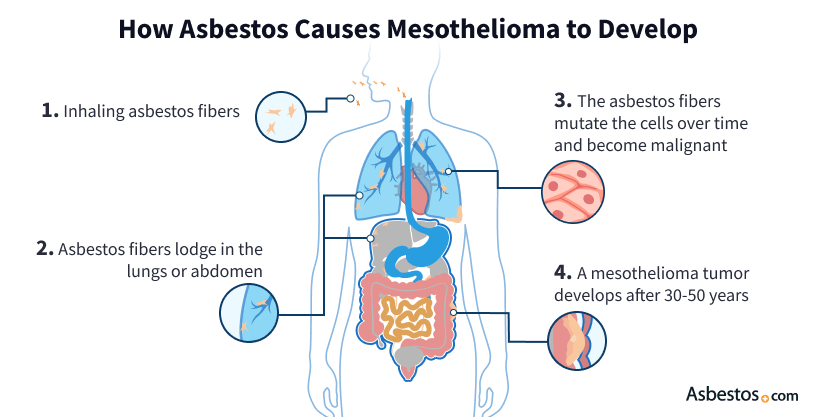
Asbestos exposure is the main cause of mesothelioma. Asbestos fibers can lodge in the lining of the lungs or abdomen, risking inflammation, DNA mutations and eventually cancer. Workers, veterans and families exposed secondhand face higher risks, with symptoms appearing 20 to 60 years after exposure.
Learn more about mesothelioma, asbestos and the steps you can take to fight this disease.
Mesothelioma is caused by exposure to asbestos. Patients inhale asbestos most of the time during their line of work, but some other times, family members would bring mesothelioma to the household, for instance.
It causes chronic inflammation, and those chronic inflammatory changes in the lung lining, which is the pleura, would then lead to genetic changes in a cell that then gets changed in its DNA into a cancer cell.
There's also talc, which has been most recently associated with development of mesothelioma.
Mesothelioma is caused by exposure to asbestos. Patients inhale asbestos most of the time during their line of work, but some other times, family members would bring mesothelioma to the household, for instance.
It causes chronic inflammation, and those chronic inflammatory changes in the lung lining, which is the pleura, would then lead to genetic changes in a cell that then gets changed in its DNA into a cancer cell.
There's also talc, which has been most recently associated with development of mesothelioma.
What Causes Mesothelioma?
Asbestos fibers cause mesothelioma when they’re inhaled or ingested and become stuck in the mesothelium, a thin tissue layer surrounding the lungs, abdomen and other organs. The body can’t clear these fibers, so they can stay there for decades, slowly damaging DNA and triggering the cell mutations that lead to cancer.
Risk varies depending on how much and how long the asbestos exposure was. While this dose-response relationship means the risk of a single exposure in a well-ventilated environment is low, there is no safe level of asbestos exposure.
Most mesothelioma diagnoses are the result of primary asbestos exposure at work or in the military. Some people develop mesothelioma from secondary exposure, which happens when workers accidentally carry fibers home on their bodies, clothes or gear.
Asbestos is a group of 6 naturally occurring fibrous minerals. Manufacturers used it heavily in construction, insulation, shipbuilding and manufacturing throughout the 20th century. When someone disturbs asbestos-containing materials, microscopic fibers enter the air and people can inhale or swallow them.
“Asbestos exposure is the primary cause of mesothelioma. Still, there is no predictability as to who or when the exposure will progress to the development of mesothelioma and where it will manifest in the body.”
Dr. Catherine Perrault, medical officer and board-certified family physician with our Medical Outreach Team
“Mesothelioma is caused by exposure to asbestos. Patients inhale asbestos most of the time during their line of work, but some other times, family members would bring mesothelioma to the household, for instance. It causes chronic inflammation, and those chronic inflammatory changes in the lung lining, which is the pleura, would then lead to genetic changes in a cell that then gets changed in its DNA into a cancer cell.”
Dr. Marcelo DaSilva, chief of thoracic surgery and medical director at AdventHealth Cancer Institute
“My mesothelioma was caused by my father’s work clothes. He had been a lagger and worked with asbestos all through my childhood. He died of mesothelioma in 1989.”
Lyn J., mesothelioma survivor
Of all people with heavy, prolonged asbestos exposure, 8% to 13% develop mesothelioma.
Workers exposed to asbestos for many years face the greatest risk.
The primary risk factor for mesothelioma is asbestos exposure including: environmental, military, occupational and secondary exposure.
Risk factors that can increase someone’s chances of developing mesothelioma after asbestos exposure include: age, family history and gender.
A growing number of mesothelioma diagnoses are being linked to exposure to asbestos-contaminated talc.
“Asbestos exposure is the primary cause of mesothelioma. Still, there is no predictability as to who or when the exposure will progress to the development of mesothelioma and where it will manifest in the body.”
Dr. Catherine Perrault, medical officer and board-certified family physician with our Medical Outreach Team
“Mesothelioma is caused by exposure to asbestos. Patients inhale asbestos most of the time during their line of work, but some other times, family members would bring mesothelioma to the household, for instance. It causes chronic inflammation, and those chronic inflammatory changes in the lung lining, which is the pleura, would then lead to genetic changes in a cell that then gets changed in its DNA into a cancer cell.”
Dr. Marcelo DaSilva, chief of thoracic surgery and medical director at AdventHealth Cancer Institute
“My mesothelioma was caused by my father’s work clothes. He had been a lagger and worked with asbestos all through my childhood. He died of mesothelioma in 1989.”
Lyn J., mesothelioma survivor
Of all people with heavy, prolonged asbestos exposure, 8% to 13% develop mesothelioma.
Workers exposed to asbestos for many years face the greatest risk.
The primary risk factor for mesothelioma is asbestos exposure including: environmental, military, occupational and secondary exposure.
Risk factors that can increase someone’s chances of developing mesothelioma after asbestos exposure include: age, family history and gender.
A growing number of mesothelioma diagnoses are being linked to exposure to asbestos-contaminated talc.
How Does Asbestos Cause Mesothelioma?
Mesothelioma develops when the DNA of healthy cells mutates and becomes cancerous. This can happen when microscopic asbestos fibers are inhaled or swallowed, travel through the body, reach the pleural and peritoneal tissues and cause irritation and inflammation over time.
A process known as “frustrated phagocytosis” can happen, which means the immune system keeps trying to clear these irritants, but can’t. The white blood cells the body sends to fight the asbestos (called macrophages), cause inflammation as they signal to the body to send more reinforcements to help in the fight. This leads to chronic inflammation.
Over time, this chronic inflammation repeatedly damages DNA in mesothelial cells, making them cancerous. The long latency period of 20 to 60 years between asbestos exposure and diagnosis reflects the time it takes for cellular damage to build up and overwhelm the body’s natural repair systems.
Asbestos damages mesothelial cells and mutates them into cancerous mesothelioma cells.
Mesothelioma Risk Factors and Secondary Causes
Asbestos exposure is the biggest risk factor for mesothelioma. Risk factors are characteristics or behaviors that increase the chances of developing a specific disease. Other risk factors include genetics, age, gender and different types of asbestos exposure.
Mesothelioma Risk Factors
Age and gender risk: The U.S. Centers for Disease Control and Prevention reports people 65 and older are nearly 13 times more likely to develop mesothelioma than those 54 and younger as of 2021. Most diagnoses occur between ages 75 and 79.
Environmental exposure: Living near asbestos deposits can lead to exposure when sediment or soil is disturbed. Environmental exposure accounts for about 3% of all mesothelioma cases, rising to 19% in women.
Family history and BAP1 gene: A mutation in the BAP1 gene raises mesothelioma risk in people who also have asbestos exposure compared to those without the mutation.
Military exposure: Military bases, housing, vehicles and crafts such as planes and ships used heavy amounts of asbestos, putting veterans at higher risk of exposure and mesothelioma.
Occupational exposure: Workers in industries that used asbestos heavily have an increased risk of mesothelioma.
Secondary exposure: Family members of asbestos workers face exposure risk from fibers workers accidentally carry home.
Simian Virus 40 and radiation: High doses of radiation can increase cancer risk. Scientists haven’t confirmed a link between Simian Virus 40 and mesothelioma risk. Research is ongoing.
Asbestos exposure can happen at work, in older homes, in public buildings and in the environment. Workers in commercial and industrial sectors have faced higher exposure risks.
Pleural mesothelioma survivor Terry Latham’s asbestos exposure happened during his 10 years of construction work. Terry tells us he received his mesothelioma diagnosis decades later. Now, he’s one of the longest-living pleural survivors. He shares, “People should know you can get through it, but you can’t stop fighting. Whatever you do, don’t give up.”
Exposure Type
Who Is Most Affected
Risk Level
Occupational
Construction workers, shipbuilders, mechanics, electricians, plumbers
Highest
Military
Navy veterans (ships built before 1983 contained 200+ asbestos products)
High
Secondary / Household
Family members of workers who brought fibers home on clothing
Moderate
Environmental
Residents near natural asbestos deposits or contaminated sites
Lower
Consumer Products
Users of talc-based products (baby powder, cosmetics)
Lower
500+ SPECIALISTS AVAILABLE
Get to the Right Mesothelioma Cancer Center, Faster
Connect with top-rated mesothelioma specialists at a cancer center near you, who will personalize treatment options based on your diagnosis.
Occupational asbestos exposure is the No. 1 cause of mesothelioma. Among the highest-risk groups are miners and industrial workers, who have long faced significant exposure. Shipyard workers, as well as those in boiler rooms and power plants, are also at risk.
Additionally, legacy asbestos present in older buildings continues to pose a hazard. Construction workers and firefighters encounter risks related to legacy asbestos, especially during renovation, demolition or disaster response. Auto mechanics remain exposed when working with legacy asbestos brakes and clutches.
Military Asbestos Exposure
Veterans get mesothelioma from military asbestos exposure. The U.S. military used asbestos extensively in bases, vehicles, ships and planes. Navy personnel have some of the highest rates of mesothelioma among military veterans because asbestos was widely applied on ships to reduce the spread of fire.
Ventilation was poor in confined spaces like engine and boiler rooms. This meant fiber concentrations reached extremely high levels and protective gear was rarely provided. Boiler workers, pipefitters and shipyard workers involved in military shipbuilding and maintenance were at particularly high risk of exposure and developing mesothelioma.
Navy veteran John Conway tells us he remembers stripping asbestos insulation as part of his job. Decades later, John shares with us that he developed pleural mesothelioma. “It used to look like it was snowing down there,” John recalls about the airborne asbestos fibers he witnessed.
John C.
Verified Asbestos.com Survivor
Navy Boiler Technician Exposed to Asbestos
John C. worked as a Navy boiler technician when ships heavily used asbestos. He then worked for the Merchant Marines for 24 years. “I was proud to serve. It was fun, too. It took me around the world three times,” he shares with us.
Secondary asbestos exposure happens when workers bring tiny asbestos fibers home on skin, clothes, shoes or tools. These fibers can spread into the air and settle on surfaces, putting family members and others close by at risk of breathing asbestos. This take-home exposure is the most common secondary form. It can lead to serious illnesses years later.
For example, barbers and ceramics workers used asbestos-contaminated talcum powder. Taking these fibers home raised the risk of cancer among family members. An engineer exposed to asbestos at work could also carry fibers into a shared office with people who don’t work directly with asbestos, but are exposed as fibers spread in the shared space.
My mesothelioma was caused by my father’s work clothes. He had been a lagger and worked with asbestos all through my childhood. He died of mesothelioma in 1989.
Lyn J., mesothelioma survivor
Environmental Asbestos Exposure
Living near asbestos deposits carries a risk of exposure. Tiny fibers can remain airborne in these areas, posing a potential health hazard. The danger is greatest close to old asbestos mines and factories.
Although the risk of disease from living near asbestos mines is lower than from working directly with asbestos, research suggests it accounts for about 3% of all mesothelioma cases. For women, that number rises significantly to 19%.
Some minerals, such as erionite, often develop near asbestos deposits. Erionite isn’t a form of asbestos but contains long, thin fibers similar to asbestos. Because of this, erionite deposits can present an additional exposure risk in affected areas.
Talc and Consumer Product Exposure
Talc and asbestos deposits form close together in the earth, which means talc can become contaminated with asbestos during mining. This has been documented in geology books since as far back as 1872, yet for most of the 20th century the talc industry was largely left to police itself and consumers were rarely warned of the risk.
Government research and a growing body of independent studies have since linked asbestos-contaminated talc to cancer. Products like baby powder, cosmetics and body powder have all been found to contain asbestos, and talc lawsuits have surged as more people learn of the risk. Many people who used these products regularly over years may have inhaled asbestos fibers without ever knowing it.
Insight From a Mesothelioma Specialist
Asbestos can be found in baby powder. Mothers who used baby powder on their children, or children who had it used on them, can also develop mesothelioma, and it may not just be pleural. It could be peritoneal or other forms.
Dr. Jacques Fontaine, Director of the Mesothelioma Research and Treatment Center at Moffitt Cancer Center.
Age and Gender Risk for Mesothelioma
Doctors diagnose mesothelioma more often in men than in women. Men made up 70% and women 30% of new mesothelioma cases in the U.S. in 2021, according to the CDC’s United States Cancer Statistics. The CDC has also reported a recent sharp rise in mesothelioma among women.
Women’s asbestos exposure historically came mainly from secondary exposure or from living near asbestos sites. Today, increased occupational exposure to legacy asbestos and use of asbestos-contaminated products like talc may contribute to the rise in cases. Better medical awareness has also helped doctors identify more cases in women than before. Women also develop peritoneal mesothelioma at proportionally higher rates than men. Researchers haven’t fully explained this disparity.
Age also plays an important role in mesothelioma risk. Most people receive their diagnosis between ages 75 and 79, which reflects the 20 to 60 year latency period after exposure. However, doctors have found cases in teens and young adults in their 20s as a result of early-life asbestos exposure.
One piece of advice I would give to a woman who has been recently diagnosed with mesothelioma is this. Let me encourage you for a moment. You have access to treatments, different treatments. You have the right to get a second opinion. You have the right to ask questions. You have the right to find the specialist who you want for your journey.
Tamron Little, peritoneal mesothelioma survivor and Survivor Advocate at The Mesothelioma Center
Family History and BAP1 Gene
Some genetic factors can increase a person’s chance of getting mesothelioma after asbestos exposure. Mesothelioma isn’t inherited like some other diseases. However, a BAP1 gene mutation can make someone more likely to develop mesothelioma if they come into contact with asbestos.
Genes carry instructions for how our bodies work, and mutations are small differences in those instructions. Certain mutations in the BAP1 gene can affect how cells grow and repair themselves. These changes are often found in mesothelioma tumors and can help explain why people with this mutation are at higher risk.
Because of this discovery, doctors now suggest that testing for BAP1 gene mutations should be part of diagnosing mesothelioma. This testing can help patients and their doctors better understand the disease and guide treatment choices.
Simian Virus 40 & Radiation
Researchers have found some cancer tumors contain Simian Virus 40, also known as SV40. However, there is no evidence that SV40, a virus found in humans and monkeys, causes mesothelioma. Scientists continue to study SV40 to understand if it plays any role in the disease.
Workers on nuclear submarines and in propulsion plants faced widespread asbestos exposure from insulation and fireproofing, putting them at higher risk for mesothelioma. Research indicates that the high doses of radiation these workers received on such vessels may add to their mesothelioma risk.
This radiation exposure differs greatly from the low levels people receive from medical imaging, such as X-rays and CT scans. Radiation from imaging scans has not been linked to mesothelioma risk.
Why Do Some People Get Mesothelioma While Others Don’t?
Not everyone exposed to asbestos will develop mesothelioma. Researchers have identified 4 key variables that influence a person’s risk. Cumulative exposure is the strongest predictor of mesothelioma. Dose and duration play the biggest role because the longer and more intense the exposure, the more fiber accumulation and DNA damage in the body.
The fiber type involved in the exposure also matters. Amphibole asbestos, including crocidolite and amosite, persists in tissue longer and carries a higher risk than chrysotile.
Every person’s immune response to asbestos fibers is different. So is each individual body’s ability to repair DNA damage before healthy cells change into cancer. Both factors help explain why some people develop mesothelioma after exposure and others don’t.
Even with all known risk factors, doctors can’t predict individual outcomes with certainty. Anyone with a documented asbestos exposure history should talk to their doctor about screenings and early detection.
How to Lower Your Risk of Mesothelioma
Employers must provide safe working conditions to prevent mesothelioma. They’re responsible for keeping workplaces free of asbestos, providing personal protective equipment and conducting proper training. If workers notice safety violations, they should talk with their union representatives or file a report with the Occupational Safety and Health Administration. OSHA then investigates.
The public can lower its risk by avoiding asbestos products, including consumer goods, home building materials and automotive parts. Older homes, salvaged and vintage materials and classic auto parts can contain legacy asbestos and put DIY-ers at risk.
Tips to Reduce Asbestos Exposure
Don’t wear clothing, footwear or other work gear that could carry asbestos fibers home.
Take care when buying vintage, antique or upcycled items that might contain asbestos.
Use a qualified asbestos abatement company to test for and remove asbestos safely from your home.
Choose talc-free cosmetics and personal care products.
Report any asbestos exposure at work to OSHA.
Talk with your employer about asbestos risks and workplace safety policies.
If you’ve already been exposed and worry about your health, our Patient Advocates can connect you with a doctor to screen for mesothelioma. Early detection improves treatment options.
See your doctor promptly if you experience symptoms of mesothelioma such as shortness of breath, chest pain or abdominal discomfort. Patient Advocates can connect you with specialists who offer expert care.
Common Questions About Mesothelioma Causes
We asked our Patient Advocates about the questions people ask when they call us about the cause of mesothelioma. Here are some common questions and helpful answers.
How much asbestos exposure can cause mesothelioma?
Asbestos has no safe exposure level, but risk isn’t equal across all exposures. Of people with heavy, prolonged occupational exposure, 8% to 13% develop mesothelioma. Risk from brief or low-intensity exposure is substantially lower but isn’t zero. Anyone with a history of asbestos exposure should talk to their doctor.
How likely am I to develop mesothelioma?
Mesothelioma is a rare cancer. The CDC reports 2,669 new cases in the U.S. in 2022, the most recent year of available data. People without any known asbestos exposure rarely develop mesothelioma. Workers in high-risk industries like construction, shipbuilding, power generation and manufacturing are among the highest risk groups.
How long does it take for mesothelioma to develop?
Asbestos can change healthy cells into cancer cells decades after exposure. The fibers start an inflammation that slowly harms genes and can lead to cancer 20 to 60 years later. After tumors form, mesothelioma can swiftly advance to stage 3 or 4. Symptoms may appear after this progression.
Does smoking cause mesothelioma?
Smoking doesn’t cause mesothelioma and evidence tying it to a higher risk for this cancer is lacking. Asbestos exposure is the primary cause of mesothelioma. This distinction matters. People who smoked and worked around asbestos aren’t responsible for their mesothelioma diagnosis. Occupational, secondary and environmental asbestos exposure are the main risk factors.
As Anna Nowak, internationally renowned asbestos researcher and mesothelioma advocate, tells us, “No, smoking does not cause mesothelioma. The primary cause of mesothelioma is exposure to asbestos fibers. Smoking and tobacco use are linked to lung cancer and other cancers. But they are not linked to a higher risk of mesothelioma.”
How does asbestos actually cause cancer?
Asbestos fibers can lodge in mesothelial tissue, triggering an immune response. The body’s immune cells try but fail to break down asbestos fibers, triggering a cycle of inflammation and cellular damage that can persist for decades. Over time, DNA in mesothelial cells can mutate, disabling the genes that normally control cell growth and repair (like BAP1 and NF2). After decades of accumulated damage, mesothelial cells turn cancerous.
Is mesothelioma hereditary?
Mesothelioma isn’t inherited. A BAP1 gene mutation that can increase risk in people who are exposed to asbestos can pass down through families. People with a family history of BAP1-associated mesothelioma may benefit from genetic counseling and testing.
Recommended Reading
Your web browser is no longer supported by Microsoft. Update your browser for more security, speed and compatibility.
If you are looking for mesothelioma support, please contact our Patient Advocates at (855) 404-4592
Fact Checked
Our fact-checking process begins with a thorough review of all sources to ensure they are high quality. Then we cross-check the facts with original medical or scientific reports published by those sources, or we validate the facts with reputable news organizations, medical and scientific experts and other health experts. Each page includes all sources for full transparency.
Reviewed
Asbestos.com is the nation’s most trusted mesothelioma resource
The Mesothelioma Center at Asbestos.com has provided patients and their loved ones the most updated and reliable information on mesothelioma and asbestos exposure since 2006.
Our team of Patient Advocates includes a medical doctor, a registered nurse, health services administrators, veterans, VA-accredited Claims Agents, an oncology patient navigator and hospice care expert. Their combined expertise means we help any mesothelioma patient or loved one through every step of their cancer journey.
More than 30 contributors, including mesothelioma doctors, survivors, health care professionals and other experts, have peer-reviewed our website and written unique research-driven articles to ensure you get the highest-quality medical and health information.
About The Mesothelioma Center at Asbestos.com
Assisting mesothelioma patients and their loved ones since 2006.
Helps more than 50% of mesothelioma patients diagnosed annually in the U.S.
A+ rating from the Better Business Bureau.
5-star reviewed mesothelioma and support organization.
My family has only the highest compliment for the assistance and support that we received from The Mesothelioma Center. This is a staff of compassionate and knowledgeable individuals who respect what your family is experiencing and who go the extra mile to make an unfortunate diagnosis less stressful. Information and assistance were provided by The Mesothelioma Center at no cost to our family.
Asbestos.com. "Mesothelioma Causes & Risk Factors." Last modified September 29, 2026. https://www.asbestos.com/mesothelioma/causes/.
Get in Touch with a Patient Advocate
Have questions about your diagnosis, treatment options, or support resources? Our Patient Advocates are here to help — for free and with compassion. Whether you're a patient, caregiver, or loved one, we're here to guide you every step of the way.
Top mesothelioma doctors and treatment centers
Financial assistance and legal support
Clinical trials and new treatment options
Emotional support and caregiver resources
The Patient Advocates are absolutely amazing and helpful! I am so very pleased with the information and the emotional support that I have received from everyone! When I felt all hope was lost, Amy gave me great information and was so compassionate. I do not feel alone, and I know there is strong support for anyone dealing with this tragic disease. I received a FREE information package, including a recipe book, information on the disease, a toll-free number to contact for assistance, and a book with the answers to 100 questions that are commonly asked. This information alone was worth my time! I read for hours and hours, and just that alone—knowledge—can be a great comfort. To fully understand this disease, to just have the knowledge!!! Thank you all!! Thank you so, so much.
I found out about The Mesothelioma Center while researching peritoneal mesothelioma days after being diagnosed with the malignant cancer. While a lot of the 'Mesothelioma' websites are actually law firms just trying to get your business, theirs is a user-friendly, comprehensive website set up to aid patients, their loved ones, and/or caregivers with all things related to a cancer diagnosis from asbestos exposure. I was soon put in touch with one of their doctors, Snehal Smart, M.D., who immediately sent me a packet of general information, a book on surviving mesothelioma, and offered me assistance in finding doctors, reputable law firms, financial help, support groups, and so much more! The Mesothelioma Center's website is, in my opinion, the best resource for anyone suffering from cancer due to asbestos. Dr. Smart is amazing! She is very knowledgeable and helpful, but she is also a very kind, caring doctor who goes the distance whether she is researching a pertinent topic, making suggestions, providing contacts, or just being a good listener on the other end of the phone. In addition, Dr. Smart referred me to a law firm who is now fighting to get me compensation for the negligence of those defendants whose products exposed me to asbestos and caused my subsequent cancer. Thank you, TMC and Dr. Smart, for helping me determine the best treatment plan for my cancer and being part of my miracle. I am currently cancer-free and back to being a mom to my precious daughter. The Mesothelioma Center, their website, and their staff rock!!
I reached out and talked to Aaron a couple of weeks before my diagnosis of malignant mesothelioma. He was very helpful and gave me a lot of information at that time. I have talked to him several times since and always gotten my questions answered. Aaron is very knowledgeable and has been very helpful and supportive. He also sent me a comprehensive packet of information, including info on nutrition, legal help, and medical resources.
My brother was recently diagnosed with mesothelioma. I began researching it online. The information I received from The Mesothelioma Center is all-inclusive. No need to look anywhere else! The first phone call was with Karen, and she answered all my questions with ease. She also had a calming effect by presenting all the options available for my brother and his family. Thank you!
My Dad was diagnosed with mesothelioma, and thankfully The Mesothelioma Center was the first place I called. Snehal Smart answered the phone immediately and was very helpful. She immediately sent us an information packet and answered questions. She followed up each week to see how things were going and if we had any questions. She also connected us with a lawyer. I highly recommend this Center.
Professional Contributors Featured In This Article
We Thoroughly vet individuals who are experts in their field to contribute to articles on Asbestos.com. We believe in the integrity and quality of our educational materials, and only publish information that is relevant, factual, and backed by experts.
Dr. Jacques Fontaine is a thoracic surgeon at Moffitt Cancer Center in Tampa, Florida, where he heads up the Mesothelioma Research and Treatment Center. He specializes in minimally invasive robotic surgery and aggressive surgeries for mesothelioma.
Fact-checked and verified content:
Our fact-checking process begins with a thorough review of all sources to ensure they are high quality. Then we cross-check the facts with original medical or scientific reports published by those sources, or we validate the facts with reputable news organizations, medical and scientific experts and other health experts. Each page includes all sources for full transparency.
Please read our editorial guidelines to learn more about our content creation and review process.