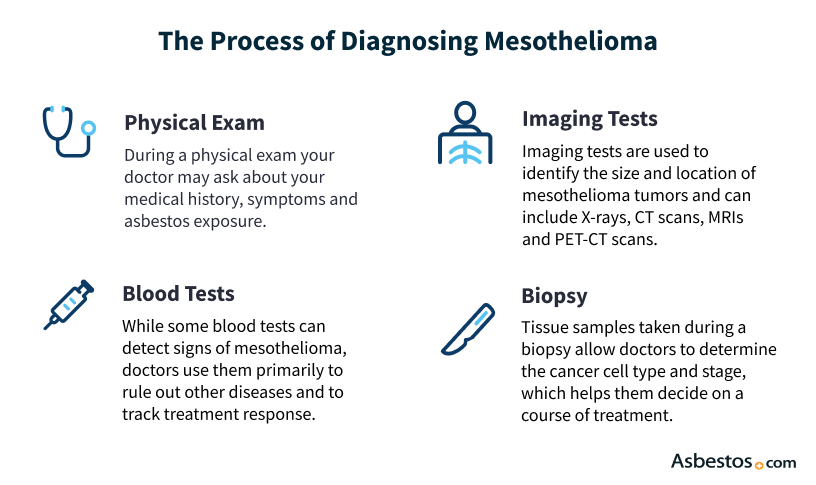
Doctors use several tests to diagnose mesothelioma, including imaging scans, blood tests and biopsies. Imaging and lab tests can show signs of cancer, but only a biopsy confirms mesothelioma. Testing early and working with a specialist helps improve accuracy and outcomes.
We actually have this amazing brochure that we can send to a patient that thinks they might have mesothelioma, never been to a doctor before, never been diagnosed. We offer a brochure they literally can take to the doctor's office with them and literally hand it to the doctor and say, I think I have this. Can I have these tests?
The first test for a patient with, symptoms related to mesothelioma will be going to their primary doctor, getting an x-ray or a CAT scan done. Based on the results from that, they may go through further testing such as a thoracentesis or paracentesis, which is where they drain fluid, whether it's from the lining of the lungs or the peritoneal area, which is the abdominal area. The next step would be for a biopsy. The biopsy is a step where they confirm the diagnosis. This sample is sent to a pathologist who ultimately tests the sample taken out from the tumor and identifies it as mesothelioma.
And not just look at under microscope by any pathologist, but pathologist who has an expertise in making that diagnosis. Because even with a good sample of tumor, looking at it under a microscope, it can sometimes be difficult to make that diagnosis. And it's important not only to know that it's mesothelioma, it's important to know what is the histological subtype. Is it epithelial or is it sarcomatoid or is it a mixture of both called mixed or biphasic, because that changes the type of treatment.
We handhold them through the diagnostic part early on. So we actually prepare them before they go of what their doctor is likely going to do or what may not need to do based on their previous studies they've had.
However, those symptoms can also and much more often be indicative of other problems, such as lung cancer, infections, heart failure, liver problems. So just because your doctor told you that you have fluid around the lung does not necessarily mean you have mesothelioma.
Even if you have an asbestos exposure, you need to look further into it. You need to have the fluid drawn and sent for analysis. And most of the time that's not enough because looking for mesothelial cells in the pleural fluid and the fluid around the lung sometimes doesn't give you an answer. In fact, the majority of the time it does not make a diagnosis of mesothelioma. Very often you need a surgical biopsy or core biopsy to make sure that you indeed have mesothelioma. I'm glad to say most patients with fluid around the lung do not have mesothelioma, don't even have cancer. They very often have inflammation or infection.
We actually have this amazing brochure that we can send to a patient that thinks they might have mesothelioma, never been to a doctor before, never been diagnosed. We offer a brochure they literally can take to the doctor's office with them and literally hand it to the doctor and say, I think I have this. Can I have these tests?
The first test for a patient with, symptoms related to mesothelioma will be going to their primary doctor, getting an x-ray or a CAT scan done. Based on the results from that, they may go through further testing such as a thoracentesis or paracentesis, which is where they drain fluid, whether it's from the lining of the lungs or the peritoneal area, which is the abdominal area. The next step would be for a biopsy. The biopsy is a step where they confirm the diagnosis. This sample is sent to a pathologist who ultimately tests the sample taken out from the tumor and identifies it as mesothelioma.
And not just look at under microscope by any pathologist, but pathologist who has an expertise in making that diagnosis. Because even with a good sample of tumor, looking at it under a microscope, it can sometimes be difficult to make that diagnosis. And it's important not only to know that it's mesothelioma, it's important to know what is the histological subtype. Is it epithelial or is it sarcomatoid or is it a mixture of both called mixed or biphasic, because that changes the type of treatment.
We handhold them through the diagnostic part early on. So we actually prepare them before they go of what their doctor is likely going to do or what may not need to do based on their previous studies they've had.
However, those symptoms can also and much more often be indicative of other problems, such as lung cancer, infections, heart failure, liver problems. So just because your doctor told you that you have fluid around the lung does not necessarily mean you have mesothelioma.
Even if you have an asbestos exposure, you need to look further into it. You need to have the fluid drawn and sent for analysis. And most of the time that's not enough because looking for mesothelial cells in the pleural fluid and the fluid around the lung sometimes doesn't give you an answer. In fact, the majority of the time it does not make a diagnosis of mesothelioma. Very often you need a surgical biopsy or core biopsy to make sure that you indeed have mesothelioma. I'm glad to say most patients with fluid around the lung do not have mesothelioma, don't even have cancer. They very often have inflammation or infection.
How Is Mesothelioma Diagnosed?
Mesothelioma diagnosis may involve a combination of tests, including a physical exam, imaging tests, fluid analysis and biopsies to confirm this rare cancer.
Mesothelioma tests depend on your symptoms and where your tumor is located. Doctors often start with imaging scans and blood tests before confirming the diagnosis through a biopsy, which is the only way to definitively identify mesothelioma cells.
Diagnosing mesothelioma can be challenging because signs of the disease are similar to other conditions. If you and your doctor have discussed your history of asbestos exposure and symptoms, they may suspect mesothelioma. Asbestos exposure is the primary risk factor for mesothelioma and the first aspect doctors consider when beginning the diagnostic process. Early detection is crucial because identifying mesothelioma earlier can expand treatment options and improve outcomes.
Key Tests to Diagnose Mesothelioma
Biopsies: Common procedures for collecting tissue or tumor samples include core needle biopsy, thoracoscopy with VATS, laparoscopy and mediastinoscopy.
Blood tests: They can show unusual blood cell counts and some markers for mesothelioma but can’t detect mesothelioma cancer cells.
Fluid analysis: Fluid is removed in procedures like thoracentesis and paracentesis. Analysis of cells in this fluid can help diagnose mesothelioma.
Imaging tests: Seeing tumor size, location and spread on PET scans, X-rays, CT scans and MRIs can help identify the stage of cancer progression.
Medical history and physical exam: Discuss your complete history with your doctor who will perform a physical exam to identify signs of mesothelioma.
Your doctor may refer you to an oncologist for further tests for mesothelioma. Your oncologist will listen for sounds indicating fluid buildup, a common sign of mesothelioma. Then, you’ll likely have imaging tests to identify where tumors are located and how far they’ve spread, a process known as staging the disease.
A biopsy is the most important test in confirming a mesothelioma diagnosis. Although other tests provide clues, only a biopsy and the resulting pathology report can confirm mesothelioma with certainty. A pathologist will use a microscope to study the tissue or tumor sample collected during your biopsy and write up their findings. Pathology reports show the specific type of mesothelioma cells in your sample. Identifying the cell type (epithelioid, sarcomatoid or biphasic) is essential because it directly influences prognosis and treatment options.
Doctors use biopsies, physical exams, imaging tests and blood tests to diagnose mesothelioma.
Medical History and Physical Exam
If you have chest pain, trouble swallowing, shortness of breath or back pain and you were exposed to asbestos, see your doctor. First, your doctor will discuss your medical history and ask about asbestos exposure.
Then, your doctor will do a physical exam, checking for symptoms of mesothelioma, such as fluid buildup in your chest (pleural effusion) or in your belly (ascites). They’ll check for fluid around your heart (pericardial effusion). In rare cases of testicular mesothelioma, they’ll perform a physical examination of the groin area.
FREE MESOTHELIOMA GUIDE
Expert Guidance for Your Mesothelioma Journey
Get answers about treatment, top doctors, and financial support from the nation’s most trusted mesothelioma resource.
Radiologists use mesothelioma imaging tests, including PET scans, X-rays, echocardiograms, CT scans and MRIs, to locate and assess mesothelioma tumors. Some scans involve contrast dye. Most scans are generally quick and painless. MRIs can take 30 to 90 minutes.
Types of Mesothelioma Imaging Scans
Computed tomography scans: CT scans produce high-resolution cross-sections with detailed views of possible tumors in the chest and abdomen.
Echocardiograms: A noninvasive procedure, echocardiograms use ultrasound to create an outline of the movement of the heart.
Magnetic resonance imaging scans: MRIs use a strong magnetic field and radio waves to form detailed images of the person’s soft tissues.
Positron emission tomography scans: PET scans use an injected radioactive tracer to find cancer cells. PET/CT scans combine both as a more comprehensive tool.
X-rays: These are most likely the first imaging test done. X-rays can identify pleural or peritoneal tumors. X-rays only provide a 2D view.
Doctors use imaging scans to see signs of asbestos exposure. They look for hardened areas on the lung lining called pleural plaques. These signs and other tests help doctors see if an asbestos-related disease is present.
Some scans such as MRIs may cause anxiety in some patients. Health care providers may prescribe anti-anxiety medications. These drugs help patients relax during the scan.
The day I found out I was diagnosed with mesothelioma, I was pretty scared. I was shocked. I was in shock. I felt like I was in the Twilight Zone. When they told me I was diagnosed with mesothelioma, no one knew what it was. I didn’t know what it was. My mom, my husband, no one. It was the day my whole life changed.
Tamron Little, peritoneal mesothelioma survivor
Blood Tests
Doctors sometimes order blood tests as part of the mesothelioma testing process. These tests look for certain proteins, white blood cell levels and other possible signs called biomarkers. However, these blood markers aren’t only found in people diagnosed with mesothelioma. Doctors use blood tests like MESOMARK, N-ERC/mesothelin and fibulin-3 blood tests to get clues, but they need a biopsy to confirm a mesothelioma diagnosis. Blood tests alone can’t diagnose mesothelioma.
Fibulin-3 is a protein your body makes to help build and support connective tissues. Mesothelioma cells can release extra fibulin-3, which leads to higher levels in the blood. But higher levels can also show up with other cancers like cervical cancer. Similarly, the MESOMARK blood test looks for molecules called soluble mesothelin-related peptides. Mesothelioma cells make SMRPs. But SMRPs have also been found in ovarian and pancreatic cancer.
Researchers are studying new types of tests. In 2025, the American Society of Clinical Oncology started to recommend genetic testing. Genetic testing often involves blood and saliva tests. A 2024 review reports up to 10% of patients diagnosed with mesothelioma have what’s known as a BAP1 mutation. They tend to respond better to chemotherapy. Patients with this mutation have a median survival of 5 years.
Fluid Analysis (Cytology Tests)
Mesothelioma cytology tests help doctors find cancer cells in fluid. Doctors collect samples from effusions or ascites from the chest, abdomen or around the heart. Then, they use a microscope to search for mesothelioma cells. If they find these cells, it helps them diagnose mesothelioma.
Types of Mesothelioma Cytology Tests
Paracentesis: Doctors insert a needle into your belly to remove fluids for testing. This test is common for people with peritoneal mesothelioma.
Pericardiocentesis: A needle is inserted into your chest to remove fluid from around your heart. This test is common for those with pericardial mesothelioma.
Thoracentesis: Doctors insert a needle into your chest. This procedure is common for people with pleural mesothelioma.
Both cytology tests and biopsies help diagnose mesothelioma, according to a 2024 study published in the Journal of the American Society of Cytopathology. The key difference between the two tests is cytology tests look at fluid, while biopsies take tissue samples. Biopsies give more information about cancer cells, which is how doctors determine whether you have mesothelioma.
Biopsies
A biopsy is the best test for confirming a mesothelioma diagnosis. This medical procedure takes a sample of tissue that’s studied under a microscope to check for cancer cells.
Doctors suggest a biopsy if you show signs of mesothelioma. Imaging scans, such as CT or PET scans, help guide where the sample should be taken from and assess cancer spread. Because fluid tests alone often cannot confirm mesothelioma, a tissue biopsy is essential for an accurate diagnosis and for determining the cell type and stage of the disease.
Types of Mesothelioma Biopsies
Laparoscopy: Doctors make a small cut in the abdomen and use a tiny camera and tools to take a tissue sample. This type of endoscopic biopsy is best for peritoneal mesothelioma.
Mediastinoscopy: A small cut is made above your breastbone, then doctors use a tube with a light to see and take tissue. This is for biopsies of the lymph nodes and around the windpipe for pleural mesothelioma.
Core needle biopsy: A thin needle is put through your skin to take a small piece of tissue. Also known as a fine-needle aspiration, it’s used for tissue samples that are hard to collect.
Surgical biopsy: Surgeons make a larger cut to remove a tissue sample when other methods don’t work. This is used when an endoscopic or core needle biopsy isn’t possible.
Thoracoscopy: Doctors make a small cut in the chest, then use a tube with a camera to examine and take tissue. This is the most accurate biopsy for diagnosing pleural mesothelioma. Laparoscopy and mediastinoscopy, may be used depending on where the tumor develops.
Thoracic surgeon Dr. Jeffrey Velotta tells us, “The diagnosis of mesothelioma is very difficult. Fluid, the majority of the time, 70% to 80% of the time will not tell you if you have mesothelioma or not. There’s just not enough cells in the fluid. You actually need tissue. I recommend all patients undergo biopsy as soon as possible and not wait.”
Staging Mesothelioma Cancer
Mesothelioma staging is part of the diagnostic process. It describes how far tumors have spread, which can be seen on imaging scans. The 4 stages of mesothelioma range from early stage (stages 1 and 2) to late stage (stages 3 and 4). The higher the number, the more the cancer has spread from where it started.
Staging helps doctors plan the best treatment. An early-stage diagnosis improves treatment options. A late diagnosis makes these treatments less effective. Later stages become more difficult to treat.
The TNM staging system is the official method for staging pleural mesothelioma. It describes tumor size, lymph node involvement and cancer spread to distant organs, helping doctors plan the most effective treatment.
Thoracic Surgeon and Director of the New York Mesothelioma Program at Mount Sinai Dr. Andrea Wolf, tells us, “When staging mesothelioma, I assess where the cancer is located, how far it has spread, and which organs are involved. This information is essential in developing the most effective treatment plan for each of my patients.”
Mesothelioma Patient Diagnoses by Stage
Stage at Diagnosis
% of Respondents
Stage 1
12%
Stage 2
17%
Stage 3
23%
Stage 4
48%
Source:
The Mesothelioma Center’s 2025 Survivor & Caregiver Survey
Why Is Diagnosing Mesothelioma Difficult?
Diagnosing mesothelioma is difficult because its symptoms mimic more common illnesses like bronchitis or pneumonia. The latency period between asbestos exposure and mesothelioma can be 20 to 60 years. So when symptoms show up decades later, an asbestos-related disease like mesothelioma may not immediately come to mind.
Mesothelioma misdiagnosis is unfortunately common, especially with doctors unfamiliar with this rare malignant cancer. This makes getting a second opinion from an asbestos-related cancer expert so important if you’ve had a history of asbestos exposure. But some people aren’t aware they’ve been exposed, making it even more challenging.
Patient Advocate and VA-accredited claims agent Danielle DiPietro tells us, “Many patients we speak with have told us they were diagnosed after going to the hospital for what they thought was an unrelated symptom.”
Mesothelioma survivor Wendy M. Phillips confirms this was the case for her. She tells us, “I went to the hospital with a swollen arm and was initially told I had a blood clot. Mesothelioma tumors were blocking my lymph nodes.”
Importance of Early Mesothelioma Detection
Finding mesothelioma early is very important because it allows doctors to start treatment sooner. An early diagnosis and guidance from a mesothelioma specialist can offer more treatment options and better outcomes. This can improve survival and quality of life.
However, according to the Centers for Disease Control and Prevention, early detection is still rare. From 2017 to 2021, 70.9% of mesothelioma cases were diagnosed after stage 1.
Survivor Story
Kim Madril: What symptoms did you experience that led to your early diagnosis?
I started feeling pain on my left back like right in the middle. I actually thought I I had a kidney stone. I woke up one early morning at 3 AM.
And I had this sharp shooting pain on the left side.
My husband jumped out of bed. He’s like, “what’s wrong?” I said, I think I’m having a kidney stone. And he’s like, alright. Let’s go to the emergency department.
I’m not one to go see doctors, and and I think really I hadn’t been to emergency department in probably 15 years or so. So we ended up there, and they said, “well, you must have passed it because we don’t we don’t see we don’t that we don’t see anything.” I was okay for probably three or four months, and then it came again.
Not to the same degree. And I was kinda like, “Oh, oh, ow, ow!” and it kept happening. And the intervals were coming closer, than than before. They weren’t as spread out.
And so my PCP finally said, “Kim,
let’s let’s just, let’s just get a a cat scan. Okay?”
And I said, “oh, okay.” And the CAT scan came back. And he said, there’s something see some sort of nodule, that’s what he called it, a nodule at the base of your left lung. It’s not your kidney. It’s the bottom of your left lung. Which is right about where your kidneys are. And I thought, oh my gosh, I never never thought it would be like a lung thing.
So, I said, oh, okay.
And he said, let’s watch it. Because it’s so small right now.
And I said, alright. I’m good with that. But then the pain kept happening. And he said, I’m gonna refer you to a pulmonologist.
And I saw the pulmonologist, And he said, he said, I don’t know Kim. The only thing I can think is you let’s biopsy it. It’s it’s something there. It’s some sort of mask. You keep having pain.
I didn’t have the I didn’t have any problems with shortness of breath. I didn’t have, coughing, excessive coughing.
It was mainly the pain. He said, we just need to biopsy it.
So I said, alright. That sounds great.
Pleural mesothelioma survivor Kevin Hession is an unusual example of someone diagnosed early. He tells us, “After my surgery, I was told my mesothelioma was stage 1-B.” His diagnosis in 2021 followed 4 cases of pleurisy, which is inflammation around the lungs. Ongoing chemotherapy is helping him manage the disease.
FREE TREATMENT CARE KIT
Ease Your Mesothelioma Treatment Experience
Get a mesothelioma treatment care kit filled with thoughtful items to bring comfort and encouragement while undergoing treatment.
Once you receive a mesothelioma diagnosis, it’s important to begin planning your mesothelioma treatment with your doctor. Often in this process, people have questions about and want another perspective on the best treatment for them. Getting a second opinion from an expert can make you aware of other approaches, new therapies or available clinical trials. Because mesothelioma is rare, consulting a mesothelioma specialist reduces the risk of misdiagnosis and ensures access to the latest treatment options.
Patient Advocate Snehal Smart, M.D., tells us, “Most people who contact us about diagnosing mesothelioma are looking for a second opinion. We can connect them with treatment specialists and arrange appointments and treatment if they do receive a confirmed mesothelioma diagnosis.”
Next Steps After a Mesothelioma Diagnosis
Consider a second opinion and clinical trials
Explore legal options for compensation
Get support from patient advocacy groups
Inquire about treatment with surgery, chemo or immunotherapy
Meet with a mesothelioma specialist
Peritoneal mesothelioma survivor Tamron Little knows the importance of a second opinion firsthand. She shares with us, “At first, I was under the care of an oncologist who said he knew nothing about mesothelioma. But I finally found the right mesothelioma specialist. I was presented with a roadblock and decided to go around it.”
A mesothelioma diagnosis can feel overwhelming, but you don’t have to go through it alone. Patient Advocates help people understand treatment options, schedule appointments, navigate insurance and explore financial support for medical expenses.
New tech aims to help diagnose mesothelioma. Researchers recently made an AI tool that successfully determined mesothelioma cell types, but diagnosis is still a big challenge, according to the journal Nature.
Patients with a history of asbestos exposure or symptoms such as persistent cough, chest pain or shortness of breath should seek medical evaluation immediately.
“Making an accurate mesothelioma diagnosis can be tough. The initial signs on imaging can be nonspecific. Misdiagnosis can occur. It’s important to tell mesothelioma apart from other cancers that can spread to the pleura. The treatments are very different based on an accurate diagnosis.”
Dr. Catherine Perrault,
medical officer and board-certified family physician with The Mesothelioma Center’s Medical Outreach Team
Common Questions About Diagnosing Mesothelioma
Who should be tested for mesothelioma?
People with a history of asbestos exposure and symptoms such as chest pain or shortness of breath should ask their doctor about testing for mesothelioma. They may recommend imaging scans, blood tests and a biopsy to diagnose mesothelioma.
How long does it take to get a mesothelioma diagnosis?
About 3 months is the average time it takes to get a mesothelioma diagnosis. This is after the first symptoms appear. The most common symptoms include shortness of breath and chest pain.
How do you prepare for a mesothelioma biopsy?
The first step in preparing for a mesothelioma biopsy is to stop all blood-thinning meds at least 5 days before your biopsy. Don’t eat or drink anything 6 hours before your appointment. Wear loose clothes to the appointment. Also, arrange for a designated driver to take you home. Plan to spend several hours undergoing the biopsy. Some biopsies need at least one night in the hospital.
Recommended Reading
Your web browser is no longer supported by Microsoft. Update your browser for more security, speed and compatibility.
If you are looking for mesothelioma support, please contact our Patient Advocates at (855) 404-4592
Fact Checked
Our fact-checking process begins with a thorough review of all sources to ensure they are high quality. Then we cross-check the facts with original medical or scientific reports published by those sources, or we validate the facts with reputable news organizations, medical and scientific experts and other health experts. Each page includes all sources for full transparency.
Reviewed
Asbestos.com is the nation’s most trusted mesothelioma resource
The Mesothelioma Center at Asbestos.com has provided patients and their loved ones the most updated and reliable information on mesothelioma and asbestos exposure since 2006.
Our team of Patient Advocates includes a medical doctor, a registered nurse, health services administrators, veterans, VA-accredited Claims Agents, an oncology patient navigator and hospice care expert. Their combined expertise means we help any mesothelioma patient or loved one through every step of their cancer journey.
More than 30 contributors, including mesothelioma doctors, survivors, health care professionals and other experts, have peer-reviewed our website and written unique research-driven articles to ensure you get the highest-quality medical and health information.
About The Mesothelioma Center at Asbestos.com
Assisting mesothelioma patients and their loved ones since 2006.
Helps more than 50% of mesothelioma patients diagnosed annually in the U.S.
A+ rating from the Better Business Bureau.
5-star reviewed mesothelioma and support organization.
My family has only the highest compliment for the assistance and support that we received from The Mesothelioma Center. This is a staff of compassionate and knowledgeable individuals who respect what your family is experiencing and who go the extra mile to make an unfortunate diagnosis less stressful. Information and assistance were provided by The Mesothelioma Center at no cost to our family.
Asbestos.com. (2026, March 30). Mesothelioma Diagnosis. Retrieved May 14, 2026, from https://www.asbestos.com/mesothelioma/diagnosis/
MLA
"Mesothelioma Diagnosis." Asbestos.com, 30 Mar 2026, https://www.asbestos.com/mesothelioma/diagnosis/.
Chicago
Asbestos.com. "Mesothelioma Diagnosis." Last modified March 30, 2026. https://www.asbestos.com/mesothelioma/diagnosis/.
The Patient Advocates are absolutely amazing and helpful! I am so very pleased with the information and the emotional support that I have received from everyone! When I felt all hope was lost, Amy gave me great information and was so compassionate. I do not feel alone, and I know there is strong support for anyone dealing with this tragic disease. I received a FREE information package, including a recipe book, information on the disease, a toll-free number to contact for assistance, and a book with the answers to 100 questions that are commonly asked. This information alone was worth my time! I read for hours and hours, and just that alone—knowledge—can be a great comfort. To fully understand this disease, to just have the knowledge!!! Thank you all!! Thank you so, so much.
I found out about The Mesothelioma Center while researching peritoneal mesothelioma days after being diagnosed with the malignant cancer. While a lot of the 'Mesothelioma' websites are actually law firms just trying to get your business, theirs is a user-friendly, comprehensive website set up to aid patients, their loved ones, and/or caregivers with all things related to a cancer diagnosis from asbestos exposure. I was soon put in touch with one of their doctors, Snehal Smart, M.D., who immediately sent me a packet of general information, a book on surviving mesothelioma, and offered me assistance in finding doctors, reputable law firms, financial help, support groups, and so much more! The Mesothelioma Center's website is, in my opinion, the best resource for anyone suffering from cancer due to asbestos. Dr. Smart is amazing! She is very knowledgeable and helpful, but she is also a very kind, caring doctor who goes the distance whether she is researching a pertinent topic, making suggestions, providing contacts, or just being a good listener on the other end of the phone. In addition, Dr. Smart referred me to a law firm who is now fighting to get me compensation for the negligence of those defendants whose products exposed me to asbestos and caused my subsequent cancer. Thank you, TMC and Dr. Smart, for helping me determine the best treatment plan for my cancer and being part of my miracle. I am currently cancer-free and back to being a mom to my precious daughter. The Mesothelioma Center, their website, and their staff rock!!
I reached out and talked to Aaron a couple of weeks before my diagnosis of malignant mesothelioma. He was very helpful and gave me a lot of information at that time. I have talked to him several times since and always gotten my questions answered. Aaron is very knowledgeable and has been very helpful and supportive. He also sent me a comprehensive packet of information, including info on nutrition, legal help, and medical resources.
My brother was recently diagnosed with mesothelioma. I began researching it online. The information I received from The Mesothelioma Center is all-inclusive. No need to look anywhere else! The first phone call was with Karen, and she answered all my questions with ease. She also had a calming effect by presenting all the options available for my brother and his family. Thank you!
My Dad was diagnosed with mesothelioma, and thankfully The Mesothelioma Center was the first place I called. Snehal Smart answered the phone immediately and was very helpful. She immediately sent us an information packet and answered questions. She followed up each week to see how things were going and if we had any questions. She also connected us with a lawyer. I highly recommend this Center.
Professional Contributors Featured In This Article
We Thoroughly vet individuals who are experts in their field to contribute to articles on Asbestos.com. We believe in the integrity and quality of our educational materials, and only publish information that is relevant, factual, and backed by experts.
Dr. Jacques Fontaine is a thoracic surgeon at Moffitt Cancer Center in Tampa, Florida, where he heads up the Mesothelioma Research and Treatment Center. He specializes in minimally invasive robotic surgery and aggressive surgeries for mesothelioma.
Fact-checked and verified content:
Our fact-checking process begins with a thorough review of all sources to ensure they are high quality. Then we cross-check the facts with original medical or scientific reports published by those sources, or we validate the facts with reputable news organizations, medical and scientific experts and other health experts. Each page includes all sources for full transparency.
Please read our editorial guidelines to learn more about our content creation and review process.