Johnson & Johnson produced baby powder made with crushed talc. This mineral can become contaminated with asbestos when it's mined. J&J has faced multimillion-dollar lawsuits claiming ovarian cancer and mesothelioma as a result of using its baby powder.
Medical supplies, consumer personal care products and pharmaceuticals
Asbestos Trust:
None
Bankruptcy Status:
None
Pursuing Compensation From Johnson & Johnson
Johnson & Johnson continues to defend itself in court against new and ongoing mesothelioma lawsuits seeking compensation for exposure to asbestos-contaminated talc in its products. The company attempted to resolve litigation through bankruptcy reorganization under the Texas Two-Step, but the courts rejected these attempts 3 times. After the most recent rejection in April 2025, J&J announced it would abandon bankruptcy proceedings and instead defend each case individually in court.
Talc lawsuits aim to prove asbestos exposure during the use of J&J’s baby powder and other talc products. While the company claims to have settled 95% of mesothelioma cases, it has spent approximately $1 billion fighting litigation and still faces more than 60,000 ovarian cancer claims. Courts have awarded billions of dollars to people who successfully proved their asbestos exposure came from J&J’s talc-based products.
People diagnosed with asbestos-related cancers like mesothelioma and ovarian cancer benefit from early legal counsel to review their options for financial assistance for medical expenses, lost wages and other diagnosis-related costs.
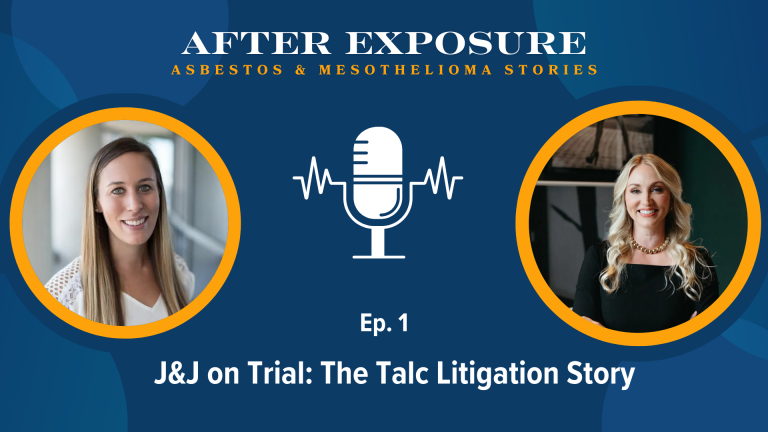
Patient Advocate Danielle DiPietro joins attorney and Consumer Safety Advocate Whitney Di Bona for a revealing conversation about the dark legal legacy of Johnson & Johnson’s famous baby powder.
Whitney Di Bona
Attorney and Consumer Safety Advocate at Drugwatch.com
Legal Help for People Exposed to Johnson & Johnson’s Asbestos
An experienced mesothelioma lawyer will navigate the complex legal process for you if you or a loved one has been exposed to Johnson & Johnson’s asbestos-contaminated talc. Your attorney will build a strong case based on medical evidence and product exposure history to secure compensation for you.
Patient Advocates understand the importance of working with a lawyer with a record of success in cases like yours. They also know how essential it is for you and your family to feel comfortable working with your legal team throughout the process. They’ll match you with respected legal professionals specializing in asbestos-contaminated talc cases and who will respect your needs and preferences.
Your Patient Advocate will also connect you with leaders in cutting-edge mesothelioma treatment, scheduling your appointments and offering ongoing support throughout your journey. They’ll provide you with free resources on treatment options and nutrition, navigate insurance and VA benefits claims for you and connect you with support groups for patients and caregivers.
$30B+ IN TRUST FUNDS AVAILABLE
File Your Mesothelioma Claim
When filing a mesothelioma claim, the right legal representation is everything. We’ll connect you to a top lawyer who will help you secure financial compensation.
Johnson & Johnson reports settling 95% of the mesothelioma lawsuits it has faced, but plaintiffs continue filing new claims. In October 2025, a Los Angeles jury awarded a record $966 million to the family of Mae K. Moore in a wrongful death lawsuit against J&J, finding the company 100% responsible for her mesothelioma death from asbestos-contaminated talcum powder.
This historic talc verdict, the largest for an individual talc plaintiff, included $16 million in non-economic damages for Moore and her three daughters. It also included $950 million in punitive damages after the jury determined J&J acted with “malice, oppression or fraud.”
Court documents revealed decades of internal company records showing J&J allegedly knew since the 1930s about asbestos contamination in talc, failed to successfully remove it, withheld positive test results and destroyed evidence of asbestos findings. In March 2026, a Los Angeles judge overturned the punitive damages, though the jury’s finding that J&J caused Moore’s mesothelioma remains intact and her family plans to appeal.
The company pursued multiple bankruptcy strategies through subsidiaries in attempts to resolve the massive volume of remaining claims, particularly ovarian cancer lawsuits. A U.S. Bankruptcy Judge in Texas rejected J&J’s $10 billion talc settlement proposal in April 2025. This marked the third time the company’s bankruptcy strategy failed in court. Instead of appealing the latest ruling, J&J announced it plans to focus on litigating each case individually in court.
Plaintiff
Diagnosis
Award
Year
Location
Notes
22 plaintiffs
Ovarian cancer
$2.1 billion
2021
Missouri
Landmark multi-plaintiff verdict; original $4.78B award reduced on appeal
Cherie Craft
Mesothelioma
$1.5 billion
2025
Baltimore, MD
Largest single-plaintiff verdict against J&J
Mae K. Moore
Mesothelioma
$966 million
2025
Los Angeles, CA
$950M punitive damages later overturned; compensatory damages retained
Kyung Lee
Mesothelioma
$260 million
2024
Oregon
Case didn’t permit punitive damages
Anna Jean Houghton Carley
Mesothelioma
$65.5 million
2025
Minnesota
37-year-old mother; peritoneal mesothelioma
Theresa Garcia
Mesothelioma
$45 million
2024
Chicago, IL
Mother of six; used baby powder on herself and her children
Paul and Kathryn Lovell
Mesothelioma
$42 million
2025
Boston, MA
No occupational asbestos exposure; used baby powder on his four children
Johnson & Johnson’s Connection to Asbestos in Talc Products
Johnson & Johnson’s baby powder was made with talc, a mineral that naturally occurs near asbestos deposits in the earth. During the mining process, talc can become contaminated with asbestos fibers. Lab tests show asbestos in J&J talc from at least 1971 to the early 2000s. The company never reported those findings to the U.S. Food and Drug Administration.
When people use asbestos-contaminated talc products, they can inhale or ingest microscopic asbestos fibers. These fibers can lodge in the lungs, abdomen or other organs, potentially causing mesothelioma decades later. Women who used J&J’s baby powder for feminine hygiene may have increased risk of ovarian cancer.
The company discontinued talc-based baby powder in North America in 2020, citing declining sales and claiming “misinformation” about the product’s safety. J&J switched to cornstarch-based ingredients after public concerns increased. However, J&J maintains that its cosmetic talc products were asbestos-free and safe, despite mounting evidence and jury verdicts suggesting otherwise.
Who Was at Risk of Asbestos Exposure From Johnson & Johnson?
Millions of consumers used Johnson & Johnson’s talc-based baby powder over multiple decades. The powder was marketed as safe for daily use, leading many people to apply it frequently for years or even decades. Various groups faced different levels of exposure risk when using or working with J&J’s asbestos-contaminated talc products.
Higher-Risk Groups for J&J Asbestos Exposure
Children and infants who had baby powder applied during diaper changes or after baths
Factory workers who manufactured or packaged J&J’s talc products
Family members who handled or laundered workers’ clothes covered with talc
Miners and mill workers involved in extracting and processing the talc used in J&J products
Parents who applied talcum powder to their children and inhaled the dust over time
Women who regularly used the product for feminine hygiene
Factory workers who manufactured or packaged J&J’s talc products may have experienced occupational exposure to higher concentrations of asbestos-contaminated dust. Miners and mill workers involved in extracting and processing the talc used in J&J products faced elevated exposure risks.
[MUSIC PLAYING] Mesothelioma is caused by asbestos. And that can occur through products that contain asbestos like insulation or even when that asbestos occurs in consumer products, such as talcum powder. Typically, women who have been diagnosed with mesothelioma didn’t know where their asbestos exposure came from. We at Simmons have done the investigation and know the companies that use talcum powder contaminated with asbestos that have led to this terrible disease. If you were diagnosed with mesothelioma and you use talcum powder in your life, you may have a case, which is why you need to speak with a mesothelioma attorney. [MUSIC PLAYING]
Johnson & Johnson’s Talc-Containing Products
Johnson & Johnson incorporated talc into various personal care products throughout its history. Johnson’s Baby Powder was the company’s flagship talc-based product and remained on store shelves for more than a century.
The iconic white bottle with its distinctive baby scent became a household staple in families worldwide. J&J marketed the powder not only for infant care but also for adult personal hygiene use.
J&J’s Talc Products
Johnson’s Baby Powder
Shower to Shower
Shower to Shower Morning Fresh
Shower to Shower Blossom Fresh
Johnson & Johnson sold the Shower to Shower brand in 2012. But the company has retained liability for asbestos exposure claims tied to the product during the years it owned it.
The company phased out talc-based baby powder in North America in 2020 but continued selling them in other markets before ultimately discontinuing talc baby powder globally in 2023. J&J now offers cornstarch-based alternatives, though the company continues to maintain that its talc products were safe and asbestos-free.
The History of Johnson & Johnson’s Talc Controversy
Johnson & Johnson’s talc controversy spans nearly a century, from internal company documents revealing early knowledge of asbestos contamination to billions of dollars in jury verdicts and a landmark scientific retraction. The timeline below traces how the story unfolded, from what the company knew internally to the investigations, legal battles and public reckoning that followed.
2026
The Lancet retracted a 1977 paper claiming cosmetic talc use couldn’t cause cancer after editors learned it was written by a J&J consultant who shared the manuscript with the company before publication without disclosing his ties to J&J.
2025
A U.S. Bankruptcy Judge rejected J&J’s third attempt to resolve talc claims through bankruptcy in April. J&J announced it would litigate each remaining case individually in court.
2023
J&J discontinued talc-based baby powder worldwide and spun off its consumer health division into a separate company called Kenvue.
2022
A federal court rejected J&J’s second bankruptcy attempt, ruling the subsidiary it created to manage talc liabilities was not in genuine financial distress.
2021
J&J filed for bankruptcy protection through a subsidiary in an attempt to consolidate and resolve tens of thousands of talc lawsuits.
2020
J&J pulled talc-based baby powder from shelves in North America, citing declining sales.
2018
A Reuters investigation revealed internal company documents showing J&J had known for decades about asbestos contamination in its talc.
1972 to 1975
And at least 3 separate labs identified asbestos in J&J talc samples.
1969
An internal J&J document acknowledged that tremolite found in its talc products could cause pulmonary diseases and cancer.
1958 to 1960
A series of Battelle Memorial Institute reports documented J&J’s repeated but unsuccessful attempts to remove asbestos from its talc.
1930s
Internal company records show J&J was aware of asbestos contamination in its talc products.
The legal story has no clear end in sight. J&J continues to face tens of thousands of talc lawsuits and maintains its products were safe and asbestos-free, despite mounting evidence and jury verdicts to the contrary.
Frequently Asked Questions
Does Johnson’s Baby Powder contain asbestos?
J&J’s original talc-based baby powder could contain asbestos because talc naturally occurs near asbestos deposits and the 2 minerals can mix during mining. Lab tests detected asbestos in J&J’s talc from at least 1971 to the early 2000s. J&J has always claimed its products were safe and asbestos-free, but juries have repeatedly ruled against the company.
Is Johnson’s Baby Powder talc-free now?
J&J switched its North American baby powder formula from talc to cornstarch in 2020, though existing inventory continued selling down on store shelves after that announcement. The company continued selling talc-based versions in other countries until 2023, when it discontinued the talc formula worldwide. While baby powder manufactured today doesn’t contain talc, checking the label for cornstarch as the listed ingredient is the surest way to confirm.
Can I still file a Johnson & Johnson lawsuit?
Yes. J&J abandoned its bankruptcy strategy in April 2025 and now defends each case individually in court. People diagnosed with mesothelioma or ovarian cancer linked to J&J talc products can still file talcum powder lawsuits.
How much are Johnson & Johnson settlements worth?
Jury verdicts and settlements in J&J talc cases have ranged widely. Recent awards include $1.5 billion to Cherie Craft in December 2025, $260 million to Kyung Lee in June 2024 and $65.5 million to Anna Jean Houghton Carley in December 2025. J&J reports settling 95% of its mesothelioma cases, though it hasn’t disclosed individual settlement amounts.
What J&J products contained asbestos?
J&J’s talc-based products that carried asbestos exposure risk include Johnson’s Baby Powder, Shower to Shower, Shower to Shower Morning Fresh and Shower to Shower Blossom Fresh.
What is the Johnson & Johnson investigation about?
J&J faces ongoing civil litigation and has previously faced a federal criminal investigation over whether it concealed asbestos contamination in its talc products. Court documents in recent cases reveal internal records allegedly showing the company knew about asbestos in its talc since the 1930s, failed to remove it and withheld test results. Three separate labs identified asbestos in J&J talc between 1972 and 1975. A 2025 Los Angeles jury found the company acted with “malice, oppression or fraud” and awarded nearly $1 billion in punitive damages in a single case.
How many lawsuits has Johnson & Johnson faced?
J&J reports settling 95% of the mesothelioma cases it has faced. As of late 2025, it still faces more than 60,000 ovarian cancer claims. After its third bankruptcy attempt failed in April 2025, new mesothelioma suits rose 17% and J&J now litigates each remaining case individually in court.
Recommended Reading
Your web browser is no longer supported by Microsoft. Update your browser for more security, speed and compatibility.
If you are looking for mesothelioma support, please contact our Patient Advocates at (855) 404-4592
Fact Checked
Our fact-checking process begins with a thorough review of all sources to ensure they are high quality. Then we cross-check the facts with original medical or scientific reports published by those sources, or we validate the facts with reputable news organizations, medical and scientific experts and other health experts. Each page includes all sources for full transparency.
Reviewed
Asbestos.com is the nation’s most trusted mesothelioma resource
The Mesothelioma Center at Asbestos.com has provided patients and their loved ones the most updated and reliable information on mesothelioma and asbestos exposure since 2006.
Our team of Patient Advocates includes a medical doctor, a registered nurse, health services administrators, veterans, VA-accredited Claims Agents, an oncology patient navigator and hospice care expert. Their combined expertise means we help any mesothelioma patient or loved one through every step of their cancer journey.
More than 30 contributors, including mesothelioma doctors, survivors, health care professionals and other experts, have peer-reviewed our website and written unique research-driven articles to ensure you get the highest-quality medical and health information.
About The Mesothelioma Center at Asbestos.com
Assisting mesothelioma patients and their loved ones since 2006.
Helps more than 50% of mesothelioma patients diagnosed annually in the U.S.
A+ rating from the Better Business Bureau.
5-star reviewed mesothelioma and support organization.
My family has only the highest compliment for the assistance and support that we received from The Mesothelioma Center. This is a staff of compassionate and knowledgeable individuals who respect what your family is experiencing and who go the extra mile to make an unfortunate diagnosis less stressful. Information and assistance were provided by The Mesothelioma Center at no cost to our family.
Asbestos.com. (2026, August 20). Johnson & Johnson. Retrieved August 20, 2026, from https://www.asbestos.com/companies/johnson-johnson/
MLA
"Johnson & Johnson." Asbestos.com, 20 Aug 2026, https://www.asbestos.com/companies/johnson-johnson/.
Chicago
Asbestos.com. "Johnson & Johnson." Last modified August 20, 2026. https://www.asbestos.com/companies/johnson-johnson/.
My primary support since being diagnosed with Mesothelioma, over 2 years ago, has been this company. Their monthly nationwide support group has been a tremendous help for me. I have learned about others' treatments and have been able to freely discuss mine, knowing others walk the same walk as I do and fully understand. Karen Selby, the nurse and patient advocate, has helped me so much. I call her and she delivers. She's experienced in Thoracic surgeries, is supportive, kind, knowledgeable, and makes a patient feel very cared for! The whole staff are polite, caring, and will help with Mesothelioma victims' many needs. I feel very blessed to have this Organization by my side as I live with this cancer.
I found out about The Mesothelioma Center while researching Peritoneal Mesothelioma days after being diagnosed with malignant cancer. While a lot of the 'Mesothelioma' websites are actually law firms just trying to get your business, theirs is a user-friendly, comprehensive website set up to aid patients, their loved ones, and/or caregivers with all things related to a cancer diagnosis from asbestos exposure. I was soon put in touch with one of their doctors, Snehal Smart, M.D., who immediately sent me a packet of general information, a book on surviving Mesothelioma, and offered me assistance in finding doctors, reputable law firms, financial help, support groups, and so much more! The Mesothelioma Center's website is, in my opinion, the best resource for anyone suffering from cancer due to asbestos. Dr. Smart is amazing! She is very knowledgeable and helpful, but she is also a very kind, caring doctor who appears to go the distance whether she is researching a pertinent topic, making suggestions, providing contacts, or just being a good listener on the other end of the phone. In addition, Dr. Smart referred me to a law firm who is now fighting to get me compensation for the negligence of those defendants whose products exposed me to asbestos and caused my subsequent cancer. Thank you, TMC and Dr. Smart, for helping me determine the best treatment plan for my cancer and being part of my miracle. I am currently cancer-free and back to being a mom to my precious daughter. The Mesothelioma Center, their website, and their staff rock!!
I just want to take this time to thank Mesothelioma Center for all the information you provide. The survival stories are inspiring and give hope where hope is needed! Thanks to you, I have met many others on the site and continue to converse with them. Keep up the good work. I am always looking forward to your posts! Thank you, Richard Delisle.
My brother was recently diagnosed with mesothelioma. I began researching it online. The information I received from The Mesothelioma Center is all-inclusive. No need to look anywhere else! The first phone call was with Karen, and she answered all my questions with ease. She also had a calming effect by presenting all the options available for my brother and his family. Thank you!
My father was recently diagnosed with mesothelioma. We, as a family, were devastated. We were uncertain where to even start, so we reached out to The Mesothelioma Center. They were absolutely amazing. They provided physicians in our area who specialize in this type of cancer because it is so rare. They also set us up with a firm who specializes in getting funds that are set aside to help with our medical bills. I’m so glad we made the phone call. They were very knowledgeable, supportive, sincere, and true patient advocates.
Whitney Ray Di Bona brings a unique perspective to The Mesothelioma Center's content on Asbestos.com. As both a practicing attorney and consumer safety advocate, she has encountered asbestos-related cases throughout her legal career. She draws on her experience in mass tort litigation and background as a former prosecutor to ensure the accuracy and helpfulness of content for mesothelioma survivors and their families.
Fact-checked and verified content:
Our fact-checking process begins with a thorough review of all sources to ensure they are high quality. Then we cross-check the facts with original medical or scientific reports published by those sources, or we validate the facts with reputable news organizations, medical and scientific experts and other health experts. Each page includes all sources for full transparency.
Please read our editorial guidelines to learn more about our content creation and review process.